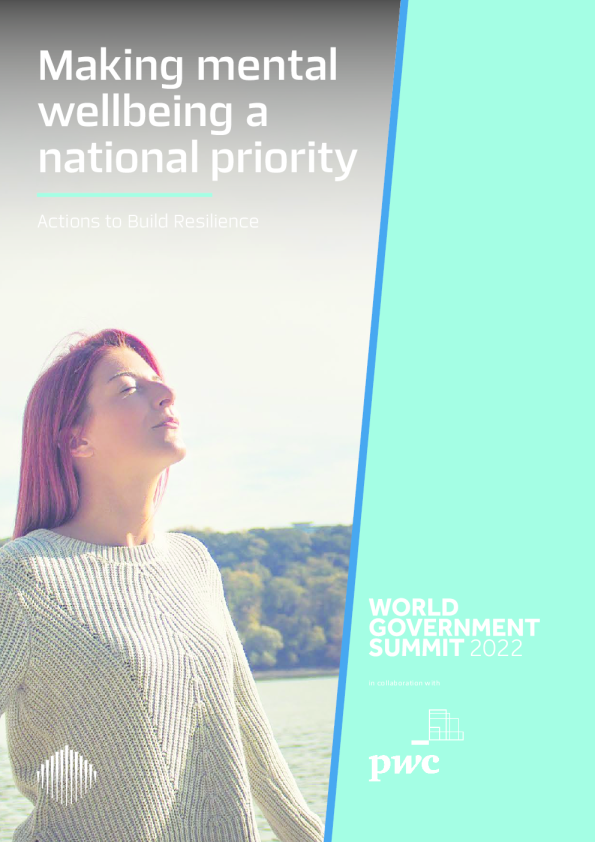
将心理健康作为国家优先事项
in collaboration with Measuring Mental Wellbeing: A Key National and LocalPerformance IndicatorConclusion:How Governments Can Promote Mental Wellbeing for All CitizensTable of ContentsExecutive SummaryThe Impact of Mental Health on Society: A Global Reality CheckHarnessing Technology to Support Mental WellbeingEndnotesTopicsAuthorsAcknowledgmentsBuilding a Mentally Resilient Workforce, from the Classroom tothe Boardroom 050713172125290404 Hamish ClarkChief Wellness Officer, PwC Middle EastHamish.Clark@pwc.comThierry BoulosManager, Health Industries, PwC Middle EastThierry.Boulos@pwc.comAuthorsAcknowledgmentsPwC Middle East would like to thank LighthouseArabia and Rob Stephenson for their insightsand contributions to this paper. ExecutiveSummary05 In 2018, the World Health Organization (WHO) defined good mentalhealth as “a state of wellbeing in which an individual realizes hisor her own abilities, can cope with the normal stresses of life, canwork productively, and is able to make a contribution to his or hercommunity”.1The purpose of this report is to set out a practical programof action for governments, policymakers, businesses and communitiesto build mentally resilient societies where citizens are supported atevery stage of their lives to achieve this state of mental wellbeing.Improving citizens’ mental health is both a moral imperative and amatter of enlightened public self-interest. For example, the WHOestimates that the global economy loses out on around $1 trillionin productivity each year due to workers suffering from anxiety ordepression, the two most common mental disorders.2Mental healthis more than merely the absence of diagnosed mental illnesses andconditions such as schizophrenia or substance abuse. Wellbeing is apositive state that requires constant monitoring and self-management.Worldwide, the COVID-19 pandemic has triggered an unprecedentedmental health crisis, amid lockdowns, social distancing constraints,job losses, enforced home schooling and the sudden shift to remoteworking. Loneliness, anxiety, loss of self-esteem and a host of otherissues have afflicted people of all ages who previously regardedthemselves as psychologically “normal.” This connects with a criticaltheme in our report – the importance of breaking down the stigmasurrounding mental health to ensure that such issues are no longersources of embarrassment or shame for the sufferer, or dismissed byfamily, friends and employers.The report’s perspective is deliberately pragmatic, drawing onPwC’s own experience of supporting its global workforce at a timeof unprecedented stress, and on examples of best practice bygovernments, businesses and voluntary organizations around the world.Key recommendationsfor governments globally and in the Middle East:•Fully integrate holistic wellbeing initiatives into mainstream publichealth services by 2025•Incorporate wellbeing into health outcome measurements by 2025•In the Middle East, collaborate to establish a wellbeing and high-performance innovation and research hub Chapter 1The Impact ofMental Health onSociety: A GlobalReality Check07 The Impact of Mental Health onSociety: A Global Reality CheckHow COVID-19 Has Deepened the WorldwideMental Health CrisisAny assessment of the social damage caused by mental healthissues must begin with the fact that the COVID-19 pandemic isitself a mental health catastrophe. Around the world COVID-19’simpact on mental wellbeing has taken many forms. Frontlinehealth workers have fallen ill with post-traumatic stress disorder(PTSD). Older people separated from children and grandchildrenhave succumbed to loneliness and depression. Working-ageparents have worried about losing their jobs. Children havemissed their friends. Students have feared they have lost foreverthe chance to realize their ambitions. All these personal traumas,repeated countless times, are occurring against a backdropwhere many millions of people are mourning the loss of lovedones who have been killed by COVID-19.Globally, governments and policymakers increasingly recognizethat the pandemic’s long term impact on mental health will bedebilitating. In the short term, the economic and social turmoilcaused by COVID-19 has disrupted or halted critical mentalhealth services in 93% of 130 countries surveyed by the WHObetween June and August 2020.3Consider the following:The picture is not entirely bleak. In some countries COVID-19has also been a catalyst for reducing the social stigmasurrounding mental illness. A prime example is China, wherethe pandemic has forced society to confront problems suchas depression, anxiety and loneliness, which in the past haveoften been overlooked because of widespread ignorance andsocial prejudice. In January 2020, China’s Joint Prevention andControl Mechanism of the State Council, the country’s centralorganization for coordinating the national response to COVID-19,published guidance on mental health intervention to help therising number of people with mental illn