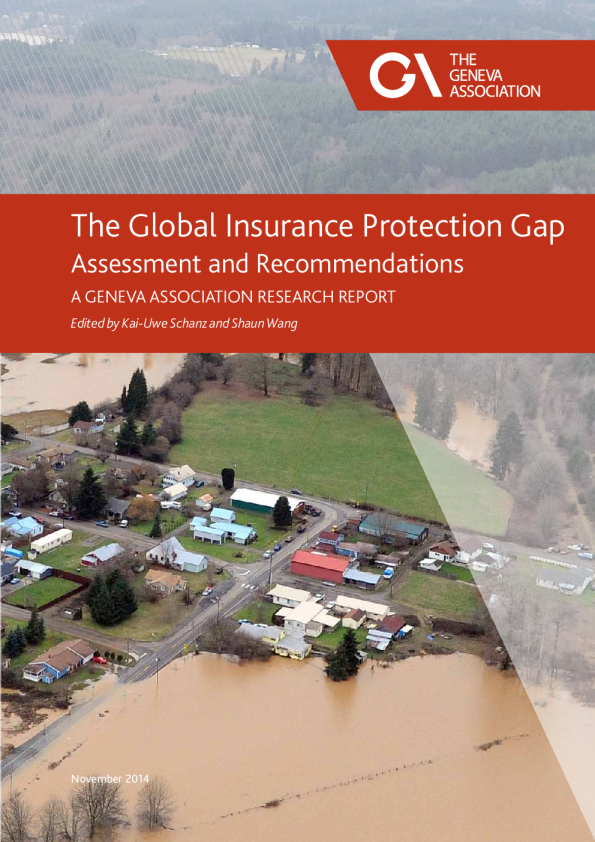
了解和解决全球保险保护差距

www.genevaassociation.orgThe Geneva AssociationThe Geneva Association is the leading international insurance think tank for strategically important insurance and riskmanagement issues. The Geneva Association identifies fundamental trends and strategic issues where insurance playsa substantial role or which influence the insurance sector. Through the development of research programmes, regularpublications and the organisation of international meetings, The Geneva Association serves as a catalyst for progress inthe understanding of risk and insurance matters and acts as an information creator and disseminator. It is the leadingvoice of the largest insurance groups worldwide in the dialogue with international institutions. In parallel, it advances—in economic and cultural terms—the development and application of risk management and the understanding ofuncertainty in the modern economy.The Geneva Association membership comprises a statutory maximum of 90 chief executive officers (CEOs) from theworld’s top insurance and reinsurance companies. It organises international expert networks and manages discussionplatforms for senior insurance executives and specialists as well as policymakers, regulators and multilateral organisations.Established in 1973, The Geneva Association, officially the ‘International Association for the Study of InsuranceEconomics’, is based in Zurich, Switzerland and is a non-profit organisation funded by its Members. @TheGenevaAssoc 1Understanding and Addressing Global Insurance Protection GapsUnderstanding and AddressingGlobal Insurance Protection GapsKai-Uwe Schanz, Senior Advisor, The Geneva Association The Geneva AssociationTalstrasse 70, CH-8001 Zurich|Tel: +41 44 200 49 00|Fax: +41 44 200 49 99secretariat@genevaassociation.orgwww.genevaassociation.orgUnderstanding and Addressing Global Insurance Protection GapsPublished by The Geneva Association (The International Association for the Study of Insurance Economics), Zurich. 2www.genevaassociation.org@TheGenevaAssoc© The Geneva AssociationCover page—Shutterstock April 2018Photo credits: ContentsAcknowledgementsForeword1. Management summary2. Size and nature of insurance protection gaps2.1. Natural catastrophes2.2. Cyber2.3. Healthcare2.4. Pensions3. Root causes—A comparative analysis3.1. The demand side3.2. The supply side4. Remedies—Towards a multi-stakeholder effort4.1. The contribution of insurers4.2. The role of governments4.3. The role of public-private partnerships (PPPs)5. Conclusions6. References 3Understanding and Addressing Global Insurance Protection Gaps45699141621252529323234363839 4www.genevaassociation.orgAcknowledgementsThis publication is an output of the Protection Gap research programme of The Geneva Association guided by ChristianMumenthaler, Group CEO of Swiss Re, and Markus Riess, CEO of Ergo Group.We are very much indebted to the members of the Working Group that was established in support of our Protection Gapresearch activities, namely: Manuel Aguilera (MAPFRE), Arne Holzhausen (Allianz), Thomas Holzheu (Swiss Re), GiselaPlassmann (Ergo Group) and Clarence Wong (Swiss Re).In addition, we would like to thank Petra Löw from Munich Re NatCatSERVICE for sharing historical data on naturalcatastrophe protection gaps globally and for different country income groups. Based on this data, we were able toperform genuinely original analyses. @TheGenevaAssoc ForewordAnna Maria D’HulsterSecretary General,The Geneva Association 5Understanding and Addressing Global Insurance Protection GapsIn November 2014, The Geneva Association published its maiden research report on ‘TheGlobal Insurance Protection Gap—Assessment and Recommendations’. This report offered asummary of major protection gaps in non-life and life insurance, their root causes as well asrecommendations for potential remedies.The topic’s relevance is unabated. Risk exposures, driven by digitisation, urbanisation andclimate change as well as value accumulation and concentration, tend to outgrow insurancepremiums, leaving individuals, households, firms and the public sector alike underinsured.It is well documented that on average only one third of economic disaster losses areinsured. In other areas too, from agriculture to term life, people buy less insurance thanis economically beneficial. In addition, the digital transformation of modern economiescreates a major gap between cyber risk exposure and available risk management andtransfer options. The fact that cyber premiums account for less than one per mille of globalinsurance premiums speaks volumes.The root causes and prevalence of insurance protection gaps vary widely across the globe,reflecting different stages of economic development as well as social, institutional andcultural peculiarities. Insurance protection gaps are most striking in developing and emergingmarkets where combined insurance premiums still fall significantly short of these countries’and regions’ share in global GDP.Against this backdro