美国的洪水风险管理
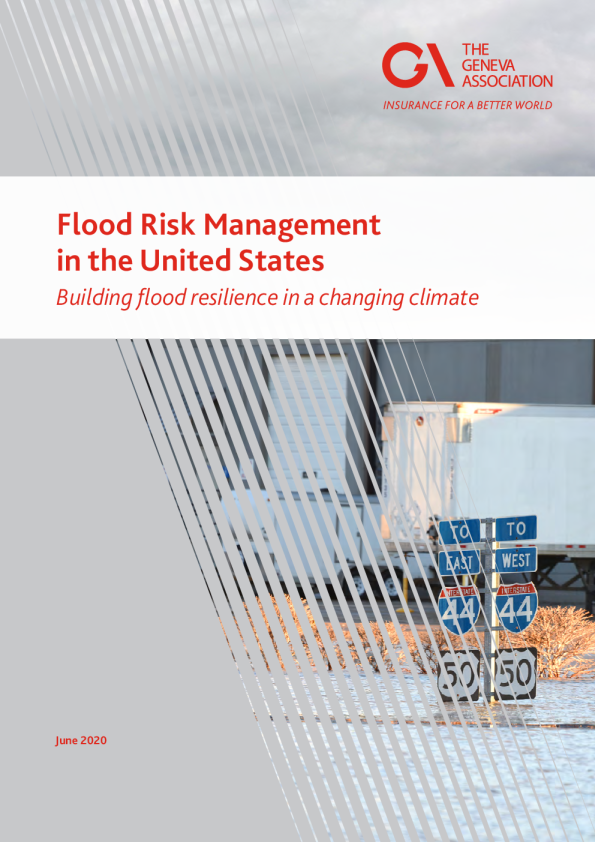
Carolyn Kousky, Wharton Risk Center, University of PennsylvaniaMaryam Golnaraghi,The Geneva AssociationFlood Risk Managementin the United StatesBuilding flood resilience in a changing climate The Geneva AssociationThe Geneva Association was created in 1973 and is the only global association of insurance companies; ourmembers are insurance and reinsurance Chief Executive Officers (CEOs). Based on rigorous research conducted incollaboration with our members, academic institutions and multilateral organisations, our mission is to identifyand investigate key trends that are likely to shape or impact the insurance industry in the future, highlighting whatis at stake for the industry; develop recommendations for the industry and for policymakers; provide a platform toour members, policymakers, academics, multilateral and non-governmental organisations to discuss these trendsand recommendations; reach out to global opinion leaders and influential organisations to highlight the positivecontributions of insurance to better understanding risks and to building resilient and prosperous economies andsocieties, and thus a more sustainable world.Published by The Geneva Association—International Association for the Study of Insurance Economics, Zurich.The Geneva Association—International Association for the Study of Insurance EconomicsTalstrasse 70, CH-8001 ZurichEmail: secretariat@genevaassociation.org | Tel: +41 44 200 49 00 | Fax: +41 44 200 49 99 2www.genevaassociation.orgJune 2020Flood Risk Management in the United States© The Geneva AssociationPhoto credits:Cover page—Gino Santa Maria, Shutterstock.Page 20—EchoFree, Shutterstock. Contents1.Executive summary2.Introduction3.Flood risk3.1.Types and impacts of flood risk3.2.Drivers of flood risk3.3.Stakeholders and their contributions to flood risk4.Flood resilience in the United States: An emerging concern5.Flood risk information and awareness5.1.FEMA’s Flood Insurance Rate Maps5.2.Other sources of flood risk information5.3.Flood risk communication and outreach activities5.4.Flood risk awareness among stakeholders6.Flood advisories and early warnings for emergency preparedness and response7.Flood insurance: The primary non-structural approach to flood risk management7.1.The National Flood Insurance Program7.2.Private-sector flood insurance8.Flood mitigation programs8.1.Federal flood mitigation efforts9.Post-flood response and reconstruction9.1.FEMA9.2.Small Business Administration9.3Department of Housing and Urban Development9.4.Internal Revenue Service9.5.U.S. Department of Agriculture10.Conclusions: Successes, continued challenges and lessons learnedReferencesAnnexesAnnex 1: Questions used for mapping and analysing the evolution of flood risk managementAnnex 2a: Local case study – New York City, NYAnnex 2b: Local case study – North Carolina 1618202022232426272732323636383839394042464649 3Flood Risk Management in the United States13153151 4www.genevaassociation.orgAcknowledgementsMaryam Golnaraghi, Director of Climate Change and Emerging EnvironmentalTopics at The Geneva Association, is the lead investigator and coordinating authorof the project.We are grateful to Munich Re’s NatCatSERVICE for providing critical data for thisproject and would like to extend our special thanks to Petra Löw and Sabine Schlüter-Mayr (Munich Re) for supporting us in this process. We acknowledge and greatlyappreciate contributions of Brett Lingle (formerly of the Wharton Risk Center, now atFirst Street Foundation) for his extensive support for preparation of this chapter. Weextend our gratitude to the members of The Geneva Association Flood Project AdvisoryTeam for providing invaluable insights for the overall design of the project, including,Shiraj Khan (AIG), Wolfgang Kron (Munich Re, retired), Leigh Wolfrom (Organizationfor Economic Cooperation and Development – OECD), Darius Pissulla (Hannover Re),Cameron Rye (formerly of SCOR), Michael Szoenyi (Zurich Insurance), Mandy Dennison(Intact Financial), Masaaki Nagamura (Tokio Marine), Jacki Johnson (IAG), Alan Milroy(AXA XL), Iain Hamilton (Aviva) and Xiaoting Hu (Tokio Marine Technologies). Thefollowing experts provided valuable input to this report by participating in discussions,interviews and the review process: John Ashenfelter, Jon Beaver, Kevin Frederick (StateFarm), Don Griffin (APCIA), Jo Ann Howard (H2O Partners), University of Maryland(Gerald Galloway), Sandra Knight (WaterWonks), Larry Larson (ASFPM), Clark Poland,Angela Gladwell, Nick Shufro, Paul Huang, Cynthia Spishak, and Andrew Read (FederalEmergency Management Agency – FEMA), Frank Nutter (Reinsurance Association ofAmerica) and Steven Weisbart (Insurance Information Institute). We would like tothank all members of The Geneva Association Working Group on Climate Change andEmerging Environmental Topics for their support, review and feedback, with particularthanks to Simone Ruiz-Vergote, Andreas Funke and Markus Aichinger (Allianz); JenniferWaldner, Anthony Zobl, Paul Di