AI智能总结
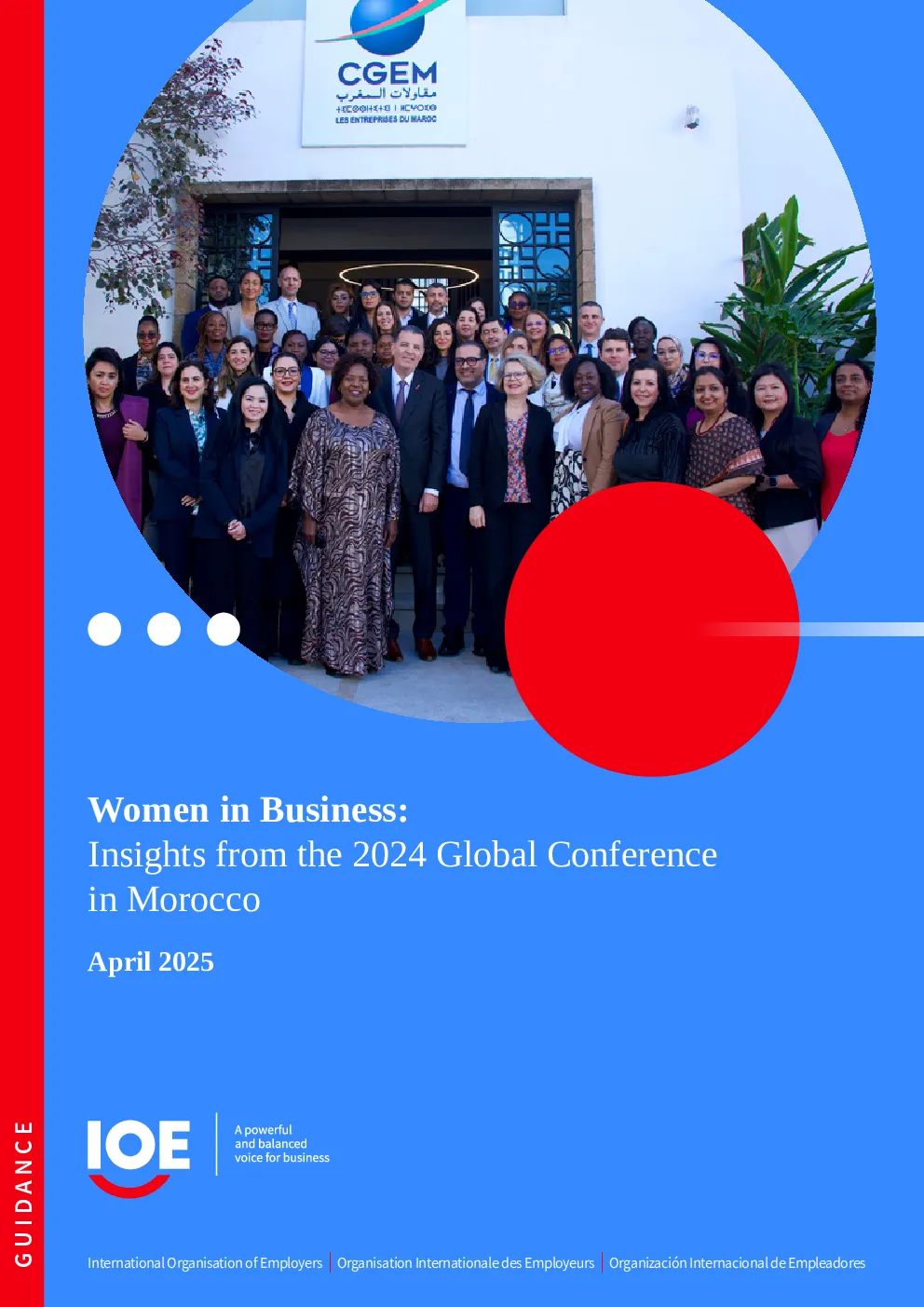
This publication was produced with the financial support of the European Union. Its contents are the soleresponsibility of the International Organisation of Employers (IOE) and do not necessarily reflect the viewsof the European Union. Table of contentsOverviewSection One – Examples of Good Practicesa. Bringing Women On Board – Representation and Leadershipb. Addressing Challenges and Harnessing Opportunitiesfor Women Entrepreneursc. Mentoring and Networking as Vehicles to Advance Womenin the Labour Market and Employers’ Good PracticesSection Two – Summary Report of the ConferenceDay OneDay Two 5771116212127 OverviewThe conferenceEmpowering Women in Business: Breaking Barriers,Building Resilience – A Contribution to LDCs on Ways Forwardtook placefrom 10–11 December 2024 in Casablanca, Morocco. The InternationalOrganisation of Employers (IOE) and theConfédération Générale desEntreprises du Maroc(CGEM) co-organised the conference, with thegenerous support from the European Union. Participants reaffirmeda shared commitment to advancing gender equality and promotingwomen’s economic empowerment. The presentations highlighted theneed to enhance women’s opportunities, participation and leadership inbusiness and the labour market – not least because gender equality drivessustainable growth, so is good for businesses and society.Another focus was removing barriers to women’s professional and businesspotential. Women are the backbone of thriving economies. Progress hasbeen made. However, they still occupy less than one third of managementand leadership positions globally. That underscores the urgent need to worktogether to promote gender equality in leadership, entrepreneurship anddecision-making. To that end, the conference brought together Employerand Business Membership Organisations and other stakeholders to sharechallenges, opportunities and lessons learned on how best to acceleratechange and positively contribute towards addressing the gender gap atlocal level.Specifically, the conference gave participants a platform to explore specifictopics, share what has proved successful for them, work together and learnfrom each other. For example, they discussed the barriers women facein business and at work, while exchanging insights and workable action-oriented solutions. Another priority was engagement and capacity-building,particularly in Least Developed Countries (LDCs).The goal of that was tospur local efforts to support women’s economic empowerment and boosttheir representation in leadership roles in business and beyond. In addition,the contributions of employers’ organisations, partners and supporterswere examined.There were five sessions, and high-level opening and closing addresses.Topics of discussion included:•Women’s Representation:Examining how increasing women’sparticipation and leadership within employers’ organisationsstrengthens businesses and gender equality.•Women Entrepreneurs:Exploring challenges, opportunities and therole of employers’ organisations and partners in fostering progress.•Mentoring and Networking:Highlighting the impact of mentoringand networking for women in the labour market and on elevating thegood practices of employers. The conference gathered the expertise and experience of IOE’s globalnetwork of more than 150 employers’ organisations, with contributionsfrom regions including Asia, Africa, Europe, Latin America and Small IslandStates. Discussions highlighted the critical role of how bringing women onboard, mentorship, leadership development and professional networks canempower women and bolster gender equality. Most of the good practicespresented were set out by employers’ organisations, which attests to thevalue of the IOE network. That underscores the potential for employers’organisations and other stakeholders to learn from each other and adaptgood practices to their local contexts.Participants showed a deep understanding of the matters at hand. Theywere clearly strongly committed to tackling the challenges faced bywomen professionals and entrepreneurs, seizing opportunities and usinggood practices, such as leadership development, to address the gendergap. The good practices presented show what can be achieved, and howemployers’ organisations, policymakers, institutions and businesses canturn knowledge gleaned from the discussions into action-oriented initiativestowards sustainable progress in advancing women in the workplace andbusiness within their communities. As emphasised in the concludingremarks, that knowledge must now be turned into local action, andemployers’ organisations and partners were urged to do just that.This report has two sections. Section one sets out some examples of goodpractices presented during the conference, with links to relevant contentand videos. It invites employers’ organisations and partners to consideradopting those practices as part of their efforts to advance women inbusiness. We encourage employers’ organisations and other stakeholdersto