AI智能总结
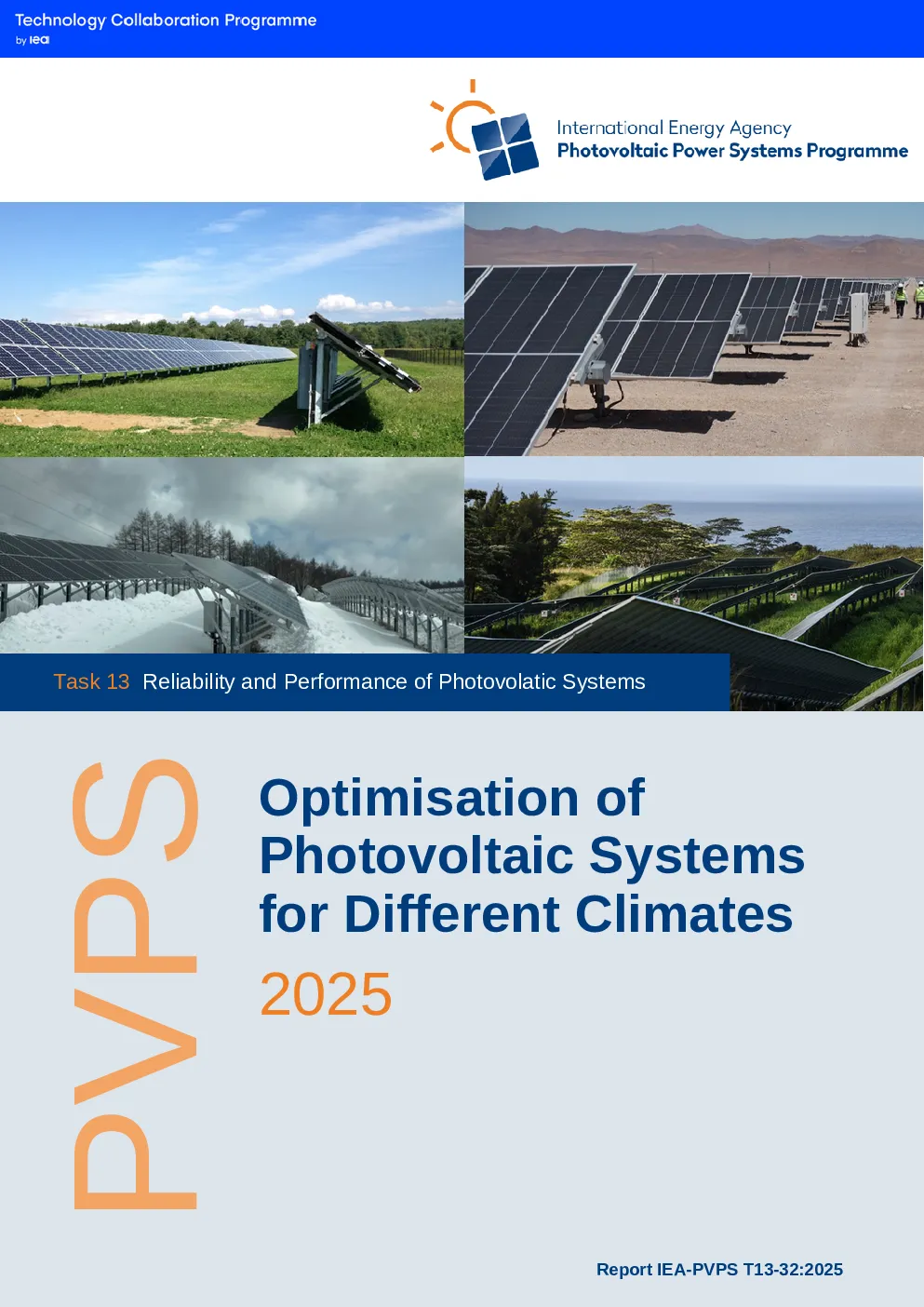
What is IEA PVPS TCP?The International Energy Agency (IEA),founded in 1974, is an autonomous body within the framework of the Organisation for EconomicCooperation and Development (OECD). The Technology Collaboration Programmes (TCP) were created with a belief that the futureofenergy security and sustainability starts with global collaboration. The programmes are made up of 6.000 experts across government, aca-demia, and industry dedicated to advancing common research and the application of specific energy technologies.The IEA Photovoltaic Power Systems Programme (IEA PVPS) is one of the TCPs within the IEA and was established in 1993. The missionof the programme is to “enhance the international collaborative efforts which facilitate the role of photovoltaic solar energy as a cornerstonein the transition to sustainable energy systems.” To achieve this, the programme’s participants have undertaken a variety ofjoint researchprojects in PV power systems applications. The overall programme is headed by an Executive Committee, comprised of one delegate fromeach country or organisation member, which designates distinct ‘Tasks,’ that may be research projects or activity areas.Australia, Austria, Belgium, Canada, China, Denmark, European Union, Finland, France, Germany, India, Israel, Italy, Japan, Korea, Malay-sia, Morocco, the Netherlands, Norway, Portugal, Solar Energy Research Institute of Singapore (SERIS), SolarPower Europe, South Africa,Spain, Sweden, Switzerland, Thailand, Türkiye, United Kingdom and United States of America.Visit us at:www.iea-pvps.orgWhat is IEA PVPS Task 13?Within the framework of IEA PVPS, Task 13 aims toprovide support tomarket actors working to improve the operation, reliability,and qualityof PV components and systems.Performancedata from PV systems in different climate zones compiled within the project will help providethe basis for estimates of the current situation regarding PV reliability and performance.The general setting of Task 13 provides a common platform to summarise and report on technical aspects affecting the quality, performance,reliability,and lifetime of PV systems in a wide variety of environments and applications. By working together across national boundaries,wecan all take advantage of research and experience from each member country and combine and integrate this knowledge into valuablesummaries of best practices and methods for ensuring PV systems perform at their optimum and continue to provide competitive return oninvestment.IEA PVPSTask 13 has so far managed to createaframework for the calculations of various parameters that canindicatethe quality of PVcomponents,systemsand applications.The framework isavailableand can be used by thePVindustrywhichhas expressed appreciationtowards the results included in the high-quality reports.The IEA PVPS countries participating in Task 13 are Australia, Austria, Belgium, Canada, Chile, China, Denmark, Finland, France, Germany,Israel, Italy, Japan, the Netherlands, Norway, Spain, Sweden, Switzerland, Thailand, and the United States of America, and theSolar EnergyResearch Institute of Singapore.DISCLAIMERTheIEAPVPSTCPisorganisedundertheauspicesoftheInternationalEnergyAgency(IEA)butisfunctionallyandlegallyautonomous. Views, findings and publica-tions of the IEA PVPS TCP do not necessarily represent the views or policies of the IEA Secretariat or its individualmembercountries.COPYRIGHT STATEMENTThiscontent may be freely used, copied and redistributed, providedappropriate credit is given(please refer to the ‘Suggested Citation’). The exception is thatsome licensed images may not becopied, as specified in the individual image captions.SUGGESTED CITATIONFriesen, G.,Micheli, L. (2025).Friesen, G.,Micheli, L.,Jahn, U.(Eds.),Optimization ofPhotovoltaic PowerSystems for Different Climates(Report No. T13-32:2025). IEA PVPS Task 13.https://doi.org/10.69766/QSYC8858COVER PICTUREPV system located in Albuquerque US,source: Sandia/Laurie Burnham;PV system in northern Chile, source: PVRadar/Thore Müller;PV system located at PiteaSweden, source: OFI/Gabriele Eder;AES Lawai Solar Project-Kauaiin Hawaii, US (Photo by Dennis Schroeder,NREL58001), source: NREL Image Gallery, IEA PVPS Task 13ReliabilityandPerformanceof Photovoltaic SystemsOptimisation of Photovoltaic Systems forDifferent ClimatesReport IEA-PVPS T13-32:2025June2025ISBN978-3-907281-74-1DOI10.69766/QSYC8858 Gabi Friesen,University of Applied Sciences and Arts of Southern Swit-zerland,SwitzerlandLeonardo Micheli, Sapienza University of Rome, ItalyGabriele C. Eder,Austrian Research Institute for chemistry and technol-ogy,AustriaThore Müller, PVRADAR Labs GmbH, GermanyJaffar Moideen Yacob Ali,Solar Energy Research Institute of Singapore,SingaporeMariella Rivera, Fraunhofer Institute for Solar EnergySystems, GermanyJulián Ascencio Vásquez, Univers SAS, FranceGernot Oreski, Polymer Competence Center Leoben, AustriaLaurie Burnham, Sandia National Laboratories, USAChristopher Baldus-Jeur