让家庭和社区参与K-12教育
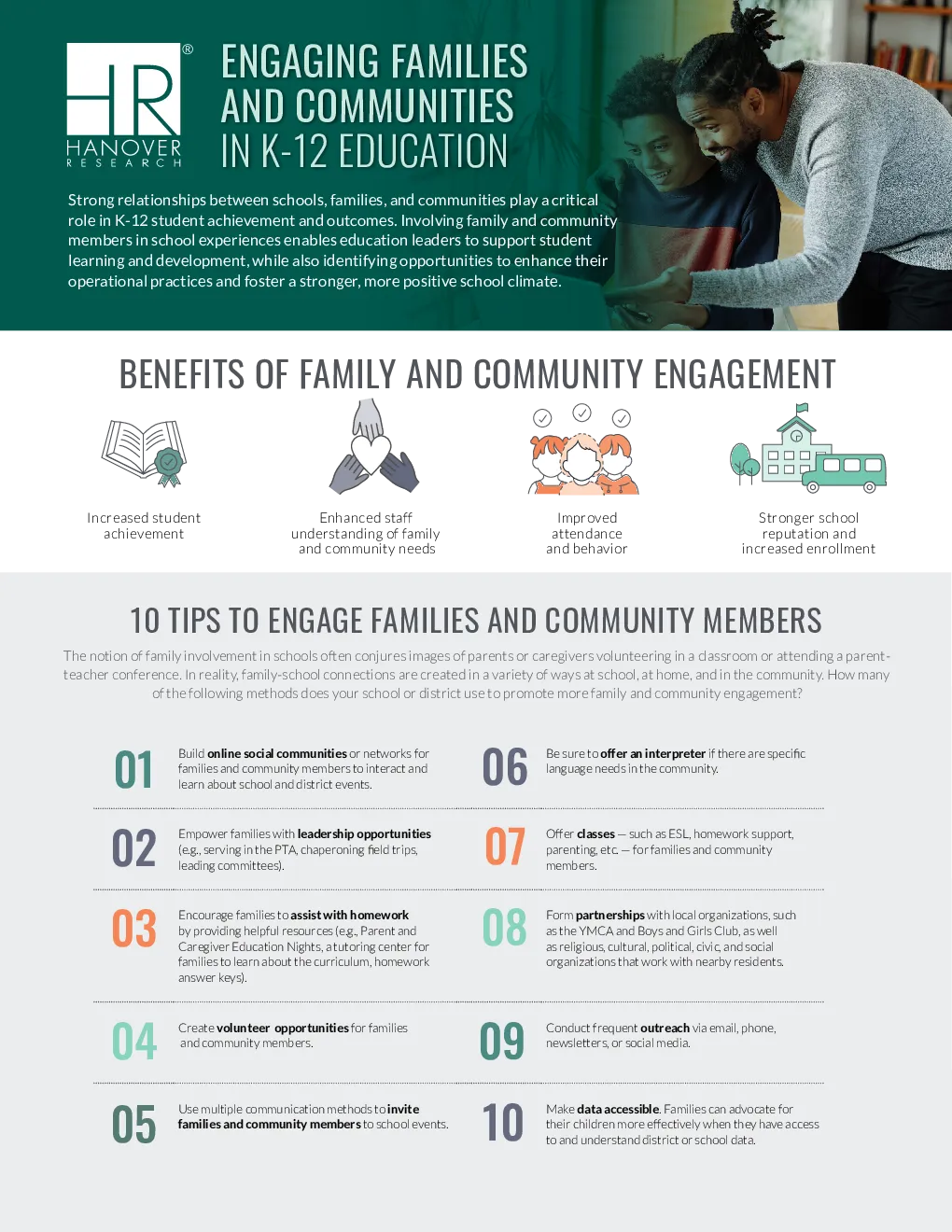
Strong relationships between schools, families, and communities play a criticalrole in K-12 student achievement and outcomes. Involving family and communitymembers in school experiences enables education leaders to support studentlearning and development, while also identifying opportunities to enhance theiroperational practices and foster a stronger, more positive school climate. BENEFITS OF FAMILY AND COMMUNITY ENGAGEMENT Enhanced staffunderstanding of familyand community needs Stronger schoolreputation andincreased enrollment Increased studentachievement Improvedattendanceand behavior 10 TIPS TO ENGAGE FAMILIES AND COMMUNITY MEMBERS The notion of family involvement in schools often conjures images of parents or caregivers volunteering in a classroom or attending a parent-teacher conference. In reality, family-school connections are created in a variety of ways at school, at home, and in the community. How manyof the following methods does your school or district use to promote more family and community engagement? 06 Be sure tooffer an interpreterif there are specificlanguage needs in the community. Buildonline social communitiesor networks forfamilies and community members to interact andlearn about school and district events. 01 02 Offerclasses— such as ESL, homework support,parenting, etc. — for families and communitymembers.07 Empower families withleadership opportunities(e.g., serving in the PTA, chaperoning field trips,leading committees). 03 Formpartnershipswith local organizations, suchas the YMCA and Boys and Girls Club, as wellas religious, cultural, political, civic, and socialorganizations that work with nearby residents.08 Encourage families toassist with homeworkby providing helpful resources (e.g., Parent andCaregiver Education Nights, a tutoring center forfamilies to learn about the curriculum, homeworkanswer keys). 09 04 Conduct frequentoutreachvia email, phone,newsletters, or social media. Createvolunteer opportunitiesfor familiesand community members. Makedata accessible. Families can advocate fortheir children more effectively when they have accessto and understand district or school data.10 05 Use multiple communication methods toinvitefamilies and community membersto school events. HOW TO MEASURE PARTNERSHIP ENGAGEMENT Engagement improves even more when schools and districts regularly collect data on family and communitymembers’ needs, perceptions, and priorities. K-12 organizations commonly use surveys and focus groups to measurehow well these parties feel welcomed, engaged, and prepared to support their students. Each data collection methodhas a specific purpose and may involve different questions and audiences, depending on local needs or challenges. Dive deeper into various groups’ feedback Reach many participants at once FDesign survey questionsto solicit accuratefeedback on community perspectives and priorities(e.g., Do families know how to get involved or find resources?) FDesign questionsto solicit deeper insights onfamily and community perspectives and priorities FSend invitationsto potential participants at leastfour weeks before scheduled sessions FUsewelcoming terminologyin directionsand questions(e.g., “families” instead of “parents”) FSchedule multiple sessionsat convenient times tominimize potential conflicts and to offer sessionsin different languages FSchedule surveys toavoid conflicts in yourdistrictto ensurethe intended audiencewill beable to respond(e.g., holidays, start/end of school year) FProvide transportation, childcare, food,and translation services tominimizelogistical barriersand/or create opportunities tohost events in the local community FOffer surveys inmultiple languages spoken inyour districtand onmultiple platforms FAdvertise surveys throughmultiplecommunication channels(e.g., online, mail, community partners) FIncentivize participationin focus groupsvia meaningful rewards Learn the common traits of a positive school climate.Download our infographic,5 Ways to Improve K-12 School Climate. DOWNLOAD NOW Sources:https://www.hanoverresearch.com/reports-and-briefs/current-state-of-school-climate-in-public-schools | https://www.childwelfare.gov/pubPDFs/f_fam_engagement.pdfhttps://nmefoundation.org/how-family-school-and-community-engagement-can-improve-student-achievement-and-influence-school-reform/ https://oese.ed.gov/files/2020/10/equitable_family_engag_508.pdfhttps://ohiofamiliesengage.osu.edu/resources/ | https://www.nea.org/professional-excellence/student-engagement/tools-tips/10-ideas-engaging-parents | https://journals.sagepub.com/doi/abs/10.1177/0042085912445643https://education.ohio.gov/Topics/Student-Supports/Family-and-Community-Engagement/Getting-Parents-Involved/Sample-Best-Practices-for-Parent-Involvement-in-Schttps://www.learningforjustice.org/magazine/publicationscritical-practices-for-social-justice-education/family-and-communityhttps://hanoverresearch.my.salesforce-sites.com/customerportal/reportDe