您的浏览器禁用了JavaScript(一种计算机语言,用以实现您与网页的交互),请解除该禁用,或者联系我们。 [SoftServe]:月球上的多机器人:探索和采矿 - 发现报告

月球上的多机器人:探索和采矿

机械设备 2025-02-26 SoftServe 刘银河
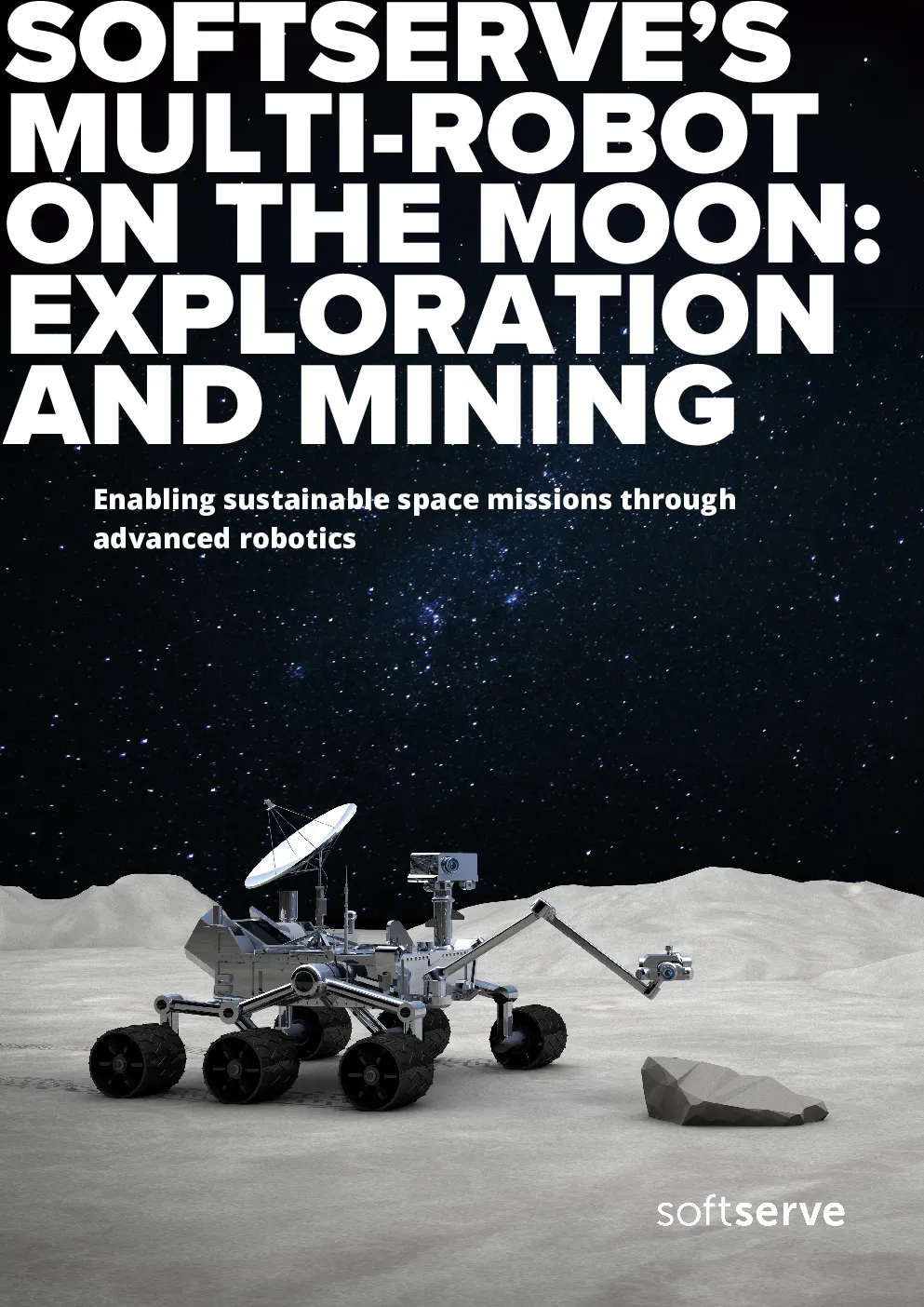
报告封面

Enabling sustainable space missions throughadvanced robotics The discovery of ice at the Moon’s poles, inferred by several differentinstruments on lunar orbiters and by an impactor experiment, has unlocked atransformative potential for space exploration. This ice, located inpermanently shadowed craters and beneath the lunar surface, can beconverted into critical resources such as water, oxygen, and hydrogen-basedrocket fuel. These resources are essential for supporting life and powering future missions,significantly lowering the cost of long-term space exploration. Using lunar ice,the Moon could become a strategic hub for deeper space missions, includingMoon-to-Mars expeditions. Resource extraction is vital to making space travelmore sustainable and economically viable. STUDY FOCUS This white paper exploresSoftServe’s multi-robot ecosystemdesigned to simulate andoptimize the extraction and processing of lunar resources efficiently. This simulation-firstapproach provides the ability to design adaptability and scalability into future lunaroperations: Simulation-First Development: Utilizing NVIDIA Omniverse™ andIsaac Sim™ for high-fidelity lunar environment simulations. Multi-Robot Ecosystem: Enables collaboration between excavators,haulers, and thruster-driven drones powered by AI-driven navigation anddecision-making, which can be extended to other types of vehicles, robots,and structures. Sustainability Focus: Reduces reliance on Earth-based supplies bycreating scalable, efficient solutions. By integrating advanced simulation technologies and robust robotics, the systemaddresses challenges such as energy efficiency, extreme environmental conditions,and autonomous collaboration. LUNAR RESOURCE POTENTIAL The current cost of sending cargo to the surface of the Moon is a staggering$1.5million per kilogram. However, these costs could be significantly reduced byutilizing lunar ice to produce rocket propellants, making lunar missions moreeconomically viable. Extracting resources directly from the Moon also promotessustainability by reducing the reliance on Earth-based supplies, enabling longer,more self-sufficient space missions. The Moon could become a vital depot for fueling future expeditions and supportingthe aerospace, mining, and construction industries. NASA’slunar outpost plansandthe growing commercial space sector would contribute to a future where lunarresources drive space exploration beyond Earth. This infrastructure would makedeep-space missions more feasible and open the door for robotic exploration andresource utilization on other planets, such as Mars. REDEFINING RESOURCE EXTRACTION APPROACH Lunar resource extraction presents unique challenges, including harsh terrain,extreme temperatures, and communication outages. These factors make traditionalsingle-robot operations inefficient and high-risk. Multi-robot fleets are essentialbecause they enable autonomous collaboration, provide risk-reducing redundancy,and allow for scalability. That ensures continuous operations even if individual robotsfail. Unlike single units, coordinated fleets can simultaneously map, excavate,transport, process resources, and construct various structures — significantlyimproving efficiency. Current methods that rely on Earth-controlled rovers or limited automation cannotscale to meet the demands of sustained lunar missions.SoftServe's missionorchestratoraddresses these challenges by seamlessly integrating diverse roboticteams, optimizing task execution, and ensuring real-time adaptability. This makeslarge-scale lunar operations feasible and sustainable. This solution is critical for anyorganization looking to deploy robotics beyond Earth. ROBOTICS AND SIMULATION TECHNOLOGIES Simulation Platforms: SoftServe’s partnership with NVIDIA enhancessimulation capabilities in space system development. Using NVIDIAOmniverse™ and Isaac Sim™, SoftServe adopts a simulation-first approach,replicating many aspects of harsh lunar conditions with high fidelity. AI Integration: Powered by ROS2 and SLAM algorithms, SoftServe’s robotsautonomously map, navigate, and interact with lunar environments. Terramechanics Modeling: Advanced terramechanics ensures precisesimulations of lunar soil interactions, allowing to optimize excavationtechniques by design and autonomously during operations. ROBOTICS DESIGN In the multi-robot simulation ecosystem, SoftServe appliesPhysical AIwhichinvolves AI-driven physics modeling and optimization, crucial for precise simulation,control, and decision-making in challenging environments. This technology isintegrated with multi-robot SLAM, enabling real-time mapping and navigation forautonomous robots. The use of Physical AI ensures that robots can make informeddecisions based on real-time data, enhancing their ability to perform complex tasksin unpredictable environments. The robotic fleet is powered by amission orchestrator, enabling autonomousdecision-making and collaboration. In the context of