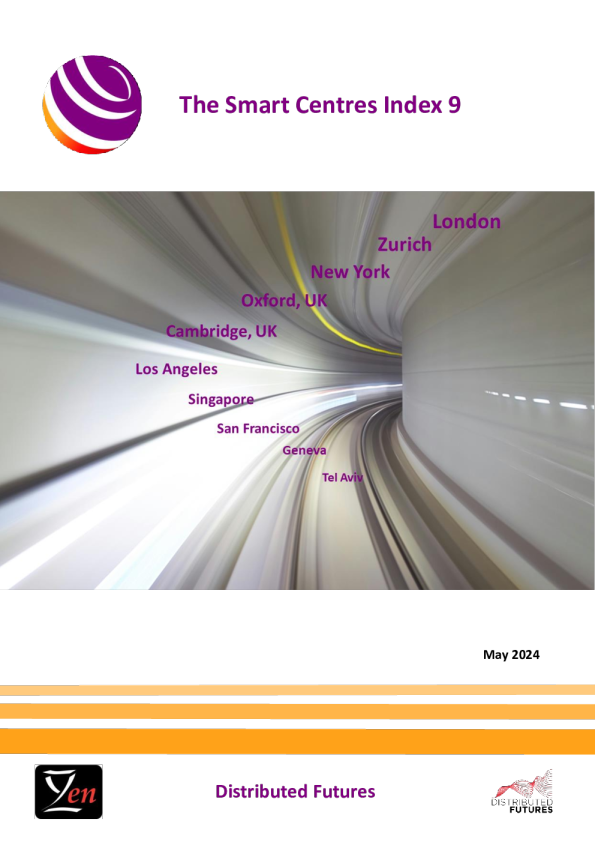
智能中心指数8
 AI智能总结
Distributed Futures We are pleased to present the eighth edition of theSmart Centres Index(SCI 8). The SCI has been developed by Z/Yen as part of its Long Finance Initiative and the Distributed FuturesProgramme to track commercial centres’ability to create, develop, and deploy technology. It aims tohelp investors, governments, and regulators track the attractiveness of technology centres for newtechnologies and products by measuring how attuned centres and their regulatory systems are toattracting innovation and growth in Science, Technology, Energy Systems, Machine Learning,Distributed Ledgers, and Fintech. The SCI tracks three dimensions related to innovation and technology in the cities that we rank:Innovation Support-the support provided by regulatory and other systems to innovation and •technology in a centre.•Creative Intensity-the intensity of technology and innovation services and opportunities in acentre.•Delivery Capability-the quality of the technology and innovation work that is taking place in acentre. Z/Yenhelps organisations make better choices-ourclientsconsider us a commercial think-tank thatspots, solves, and acts. Our name combines Zen and Yen-‘a philosophical desire to succeed’-in aratio, recognising that all decisions are trade-offs. One of Z/Yen’s specialisms is the development andpublication of research combining factor analysis and professional assessments. Long Financeis a Z/Yen initiative designed toaddress the question“When would we knowour financial system is working?”Thisquestion underlies Long Finance’s goal toimprove society’s understanding and use offinance over the long-term. In contrast to theshort-termism that defines today’s economicviews, the Long Finance timeframe is roughly100 years. The authors of this report, Mike Wardle andProfessor Michael Mainelli, would like to thankBikash Kharel and the rest of the Z/Yen teamfor their contributions with research,modelling, and ideas. © Z/Yen Group 2023 ContentsPage Summary And Headlines1SCI 8 Ranks And Ratings3The Three SCI Dimensions5Top Five Centres7SCI 8: Further Analysis9Areas Of Competitiveness10Commentary On Factors13Reputation14The SCI 8 World-Centres In The Index15Regional Analysis17•North America18•Asia/Pacific20•Western Europe22•Middle East & Africa24•Eastern Europe & Central Asia25•Latin America & The Caribbean27Appendix 1: Assessment Details28Appendix 2: Respondents’Details31Appendix 3: Methodology32Appendix 4: Instrumental Factors35 Summary And Headlines CommentaryThe Smart Centres Index focuses on technology and innovation in financial and commercial centres across the world, including Science, Energy Systems, and Machine Learning, along with otherapplications. The index is designed to improve our understanding of science and technology policy,regulation, and delivery. Leading centres in the SCI are based in places which combine a highperforming university sector across STEM subjects, with well-developed regulatory, commercial, andfinancial services. The SCI takes into account the three dimensions of Innovation Support, Creative Intensity, and DeliveryCapability. In broad terms, centres in North America score higher for Delivery Capability. Centres inWestern Europe score higher for Innovation Support and Creative Intensity. Centres in Asia/Pacificscore lower for Delivery Capability and higher for Creative Intensity. As a mark of continued technological progress, we asked respondents to the SCI survey to predict thetime frame over which they expected quantum computers to be able to break current public keyencryption. Over three-quarters of respondents expect this point to be reached within five years.Alongside the development of generative AI, these developments will continue to have an impact onwork and leisure. Following a rise in the average ratings in SCI 7, the average rating in SCI 8 rose by just 0.47%. Against abackground of geopolitical threats, this may reflect uncertainty over the perceived risks and uncertaintypes of benefits arising from technologies such as generative AI. Most centres in the top half of thetable fell in the ratings, while the reverse is true for centres in the lower half of the index. Regionalperformance followed this trend, with Western European and North American centres’average ratingfalling, reflecting the higher number of centres in these regions in the top half of the ranking. SCI 8 Results •London retained first place in the index, with New York and Singapore in second and third positions.•Four Western European centres feature in the top 10, and three US centres.•Singapore and Hong Kong feature in the top 10 among Asia/Pacific centres and Tel Aviv continues tofeature in the top 10.•Four centres rose 10 or more places in the ranking in SCI 8, while five centres fell 10 or more places. North America •Nine North American centres feature in SCI 8 and three are in the world top 10.•Five centres in the region maintained or improved their rank position compared with