您的浏览器禁用了JavaScript(一种计算机语言,用以实现您与网页的交互),请解除该禁用,或者联系我们。[ZYen]:中国金融中心指数15摘要 - 发现报告

中国金融中心指数15摘要

金融2024-02-01ZYen�***
AI智能总结
查看更多
中国金融中心指数15摘要

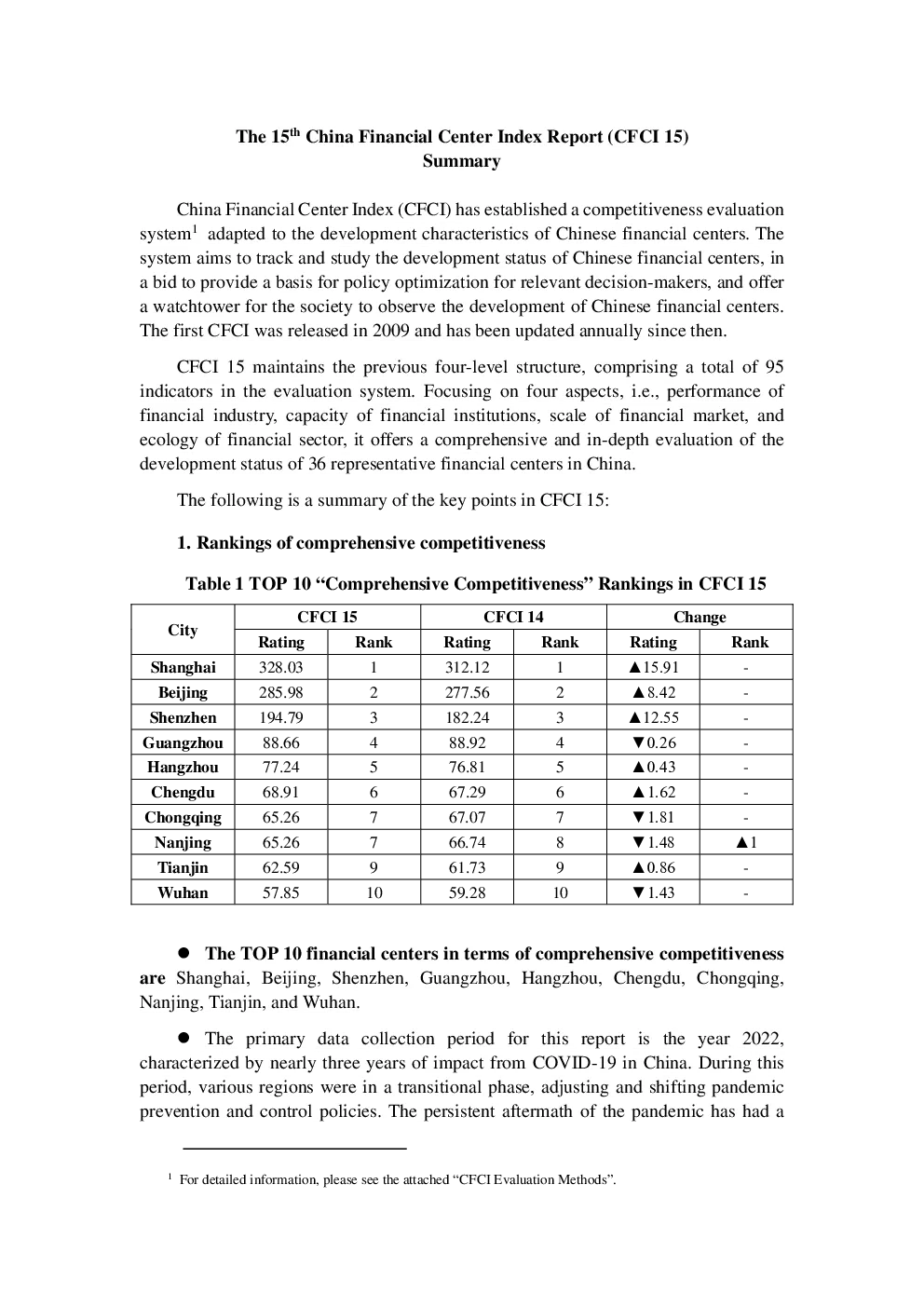
China Financial Center Index (CFCI) has established a competitiveness evaluationsystem1 adapted to the development characteristics of Chinese financial centers. Thesystem aims to track and study the development status of Chinese financial centers, ina bid to provide a basis for policy optimization for relevant decision-makers, and offera watchtower for the society to observe the development of Chinese financial centers.The first CFCI was released in 2009 and has been updated annually since then. CFCI 15 maintains the previous four-level structure, comprising a total of 95indicators in the evaluation system. Focusing on four aspects, i.e., performance offinancial industry, capacity of financial institutions, scale of financial market, andecology of financial sector, it offers a comprehensive and in-depth evaluation of thedevelopment status of 36 representative financial centers in China. The following is a summary of the key points in CFCI 15: 1.Rankings of comprehensive competitiveness The TOP 10 financial centers in terms of comprehensive competitivenessareShanghai, Beijing, Shenzhen, Guangzhou, Hangzhou, Chengdu, Chongqing,Nanjing, Tianjin, and Wuhan. The primary data collection period for this report is the year 2022,characterized by nearly three years of impact from COVID-19 in China. During thisperiod, various regions were in a transitional phase, adjusting and shifting pandemicprevention and control policies. The persistent aftermath of the pandemic has had a negative impact on certain financial centers. Among the 36 financial centers, 17 haveimproved their ratings to varying degrees, while 19 centers have seen a slight declinein their overall competitiveness ratings. Among the 33 regional financial centers, the top three cities with the fastestrating growth in this period are Suzhou, Chengdu, and Ningbo. They have respectivelyseen an increase of 2.18 points, 1.62 points, and 1.61 points in their ratings from theprevious index, significantly outperforming other regional financial centers in China. Wuhan, Suzhou, Zhengzhou, and Xi’an maintain a distinct competitiveadvantage over other financial centers in their respective regions, continuing to holdtheir leading positions in this period. However, the comprehensive competitivenessratings for Wuhan and Suzhou saw a decrease and an increase, respectively, whichnarrowed the gap between them to less than 1%. 2.Rankings of performance of financial industry The financial industry plays a crucial role in propelling the socioeconomicdevelopment of a city and serves as a direct and comprehensive reflection of itsfinancial competitiveness. The CFCI report categorizes the assessment of financialindustry performance into two evaluation dimensions: the output-driven level and thebusiness development level, based on the multiplier theory of industrial economics. The TOP 10 financial centers in terms of performance of financialindustry are, in sequence, Beijing, Shanghai, Shenzhen, Guangzhou, Hangzhou,Chengdu, Nanjing, Chongqing, Suzhou and Tianjin. The development of financial industry in various cities continued to show apositive growth trend in this index. 29 out of the 36 cities have achieved positive ratinggrowth, while only 7 cities have experienced a slight decrease in ratings. CFCI 15 witnessed significant shifts in the performance rankings of the financial industry. In terms of sub-item rankings, 15 cities have improved, 11 cities haveseen a drop in rankings, while the rankings of 16 cities remain unchanged. Among them,Ningbo, which saw the biggest improvement in sub-item rankings, rose by 4 places torank 20th in China; Lanzhou saw the biggest drop in rankings, falling by 4 places torank 31st in China. The concentration of the financial industry in domestic financial centers hasfurther intensified. In 2022, the total added value of the financial industry of 36financial centers was RMB 6.07 trillion, accounting for 62.7% of the added value ofthe China’s financial industry in that year, setting a new historical record. The year 2022 marked the culmination of China’s three-year journey ofbalancing pandemic control with socio-economic development. Financial centers haveplayed a robust and supportive role in ensuring stable growth and safeguardinglivelihoods in their respective regional economies and societies. In 2022, the addedvalue of the financial industry in all 36 financial centers accounted for over 6% of theirGDP, with an average of 10.9%. Simultaneously, only three of these centers had afinancial industry growth rate lower than the corresponding GDP growth rate. The restof the cities witnessed financial industry growth significantly outpacing GDP growth,contributing substantially to the stimulation of local economic development. 3.Rankings of capacity of financial institutions Financial institutions are the primary carriers of local financial industrydevelopment. The aggregation of influential financial institutions can play a