投降与自满信号:美国投资级与高收益
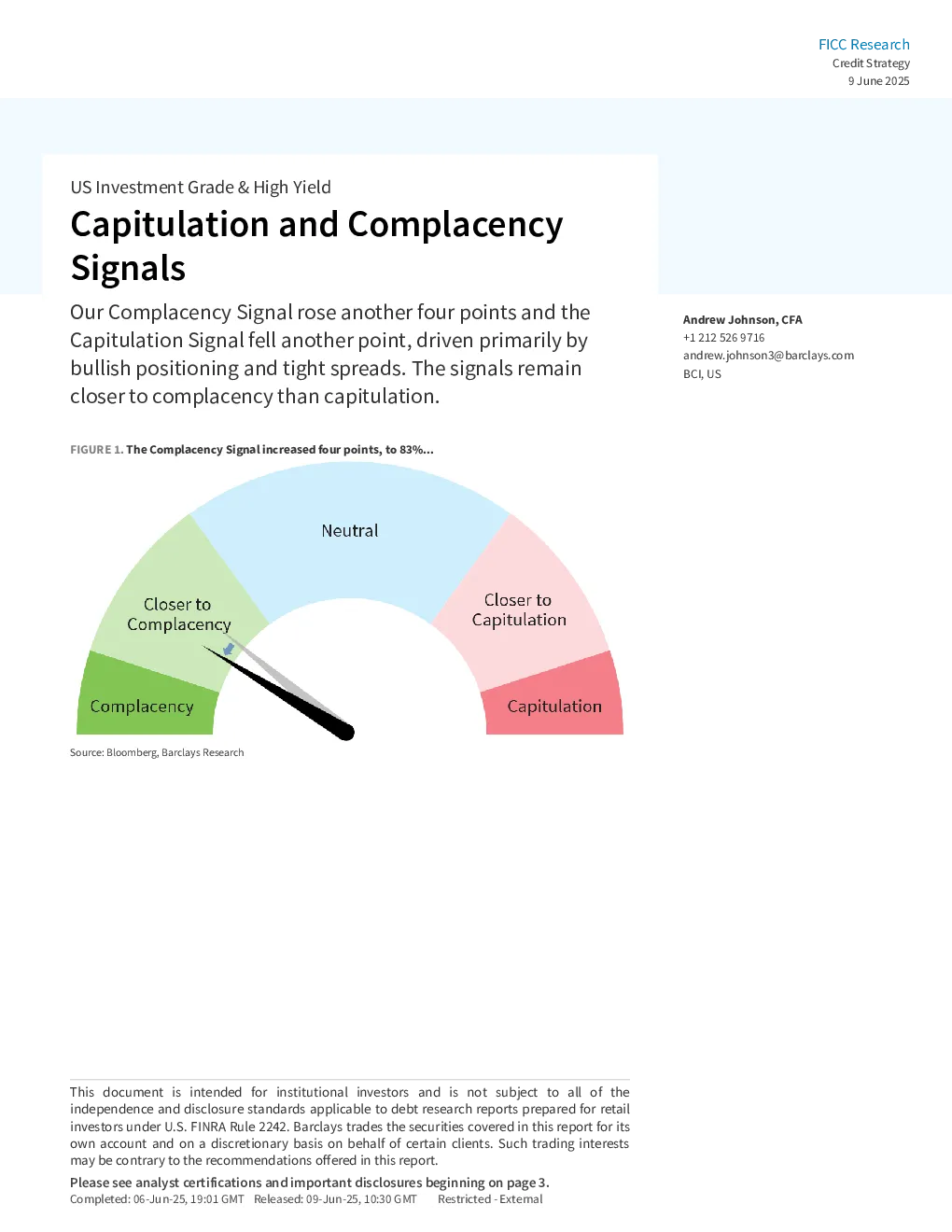
Capitulation and ComplacencySignals Our Complacency Signal rose another four points and theCapitulation Signal fell another point, driven primarily bybullish positioning and tight spreads. The signals remaincloser to complacency than capitulation. Andrew Johnson, CFA+1 212 526 9716andrew.johnson3@barclays.comBCI, US Source: Bloomberg, Barclays Research Risk-on sentiment continues to pervade markets and spreads continue to hover in the low 300s,the post-"liberation day" tights. Our Complacency Signal has been reflecting this and continuesto move higher — this week increasing four points to 83%. Similarly, the Capitulation Signal fellanother point to 52%. On the Complacency side, the biggest driver of the move was anincreasein bullish SPX positioning, which sent the equities positioning component of the signal to itstrigger.CDX.HY positioning also grew more bullish, with investors selling another $2bn inprotection in the on-the-run index, though that component of the signal is already at its trigger.On the Capitulation side, the biggest driver of the move lower wasstrength in HY spreads. Thesignals remain closer to complacency than capitulation. For more information on how these signals are generated, please see here, here, and here. For an audio overview of both signals, please see our Creditcast: Quantifying Complacency andCapitulation in Credit Markets. Analyst(s) Certification(s): I, Andrew Johnson, CFA, hereby certify (1) that the views expressed in this research report accurately reflect my personal views about any or all of thesubject securities or issuers referred to in this research report and (2) no part of my compensation was, is or will be directly or indirectly related to thespecific recommendations or views expressed in this research report. Important Disclosures: Barclays Research is produced by the Investment Bank of Barclays Bank PLC and itsaffiliates(collectively and each individually, "Barclays"). All authors contributing to this research report are Research Analysts unless otherwise indicated. The publication date at the top of the report reflectsthe local time where the report was produced and maydifferfrom the release date provided in GMT. Availability of Disclosures: For current important disclosures regarding any issuers which are the subject of this research report please refer to https://publicresearch.barclays.com or alternatively send a written request to: Barclays Research Compliance, 745 Seventh Avenue, 13th Floor, New York, NY10019 or call +1-212-526-1072. Barclays Capital Inc. and/or one of itsaffiliatesdoes and seeks to do business with companies covered in its research reports. As a result, investorsshould be aware that Barclays may have a conflict of interest that couldaffectthe objectivity of this report. Barclays Capital Inc. and/or one of itsaffiliatesregularly trades, generally deals as principal and generally provides liquidity (as market maker or otherwise) in the debt securities that are thesubject of this research report (and related derivatives thereof). Barclays trading desks may have either a long and / or short position in such securities,other financial instruments and / or derivatives, which may pose a conflict with the interests of investing customers. Where permitted and subject toappropriate information barrier restrictions, Barclays fixed income research analysts regularly interact with its trading desk personnel regardingcurrent market conditions and prices. Barclays fixed income research analysts receive compensation based on various factors including, but notlimited to, the quality of their work, the overall performance of the firm (including the profitability of the Investment Banking Department), theprofitability and revenues of the Markets business and the potential interest of the firm's investing clients in research with respect to the asset classcovered by the analyst. To the extent that any historical pricing information was obtained from Barclays trading desks, the firm makes norepresentation that it is accurate or complete. All levels, prices and spreads are historical and do not necessarily represent current market levels, pricesor spreads, some or all of which may have changed since the publication of this document. Barclays Research Department produces various types ofresearch including, but not limited to, fundamental analysis, equity-linked analysis, quantitative analysis, and trade ideas. Recommendations andtrade ideas contained in one type of Barclays Research maydifferfrom those contained in other types of Barclays Research, whether as a result ofdifferingtime horizons, methodologies, or otherwise. In order to access Barclays Statement regarding Research Dissemination Policies and Procedures, please refer to https://publicresearch.barclays.com/S/RD.htm. In order to access Barclays Research Conflict Management Policy Statement, please refer to: https://publicresearch.barclays.com/S/CM.htm. Disclosure(s) regarding Informati