Okta(OKTA):cRPO覆盖范围是否表明疲软?或许并非如此
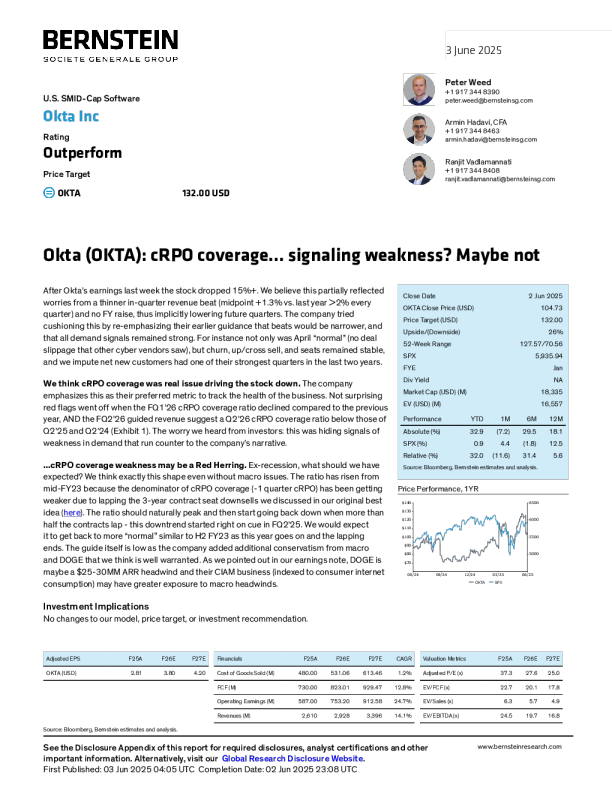
F26E27.620.16.35.719.72 Jun 2025127.57/70.566M29.5(1.8)31.406/255000550060006500 Okta IncRatingOutperformPrice TargetOKTAAdjusted EPSOKTA (USD)Source: Bloomberg, Bernstein estimates and analysis.After Okta’s earnings last week the stock dropped 15%+. We believe this partially reflectedworries from a thinner in-quarter revenue beat (midpoint +1.3% vs. last year >2% everyquarter) and no FY raise, thus implicitly lowering future quarters. The company triedcushioning this by re-emphasizing their earlier guidance that beats would be narrower, andthat all demand signals remained strong. For instance not only was April “normal” (no dealslippage that other cyber vendors saw), but churn, up/cross sell, and seats remained stable,and we impute net new customers had one of their strongest quarters in the last two years.We think cRPO coverage was real issue driving the stock down.The companyemphasizes this as their preferred metric to track the health of the business. Not surprisingred flags went off when the FQ1’26 cRPO coverage ratio declined compared to the previousyear, AND the FQ2’26 guided revenue suggest a Q2’26 cRPO coverage ratio below those ofQ2’25 and Q2’24 (Exhibit 1). The worry we heard from investors: this was hiding signals ofweakness in demand that run counter to the company’s narrative....cRPO coverage weakness may be a Red Herring.Ex-recession, what should we haveexpected? We think exactly this shape even without macro issues. The ratio has risen frommid-FY23 because the denominator of cRPO coverage (-1 quarter cRPO) has been gettingweaker due to lapping the 3-year contract seat downsells we discussed in our original bestidea (here). The ratio should naturally peak and then start going back down when more thanhalf the contracts lap - this downtrend started right on cue in FQ2’25. We would expectit to get back to more “normal" similar to H2 FY23 as this year goes on and the lappingends. The guide itself is low as the company added additional conservatism from macroand DOGE that we think is well warranted. As we pointed out in our earnings note, DOGE ismaybe a $25-30MM ARR headwind and their CIAM business (indexed to consumer internetconsumption) may have greater exposure to macro headwinds.Investment ImplicationsNo changes to our model, price target, or investment recommendation.See the Disclosure Appendix of this report for required disclosures, analyst certifications and otherimportant information. Alternatively, visit our Global Research Disclosure Website.First Published: 03 Jun 2025 04:05 UTC Completion Date: 02 Jun 2025 23:08 UTC 5,935.94 F27E25.017.84.916.8104.73132.0026%JanNA18,33516,55712M18.112.55.6 132.00 USDF27E4.20FinancialsCost of Goods Sold (M)FCF (M)Operating Earnings (M)Revenues (M) F25AF26E2.813.80F25AF26EF27ECAGR480.00531.06613.461.2%730.00823.01929.4712.8%587.00753.20912.5824.7%2,6102,9283,39614.1%Close DateSPXFYEDiv YieldEV (USD) (M)PerformanceAbsolute (%)SPX (%)Relative (%)$140$130$120$110$100$90$80$7006/24 DETAILSWe shared many investors confusion earnings night. The commentary seemed positive, but we worried the actual numbers tolda different story, particularly the cRPO coverage. The company has emphasized this metric as a way to see the health (and futuregrowth) of their business, defined as cRPO Coverage = current quarter revenue / minus 1Q cRPO. Essentially they are signalingthe business remains durable and stable, so is adding a roughly consistent amount of revenue each quarter.Our initial reaction to cRPO coverage was worrywhen we saw the quarter coverage numbers come in a bit weaker than weexpected, and the revenue guidance continuing to make the coverage even weaker (Exhibit 1). We went back and forth with thecompany assuming we were somehow calculating this coverage wrong. But according to the company we weren’t wrong. Thecompany kept emphasizing that it was expected the coverage would be less this quarter - that we should be comparing it totwo years ago to see that it was appropriate. We were scratching our head as we looked at last year and noted it was down fromthere. It initially seemed weird they’d point us two years back.Finally, we had an epiphany: perhaps this is the right shape.In fact, we should have been tipped off by the shape of thecRPO coverage over the last couple of years. If the company adds more business every quarter, the coverage would get higher.But the company hasn’t been seeing a lot of improvement in net new business each quarter, in fact the macro demand hasn’tbeen great. If the numerator isn’t getting better, what could have driven up the cRPO coverage since FY23? Potential answer:the denominator is getting weaker. On reflection this seems expected. We know they are lapping the effects of over-selling/buying of seats during the COVID time period. As that occurs the contribution of incremental +1 year RPO becoming cRPO isweak, and thus it has been weakening the backlog of RPO to go into cRPO.This logic explains why the coverage ratio starte