化工价差反转探寻:机器学习指标指向玉米、烯烃、甲醇
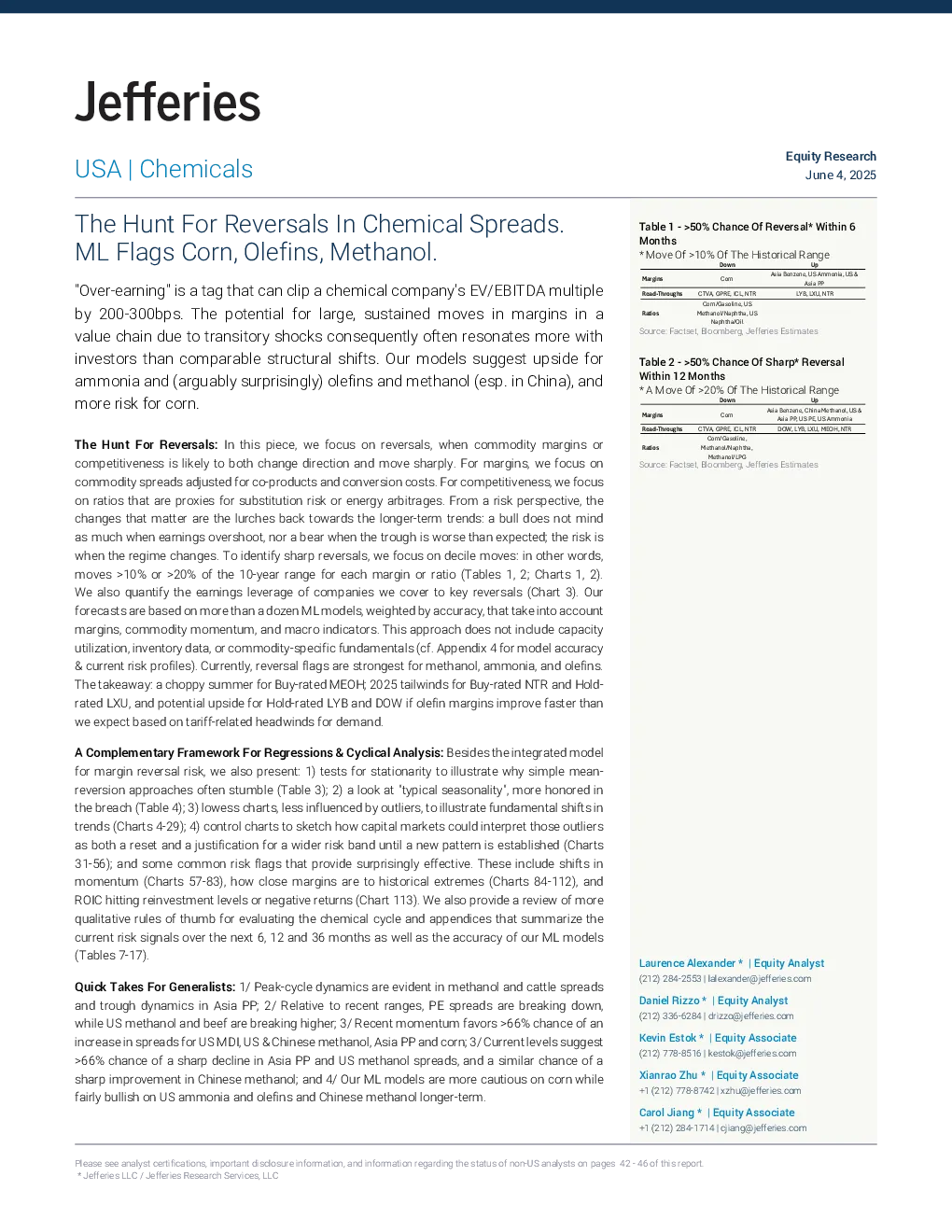
Laurence Alexander * | Equity Analyst(212) 284-2553 | lalexander@jefferies.comDaniel Rizzo * | Equity Analyst(212) 336-6284 | drizzo@jefferies.comKevin Estok * | Equity Associate(212) 778-8516 | kestok@jefferies.comXianrao Zhu * | Equity Associate+1 (212) 778-8742 | xzhu@jefferies.comCarol Jiang * | Equity Associate+1 (212) 284-1714 | cjiang@jefferies.com .The Hunt For Mean-Reversion•Mean reversion and over-earning are popular frameworks for analyzing chemicals.•The challenge, in our view, is that most of the key commodity margin spreads and ratios wetrack have failed to show reliable mean reversion over the past decade.•Each of the spreads presented include, where plausible, conversion costs and co-productcredits: in other words, a closer proxy of the sequential evolution of EBITDA at the plant level.•We show the results of three statistical tests. The time beta p-value test indicates a time seriesis mean-reversion if >=0.05. The augmented Dickey-Fuller (ADF) test aims to identify if there isa unit root for an autoregressive process: a value <0.05 implies mean-reversion is observable.The Hurst exponent, a related test, identifies mean reversion when it is <0.5, a random walk at0.5, and a trending series >0.5.•Mean reversion shows up in cases where energy arbitrages dominate: benzene-toluene;methanol-diesel and methanol-LPG; ethane frac spreads; and naphtha-oil.Please see important disclosure information on pages 42 - 46 of this report.This report is intended for Jefferies clients only. Unauthorized distribution is prohibited. •Forthe purposes of this report,we arefocusing on decile moves•We split the historical range for each marginspread into 10 bands•Ourmodels estimate the probability ofmargins jumping at least one or two bands•Weshow in the Appendices the impliedprobabilities across multiple time periods4 Table 3 - Mean-Reversion Tests.Source: Bloomberg, FactSet, JefferiesSeasonal Smoothed & Normalized•Another common approach is "typical seasonality". We present below the average shifts overthe past decade in the key margin spreads we track.•For most chemical companies, Q2 represents the largest volume quarter, followed by Q3. Wegenerally expect the first half of the year to represent 55%-65% of the year, depending on theregion and commodity.Please see important disclosure information on pages 42 - 46 of this report.This report is intended for Jefferies clients only. Unauthorized distribution is prohibited. Table 4 - Normalized Seasonal Smoothed Quarterly Margins/Ratios.Source: Bloomberg, FactSet, JefferiesLowess Illustrates The Trouble With Trends•The challenge for mean reversion strategies, or basic seasonality, is that most of the spreadsand ratios we track have shown significant shifts in trend over the past decade, reflecting somecombination of structural shifts in demand, dislocations in the relevant cost curve and periodsof aggressive investment by producers.•We prefer lowess smoothers to identify longer-term trends with less impact from outliers.Please see important disclosure information on pages 42 - 46 of this report.This report is intended for Jefferies clients only. Unauthorized distribution is prohibited. ...Please see important disclosure information on pages 42 - 46 of this report.This report is intended for Jefferies clients only. Unauthorized distribution is prohibited. ...Please see important disclosure information on pages 42 - 46 of this report.This report is intended for Jefferies clients only. Unauthorized distribution is prohibited. ...Please see important disclosure information on pages 42 - 46 of this report.This report is intended for Jefferies clients only. Unauthorized distribution is prohibited. ...Please see important disclosure information on pages 42 - 46 of this report.This report is intended for Jefferies clients only. Unauthorized distribution is prohibited. ..Key Arbitrages•Another framework that seems appropriate, where feasible, is to compare commodity pricesto levels warranted by regional arbitrages, fundamental energy arbitrages, or levels that triggerrestarting idle capacity or otherwise triggering substitution dynamics.•For benzene, for example, we show how the commodity price has been for the most partconstrained between a floor and ceiling model tied to toluene arbitrages, as well as a regressionmodel based on gasoline prices. We find this approach works more consistently than eitherinternational arbitrages or naphtha arbitrages that arguably have a better fundamental basis.•Regime shifts, of course, matter. The most significant failures of this approach were aroundthe financial crisis, the EU banking crisis, the US industrial recession and shale crash in themid-2010s, the COVID shock in early 2020 and the energy complex volatility following theinvasion of Ukraine.Please see important disclosure information on pages 42 - 46 of this report.This report is intended for Jefferies clients only. Unauthorized distribution is prohibited. Chart 30 - Benzene