AI智能总结
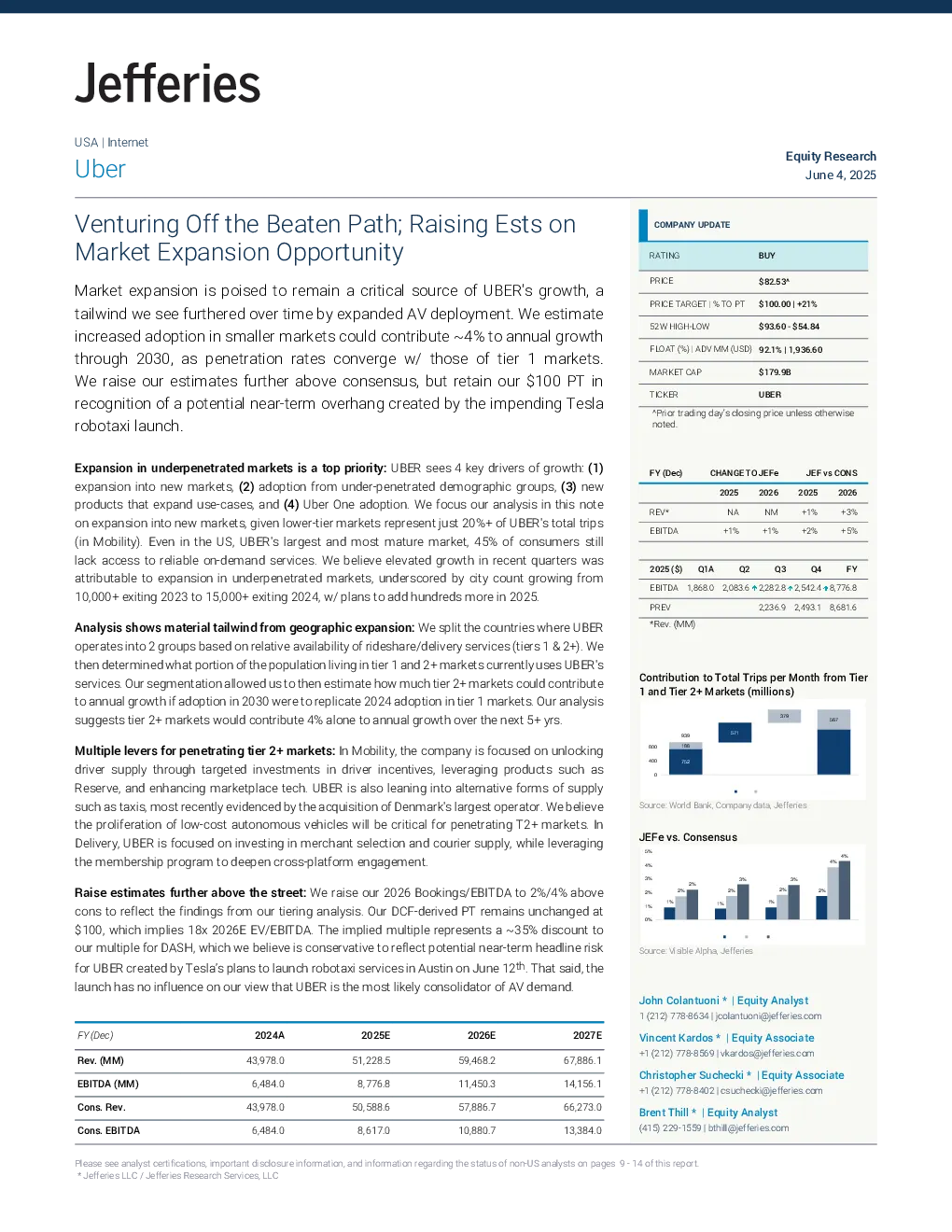
2024A2025E2026E2027E43,978.051,228.559,468.267,886.16,484.08,776.811,450.314,156.143,978.050,588.657,886.766,273.06,484.08,617.010,880.713,384.0. That said, the John Colantuoni * | Equity Analyst1 (212) 778-8634 | jcolantuoni@jefferies.comVincent Kardos * | Equity Associate+1 (212) 778-8569 | vkardos@jefferies.comChristopher Suchecki * | Equity Associate+1 (212) 778-8402 | csuchecki@jefferies.comBrent Thill * | Equity Analyst(415) 229-1559 | bthill@jefferies.com The Long View: UberInvestment Thesis / Where We DifferWe estimate UBER's core Rideshare/Restaurant Delivery businesses eachoperatein~$1 trillion addressable markets,which implies just~5%penetration and a long runway for growth. We believe UBER's dominant scaleand network effect support greater reinvestment into customer experience/adoption, which should spur frequency/stickiness and grow market shareover time. In addition, multiple product offerings (mobility, Eats, new verticals,freight,etc.),and geographic diversity expand UBER's TAM while alsodriving cross-sell opportunities and reducing macro risk. We also expect acontinuation of impressive EBITDA growth to improve confidence in long-termprofitability.Base Case,$100, +21%•Mobility Bookings CAGR of ~15% over the next3 years•Delivery Gross Bookings CAGR of ~15% over thenext 3 years•MAPCs CAGR of ~10% is exceeded by TripsCAGR of ~15% over the next 3 years as usagefrequency improves•Adjusted EBITDA CAGR of ~30% over the next3 years as margin expands beyond 5%+ ofBookings•DCF-derived PT of $100 implies ~18x '26E EV/EBITDA (plus $4/share in investments)Sustainability MattersTop Material Issue(s): 1) Customer Welfare.Addressing concerns about safety. This is a top issue forrideshare companies, whose users and employees rely on them to get them safely from point A to pointB. Users and employees are increasingly focused on the processes in place to ensure their safety.2) DataSecurity.Risks associated with the collection, use, retention, and disposal of confidential information.Internet companies, including UBER, have amassed large amounts of user data which could be used inharmful ways if exposed.Company Target(s): 1)Goal to have net-zero total climate emissions across scopes 1, 2 & 3 by 2040.2)Aims to have 100% of rides in the US, Canada, and Europe in battery EVs, micro-mobility, or throughpublic transit (sustainable rides) by 2030.Qs to Mgmt: 1)What processes does UBER have in place to ensure user and employee safety?2)Whatsteps is UBER taking to ensure data security and user privacy?3)What are UBER's short- and medium-term goals with regard to DE&I at the firm level?Link to Sector Note: ESG Sector Deep Dive: Internet Media & ServicesPlease see important disclosure information on pages 9 - 14 of this report.This report is intended for Jefferies clients only. Unauthorized distribution is prohibited. Upside Scenario,$150, +82%•Delivery growth accelerates as New Deliveryverticalsgaintractionpenetration expands•Mobility advertising contributes meaningfulprofit•Penetration improves across Mobility andDeliveryspaces and UBER takes additionalshare•Valuationimprovesdiversificationare realized and executionremains strong•DCF-derived PT of $150 implies ~25x '26E EV/EBITDA (plus $5/share in investments) Downside Scenario,$50, -39%•New products fail to drive sustainable Bookingsgrowth•Incremental margin contracts as UBER investsin lower-margin New Verticals and Growth bets•UBER loses share to direct competitors inMobility and/ or Delivery spaces•Regulation of the gig economy weighs onprofitability at the industry level•DCF-derived PT of $50 implies ~12x '26E EV/EBITDA (plus $2/share in investments)Catalysts•Earnings•Market share shifts•Geographic expansion•Macro developments•Gas and food prices•Regulatory developments•AV developments andmembershipasbenefitsof 2 Expansion in Smaller Markets Helps Support Growth; Raise Estimates:Market expansion is poisedto remain a critical source of UBER's growth, a tailwind we see furthered over time by expanded AVdeployment. We estimate increased adoption in smaller markets could contribute ~4% to annualgrowth through 2030, as penetration rates converge w/ those of tier 1 markets. We raise ourestimates further above consensus, but retain our $100 PT in recognition of a potential near-termoverhang created by the impending Tesla robotaxi launch.Expansion in underpenetrated markets is a top priority:UBER sees 4 key drivers of growth:(1)expansion into new markets,(2)adoption from under-penetrated demographic groups,(3)newproducts that expand use-cases, and(4)Uber One adoption. We focus our analysis in this note onexpansion into new markets, given lower-tier markets represent just 20%+ of UBER's total trips (inMobility). Even in the US, UBER's largest and most mature market, 45% of consumers still lack accessto reliable on-demand services. We believe elevated growth in recent quarters was attributable toexpansion in underpenetrated markets, underscored by city count growing f