与薛定谔公司炉边谈话的要点及对库拉、辛达克斯和努里克斯公司的启示
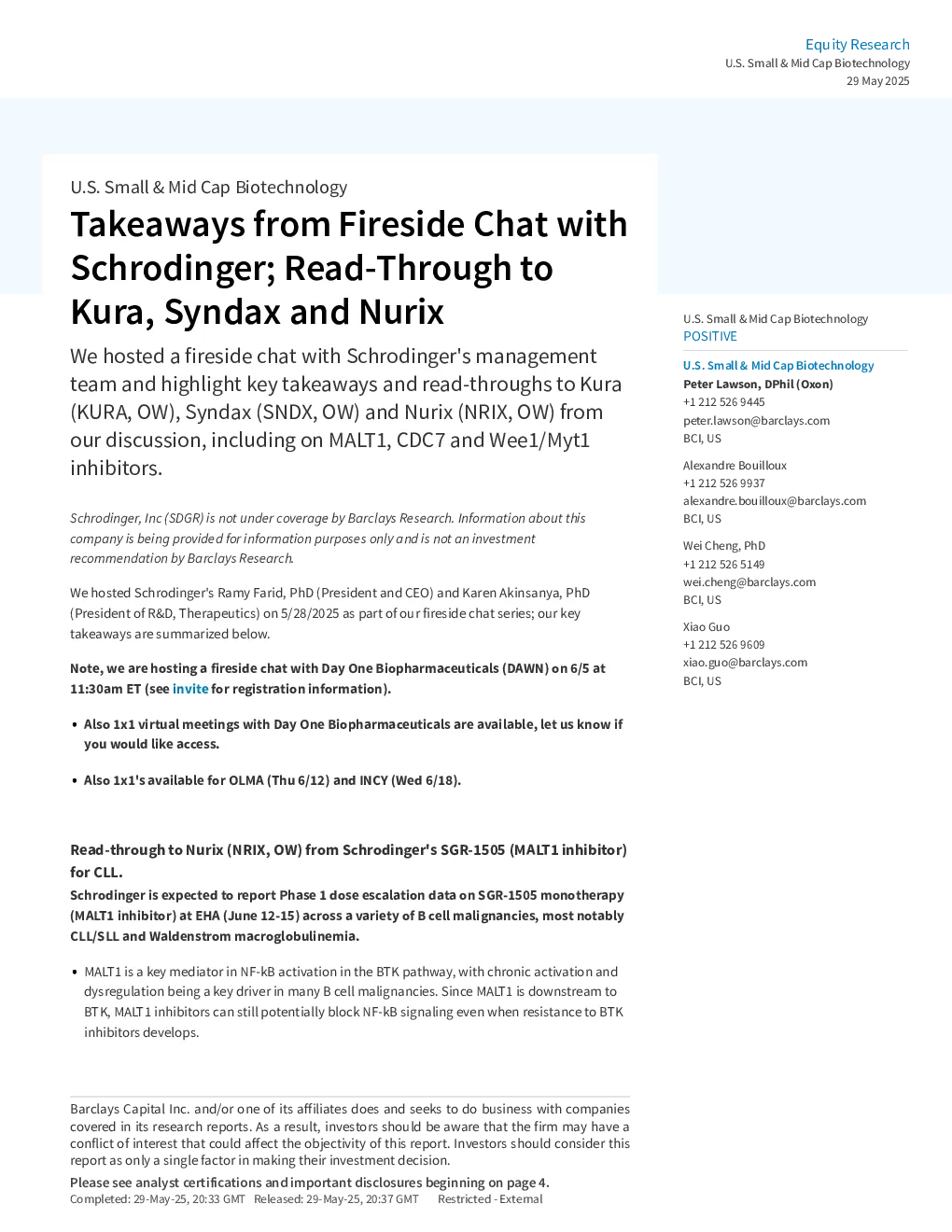
Restricted - External U.S. Small & Mid Cap BiotechnologyPOSITIVEU.S. Small & Mid Cap BiotechnologyPeter Lawson, DPhil (Oxon)+1 212 526 9445peter.lawson@barclays.comBCI, USAlexandre Bouilloux+1 212 526 9937alexandre.bouilloux@barclays.comBCI, USWei Cheng, PhD+1 212 526 5149wei.cheng@barclays.comBCI, USXiao Guo+1 212 526 9609xiao.guo@barclays.comBCI, US •At EHA, Schrodinger will present data on SGR-1505's safety, PK, PD and early clinical activity•across a range of doses.°Management noted a 90% IL-2 inhibition in all patients dosed twice a day with SGR-1505°and in >80% of patients who were dosed once a day, suggesting inhibition of the BTKpathway. Because NF-kB signaling directly promotes the expression of IL-2 (a key cytokinesupporting T cell proliferation and survival), IL-2 inhibition is a key PD marker.°Early signals of activity with responses were observed across a number of lymphoma°subtypes, including in CLL/SLL and Waldenstrom macroglobulinemia patients that hadfailed prior BTK and BCL2 inhibitors.°On safety, SGR-1505 appears to be well tolerated, with no DLTs, serious TRAEs and AE-°related deaths. Management noted that this contrasts with a prior MALT1 inhibitor fromJNJ which, despite encouraging signals of clinical activity, had an unfavorable safetyprofile with DLTs, including cardio-renal toxicities.°Management believes these AEs were compound-related rather than inherent to MALT1°inhibition, withinsufficientpotency potentially leading to a need for higher doses,ultimately leading to DLTs. Management highlighted that SGR-1505 has so far shown amore favorable safety profile due to greater selectivity for MALT1.°On expansion opportunity, management noted that autoimmune diseases will be an area°of interest, although initial focus remains on lymphoma.•Schrödinger has noted responses with SGR-1505 in CLL patients who have failed multiple BTK•inhibitors — which could act as a read-through to Nurix developing NX-2127, a BTK degraderaimed at BTK-refractory CLL.°Both programs are addressing post-BTK inhibitor patients, but through verydifferent°mechanisms: Nurix’s approach is BTK protein degradation, while Schrödinger is inhibitingthe MALT1 protease, a key component of the CBM signaling complex downstream of BCRactivation.°If SGR-1505 continues to show activity in heavily pre-treated CLL — with a clean safety°profile — it could represent a more combinable approach with existing BTK inhibitors. Thiswould raise the bar for Nurix, especially if Schrödinger pushes toward combinations withanti-CD20s or even BTK inhibitors themselves.°Main risk for Nurix — if SDG-1505 shows clean andeffectiveactivity in post-BTK CLL, it may°be seen as a complementary strategy to BTK inhibitors.Read-through to Kura (KURA, OW) and Syndax (SNDX, OW) from Schrodinger'sSGR-2921 (CDC7 inhibitor) for r/r AML.Schrodinger will report Phase 1 data in r/r AML and MDS in 2H25 for SGR-2921monotherapy.•Management noted encouraging preclinical PDX model data, which indicated that p53-•mutant AML (a historically challenging AML subtype with poor prognosis) responded to CDC7inhibitors. Additionally, management highlighted the ability of CDC7 inhibitors to re-sensitizeFLT3 and venetoclax-resistant AML, indicating the potential for CDC7 inhibitors in challengingAML subtypes. 2 •In addition to data on safety/tolerability and PK, management noted blast count reduction•data are likely to be included in the readout in 2H25.•Based on the preclinical package, management expects single agent activity.••If Schrodinger’s CDC7 inhibitor shows clinical activity in NPM1- and KMT2A-mutant AML, this•would directly overlap with the target populations for Kura’s and Syndax’s menin inhibitors.CDC7 is mutation-agnostic, so we will be watching for activity in menin-sensitive populationswhich would raise the bar.°However, menin inhibitors have demonstrated a favorable safety profile, with relatively°clean tolerability in monotherapy settings. This sets a high bar for Schrödinger — if theirCDC7 program brings toxicity, such as myelosuppression or replication stress-relatedcytopenias, it may be regulated to later-line or combo settings. That would reduce thethreat to the menin space.°Main risk for Kura and Syndax — if SGR-2911 showsefficacyin menin-sensitive AML subsets°with CDC7 inhibitors, it blurs the lines on mutation-specific targeting andshiftsthecompetitive lens toward tolerability and breadth.Lastly, Schrodinger highlighted their SGR-3515 (Wee1/Myt1 co-inhibitors)program.•Management noted this trial was only initiated in 2H24, and expects a more limited dataset to•be shared in 2H25, with data on safety, PK and PD endpoints. Management is uncertain at thistime whether data on response rates will be available by year end.•On the bar for success, management noted the goal would be to see evidence of engagement•of both Myt1 and Wee1 pathways, given the synthetic lethality between these two kinases. 3 Analyst(s) Certification(s):I, Peter Lawson, DPhil (Oxon),