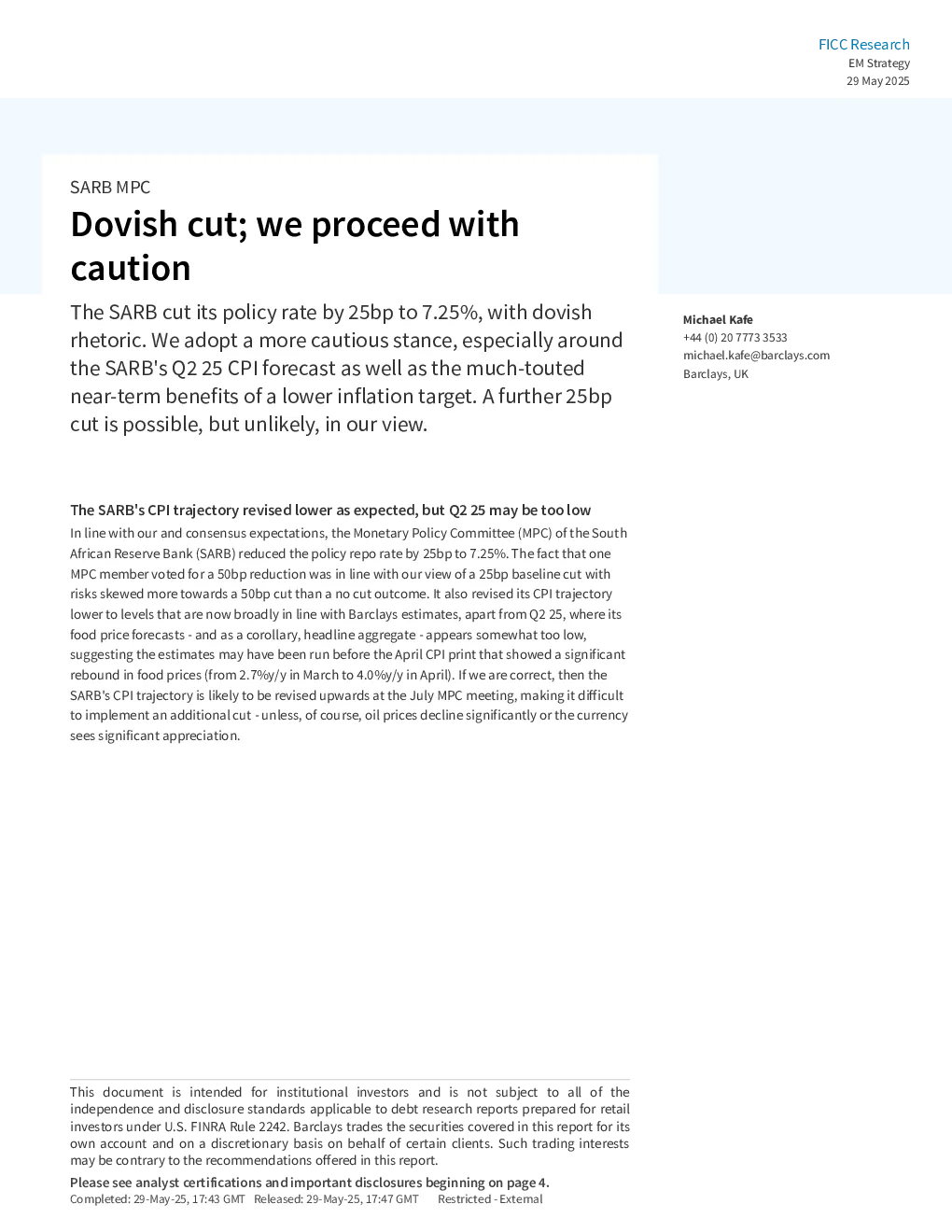
Restricted - External Michael Kafe+44 (0) 20 7773 3533michael.kafe@barclays.comBarclays, UK FIGURE 1. SARB revised forecasts broadly in line, but Q2 25 appears rather lowSource: Statistics South Africa, SARB, Barclays ResearchFIGURE 2. CPI to rebound in the months ahead, making it moredifficultto ease further3.23.22.72.82.72.93.43.53.64.14.24.44.43.53.43.13.03.13.13.33.43.53.63.63.83.8012345Jan-25Mar-25May-25Jul-25Sep-25Nov-25Jan-26Headline% y/yBarclays forecastsSource: Statistics South Africa, SARB, Barclays ResearchNo mention of food CPI risks - focus on the benefit of lower CPI targetImportantly, contrary to our expectation that the rhetoric of the statement would be driven by afocus on upside risks from the unexpected up-tick in food inflation that was captured in theApril CPI, we note that, for the second consecutive time this year, the MPC statementsurprisingly does not even mention food prices. Instead, the Committee chose to showcase thepotential benefits of targeting a lower inflation band: it provided details of a scenario with alower inflation target of 3%, and was at pains to stress that this would not only result in lowerinflation outcomes, but would also result in lower interest rates and higher growthoutcomes. This has created the expectation that the likely introduction of a lower target bandwould result in even lower policy rates in the coming months/quarters.We agree that a lower target would ultimately result in both lower inflation and interest rates,and a more favourable growth outcome. However, it is important to point out that this wouldonly happen in the medium to long term, and not in the near term. The scenario painted by the29 May 2025 2 SARB shows that, if the inflation target were currently at 3%, headline CPI would average 3% in2025, 3.1% in 2026 and 3% in 2027 - much lower than its baseline forecasts of 3.2%, 4.2% and4.4%, respectively.Caution warrantedThis is purely academic, however, as even if a new inflation target were introduced today:(a) it would take at least a year for inflation expectations to adjust to the new lower target - notweeks as suggested by the modelled scenario;(b) it would take at least a year or two for the fiscal authorities, government departments,regulators and other economic agents involved in setting administered and other prices toadjust their pricing behaviours;(c) while the model assumes that constituent sub-indices, including partly exogenously-drivencomponents, such as food and fuel, would decelerate below the baseline estimates from asearly as Q3 25, a more pragmatic approach would suggest otherwise, ie, a longer lag length;and(d) the model assumes an inflation target of 3%, presumably for simplicity sake; we believe thatgiven thedifficultiesassociated with targeting a point estimate – especially for a country suchas South Africa where the inflation basket is significantly susceptible to the vagaries of theweather, oil prices, currency shocks and food prices – an eventual target of say, 3%+/-1% oversome two to three years or so would be far more realistic.Effectively,this would imply a targetceiling of 4% and not 3%, with clear implications for adaptive inflation expectations - and as acorollary, terminal policy rates.On the whole, therefore, while we welcome the positive surprise from a more dovish rhetoricthan we had expected, we are careful not to get overly optimistic. This, combined with our viewthat Q2 25 CPI outcomes are likely to print above the SARB's expectations leads us to believethat further easing, while of course possible, is unlikely, in the months ahead.3 Analyst(s) Certification(s):I, Michael Kafe, hereby certify (1) that the views expressed in this research report accurately reflect my personal views about any or all of the subjectsecurities or issuers referred to in this research report and (2) no part of my compensation was, is or will be directly or indirectly related to the specificrecommendations or views expressed in this research report.Important Disclosures:Barclays Research is produced by the Investment Bank of Barclays Bank PLC and itsaffiliates(collectively and each individually, "Barclays").All authors contributing to this research report are Research Analysts unless otherwise indicated. The publication date at the top of the report reflectsthe local time where the report was produced and maydifferfrom the release date provided in GMT.Availability of Disclosures:For current important disclosures regarding any issuers which are the subject of this research report please refer to https://publicresearch.barclays.com or alternatively send a written request to: Barclays Research Compliance, 745 Seventh Avenue, 13th Floor, New York, NY10019 or call +1-212-526-1072.Barclays Capital Inc. and/or one of itsaffiliatesdoes and seeks to do business with companies covered in its research reports. As a result, investorsshould be aware that Barclays may have a conflict of interest that couldaffectthe objectivity of this rep