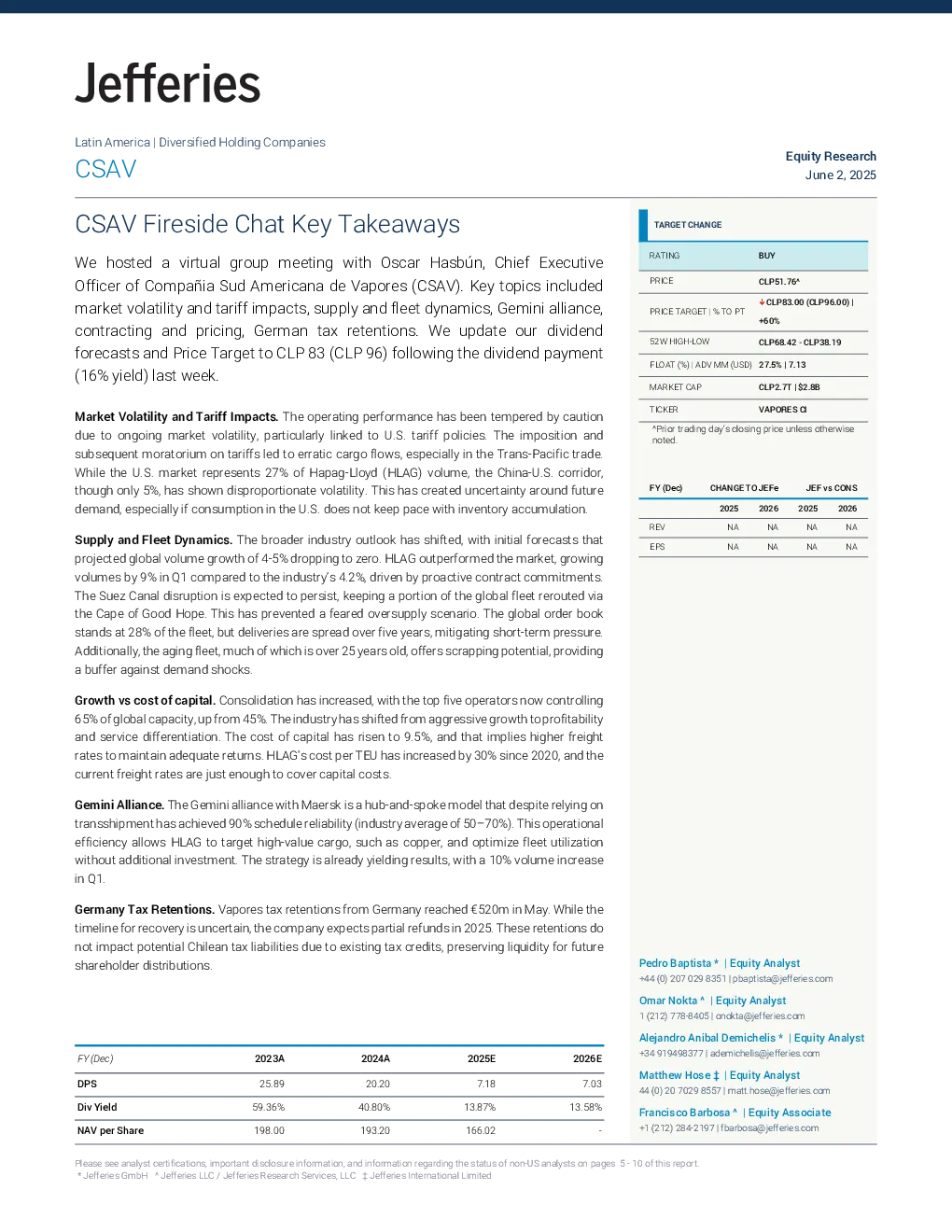
2024A20.2040.80%193.20 2025E2026E7.187.0313.87%13.58%166.02- Pedro Baptista * | Equity Analyst+44 (0) 207 029 8351 | pbaptista@jefferies.comOmar Nokta ^ | Equity Analyst1 (212) 778-8405 | onokta@jefferies.comAlejandro Anibal Demichelis * | Equity Analyst+34 919498377 | ademichelis@jefferies.comMatthew Hose ‡ | Equity Analyst44 (0) 20 7029 8557 | matt.hose@jefferies.comFrancisco Barbosa ^ | Equity Associate+1 (212) 284-2197 | fbarbosa@jefferies.com The Long View: CSAVInvestment Thesis / Where We Differ•CSAV currently trades at a 69% discount to market NAV. Our price targetassumes a 50% discount to NAV, with HLAG at target valuation (HLAG at€150/share).•Our Hold rating on HLAG is based on our cautious outlook for the containersector, given low freight rates, softer economic activity, and a large newvessel orderbook. We believe HLAG will continue to focus on its nichemarkets and enhance its offering with its ongoing investments in terminalcapacity.Base Case,CLP83, +60%•Price target based on 50% discount to NAV withHapag-Lloyd at our target valuation•Dividends to be gradually paid in as German taxauthorities release dividends received at CSAVGermany•Freight rates under pressure until 2026 on newsupply and weaker demandSustainability MattersCSAV is a single-asset holding company with a 30% shareholding in Hapag-Lloyd. ESG objectives andstrategies are driven at the subsidiary level and are specific to its own sectors. These are then consolidatedand reported in aggregated at the holding company level. CSAV sets a holistic sustainability agenda toensure that underlying operations are aligned with their values to generate the right ESG conditions. Theoverall agenda is built on a materiality analysis process identifying the ESG risks and opportunities relevantto the underlying subsidiaries and stakeholders, i.e., a process of understanding internal and externalfactors and the prioritization of relevant topics.Please see important disclosure information on pages 5 - 10 of this report.This report is intended for Jefferies clients only. Unauthorized distribution is prohibited. Upside Scenario,CLP120, +132%•Dividends flow from Germany paid over the next12 months•Holding discount narrows as a single assetholding company with no holding debt•Consumer demand surprises to the upside•Port congestion remains elevated over the nextseveral quarters•Liner freight rates maintain averages abovecosts Downside Scenario,CLP35, -32%•Shipping rates maintained at pre-Covid levels•Holding discount to NAV maintained at averagehistorical levels•Consumer demand remains weak for anextendedperiod,leading to a slower retailinventory unwind•Liner freight rates fall to below operating costsCatalysts•CSAV dividend flows•Simplification of group structure,potentialcascade structure collapse•Recovery in freight rates•Consumer demand outpaces supply•Upside in terminal projects•Geographic expansion 2 CSAV (Vapores) owns 30% of HLAG and is the firm’s largest shareholder, together with KühneMaritime. HLAG is one of the largest liner companies globally, with a market footprint across mostkey trade regions and a growing network of terminals worldwide. Vapores trades at a 68% discountto the market value of its 30% stake in Hapag-Lloyd. Quinenco owns 66% of CSAV, and its indirectstake in HLAG (c.20%) is currently worth its market cap, with all other assets trading mostly for 'free',in our view.Premium yield.CSAV announced dividends of US$116.5m (minimum dividend, 30% earnings) andEUR245m based on the dividend paid by HLAG, which were paid on 23 May, a 16% dividend yield.The company still has EUR520m tax withholdings in Germany to be recovered. HLAG paid a €8.20/share dividend, a 60% earnings payout.The new Gemini Cooperationbetween Maersk and Hapag-Lloyd started in February 2025 and, sincethe partnership became public in January 2024, both parties have been confident in their abilityto boost reliability. Gemini's hub-and-spoke model, in which large vessels carry cargo long-haul tohubs and then shuttle it to final port destinations, promises 90% reliability (versus ~70% industryhistory). Should it achieve 90% reliability, HLAG and Maersk would capture a significant competitiveadvantage in customer pricing while costs would be more advantaged as a result of higher utilization.Contracting and Pricing Strategy.Vapores has increased its share of contracted volumes to 55%,up from the typical 50%, to secure network utilization amid volatility. Contracts now include flexiblepricing mechanisms that track spot rates within defined ceilings and floors, offering stability for boththe company and its clients.Port terminals.The company’s terminal investment strategy has been primarily driven by securingaccess to key ports to ensure long-term competitiveness, enhancing service quality by controllinghub operations, especially critical under the Gemini model and investing in high-potential marketslike India, where HLAG co-owns the second-largest terminal infrastructur