您的浏览器禁用了JavaScript(一种计算机语言,用以实现您与网页的交互),请解除该禁用,或者联系我们。 [Payscale]:2024年同行趋势报告 - 发现报告

2024年同行趋势报告

文化传媒 2024-11-14 Payscale John
报告封面

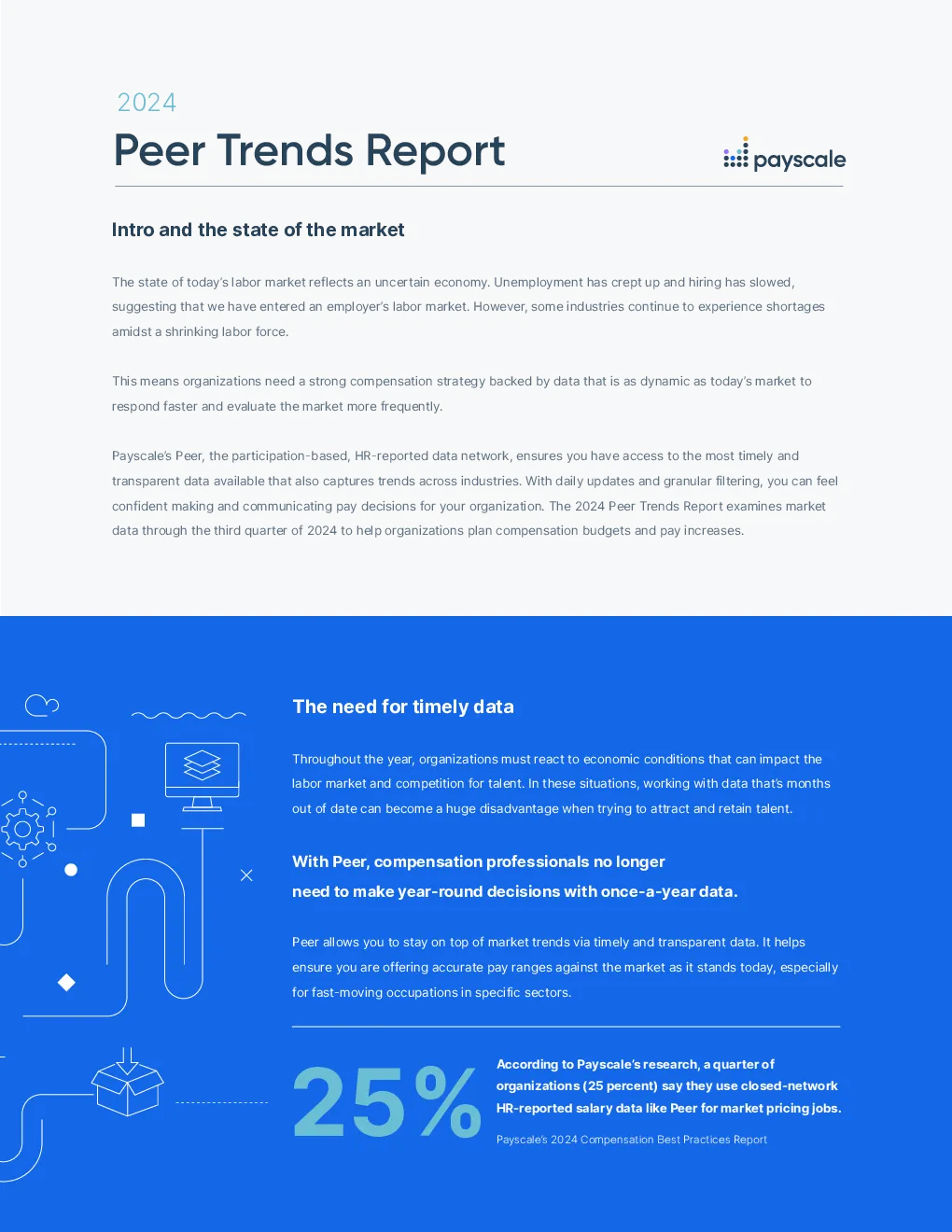
The need for timely dataThroughout the year, organizations must react to economic conditions that can impact thelabor market and competition for talent. In these situations, working with data that’s monthsout of date can become a huge disadvantage when trying to attract and retain talent.With Peer, compensation professionals no longerneed to make year-round decisions with once-a-year data.Peer allows you to stay on top of market trends via timely and transparent data. It helpsensure you are offering accurate pay ranges against the market as it stands today, especiallyfor fast-moving occupations in specific sectors.According to Payscale’s research, a quarter oforganizations (25 percent) say they use closed-networkHR-reported salary data like Peer for market pricing jobs.25%Payscale’s 2024 Compensation Best Practices Report Why Peer?15 organizations join the Peer networkeach week, on average5,100+ organizationschoose Peer to help themmake accurate and timely pay decisions8.6 million employees are represented“ Notable new organizations include:the American Nurses Association, CentennialBank, Vital Farms, Business Insider, and Alliance Health Services.Joe SwainCompensation & Benefits Senior Analyst, University of Notre Dame“Peer gives you real-time salary data updates andaccess to instant data changes, providing theflexibility and speed needed in an ever-changingworld. The model of annualized surveys is becomingmore and more outdated. With Peer, you don’t needto wait a year to see salary trends — it’s real-time.” Job openings,hires, separations,& unemploymentParticipation Rate2006200720082009201020112012201320142015201620172018201920202021HiresJob openingsLayoffsTotal separationsUnemployment rate15%12%9%6%3%0%200620072008200920102011201220132014201520162017201820192020202170%65%60%Labor Statistics (BLS)Labor Statistics (BLS)Labor force participationstill hasn’t recovered topre-pandemic levels, shrinking the pool of workersavailable to hire and increasing labor competition.The Consumer Price Indexshows that inflationhas decreased to almost 2 percent while wageshave continued to rise, albeit at slower rates thanbefore the Great Resignation.Layoffsare below pre-pandemic thresholds, but theuncertainty of the economy continues to threaten layoffs— especially in sectors impacted by high interest rates,which have started to decrease but only marginally.The Unemployment Ratehas increased to 4.1 percent,which is still not historically high but a sharp tick upfrom what it has been at any time since the COVID-19pandemic layoffs.Market indicators from the Bureau of Labor statistics (BLS)To demonstrate the strength of Peer as a timely and reliable data source, we first offer a broader look at labormarket conditions. Market indicators from the Bureau of Labor Statistics (BLS) show the unique labor challenges ofvarious industries where we should expect strong or stagnating wage growth. In turn, Peer trends corroborate thesefindings and confirm wage growth conditions throughout the labor market. Labor Force202220232024202220232024Source: Bureau ofSource: Bureau of 3 Key industry indicators: Peer trends with market metricsPayscale tracked the following trends in Peer to provide visibility into economic movement by industry. Peer delivers timelydata that helps you keep up with market trendsandrespond to changes because it’s updated daily as new informationbecomes available (after 90 days). The below analysis pairs Peer trends with market metrics from the Bureau of LaborStatistics to observe how the data tracks to broader economic conditions.When looking at broad macroeconomic trends according to data from the Job Openings and Labor Turnover Survey(JOLTS) by the Bureau of Labor Statistics, we find that theratio of hires to job openings is 0.8, suggesting that eventhough demand for talent is high, jobs are not being filled. Meanwhile,hires to separations is a ratio of 1, showing thatorganizations are barely able to hire at the same rate as turnover. Lastly,the ratio of quits to separations is 0.6, showingthat the majority of turnover(60 percent)is voluntary.Collectively, this suggests that it is still an employee’s labor market. However, there are nuances. While the hires to jobopenings ratio looks healthy, it isn’t in all sectors. In Technology, for example, the hires to job openings ratio drops to0.6, suggesting that either talent is much harder to find in this sector or that organizations are posting jobs but not hiringtalent. Reasons for this range from the impact of artificial intelligence on the job application and evaluation process touncertainty in economic conditions that are making employers hesitant to grow the labor force to employers receiving somany applications that they are being incredibly picky and slow to pull the trigger. Correspondingly, the Technology marketis seeing a lower quits to separations ratio (0.5), suggesting that talent is staying put in this sector. 4 Hospitality wage growth trends (Peer)T