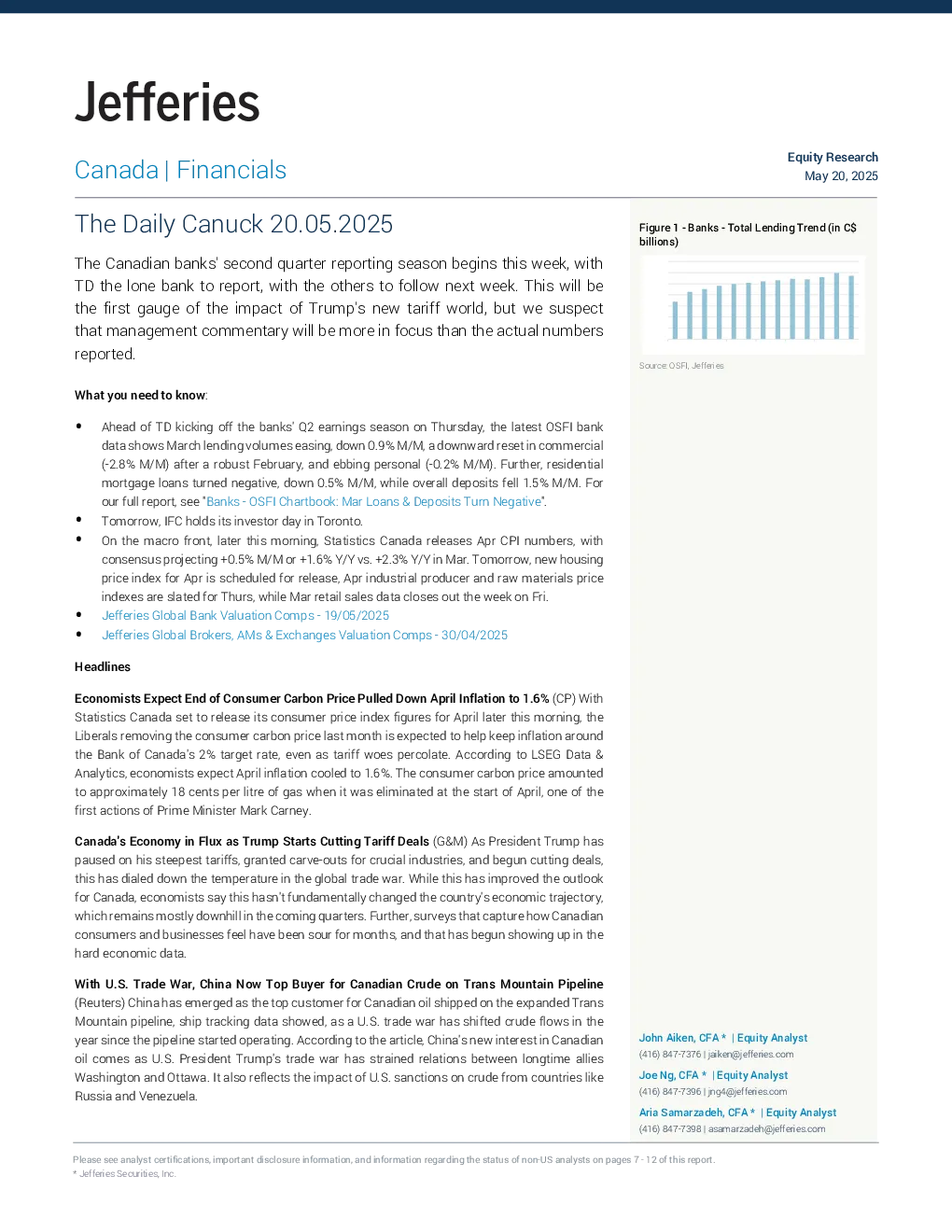
John Aiken, CFA * | Equity Analyst(416) 847-7376 | jaiken@jefferies.comJoe Ng, CFA * | Equity Analyst(416) 847-7396 | jng4@jefferies.comAria Samarzadeh, CFA * | Equity Analyst(416) 847-7398 | asamarzadeh@jefferies.comSource: OSFI, Jefferies Macroeconomic/GlobalEconomists Expect End of Consumer Carbon Price Pulled Down April Inflation to 1.6%(CP)Yesterday, the Canadian Press reported that with Statistics Canada set to release its consumerprice index figures for April later this morning, the Liberals removing the consumer carbon price lastmonth is expected to help keep inflation around the Bank of Canada's 2% target rate, even as tariffwoes percolate. According to LSEG Data & Analytics, economists expect April inflation cooled to1.6%. The consumer carbon price amounted to approximately 18 cents per litre of gas when it waseliminated at the start of April, one of the first actions of Prime Minister Mark Carney. The shockof removing the consumer carbon price is expected to drop headline inflation by 0.7 percentagepoints in April, according to calculations from the Bank of Canada’s latest monetary policy report.Further, the central bank expects the end of the carbon price will lower the overall inflation figuresby roughly that amount each month for the coming year, after which the removal of the levy willfall out of the annual comparison. That said, some economists caution that hopes that the cheapertransportation costs could feed through supply chains might fall flat, as any relief businesses gotfrom cheaper gas costs might end up "cancelled out" by trade uncertainty, as companies reorienttheir supply chains to steer away from the U.S. or absorb the hit from tariffs. Economists highlightthat the incoming data is "increasingly painting a picture of a slowing Canadian economy", whichleaves the door open for a 25 bps BoC rate cut in June.Canada's Economy in Flux as Trump Starts Cutting Tariff Deals(G&M) Last Friday, the Globe andMail highlighted that as President Trump has paused on his steepest tariffs, granted carve-outs forcrucial industries, and begun cutting deals, this has dialed down the temperature in the global tradewar. While this has improved the outlook for Canada, economists say this hasn't fundamentallychanged the country's economic trajectory, which remains mostly downhill in the coming quarters.The article notes that key Canadian industries still face high U.S. tariffs, businesses are pausingnew hiring and investment amid widespread uncertainty, and hard economic data in recent weeksshows tariffs are already starting to bite. Further, Canada is now just one of dozens of countriesjockeying for tariff relief from the White House. With the U.S. rushing to do deals with other countriesbefore the 90-day reprieve Mr. Trump announced in early April comes to an end, Canada may benear the back of the line. Although Canada has the exemption for products that meet USMCA tradeagreement, a carve-out that allows 80% to 90% of Canadian exports to continue to cross the bordertariff free, this doesn't change the fact that Canada's highly trade dependent economy is facing amajor shock, with potentially more tariffs on the horizon for lumber, copper, other critical minerals,and even movies. Further, surveys that capture how Canadian consumers and businesses feel havebeen sour for months, and that has begun showing up in the hard economic data, including risingunemployment, job losses in manufacturing industries, and falling manufacturing sales numbers.See also "Evidence Builds That Tariffs are Chewing into Canada's Economy", Financial Post, May16, 2025.With U.S. Trade War, China Now Top Buyer for Canadian Crude on Trans Mountain Pipeline(Reuters) On Friday, Reuters reported that China has emerged as the top customer for Canadianoil shipped on the expanded Trans Mountain pipeline, ship tracking data showed, as a U.S. tradewar has shifted crude flows in the year since the pipeline started operating. According to thearticle, China's new interest in Canadian oil comes as U.S. President Trump's trade war has strainedrelations between longtime allies Washington and Ottawa. It also reflects the impact of U.S.sanctions on crude from countries like Russia and Venezuela. Canada is the world's fourth-largestoil producer, but its main oil-producing province of Alberta is landlocked with limited access totidewater ports. That means the bulk of Canadian oil - about 4 million barrels per day or 90% - isexported to the U.S. via pipelines that run north-south. The C$34 billion Trans Mountain is Canada'sonly east-west oil pipeline, carrying oil to the Pacific Coast where it can be loaded onto tankers forexport. The expansion, which began operations on May 1, 2024, tripled the pipeline's capacity toPlease see important disclosure information on pages 7 - 12 of this report.This report is intended for Jefferies clients only. Unauthorized distribution is prohibited. 890,000 barrels per day and opened opportunities for Canadian oil along