您的浏览器禁用了JavaScript(一种计算机语言,用以实现您与网页的交互),请解除该禁用,或者联系我们。 [SolarPower]:插入式太阳能光伏 - 发现报告

插入式太阳能光伏

电气设备 2025-03-12 SolarPower 路仁假
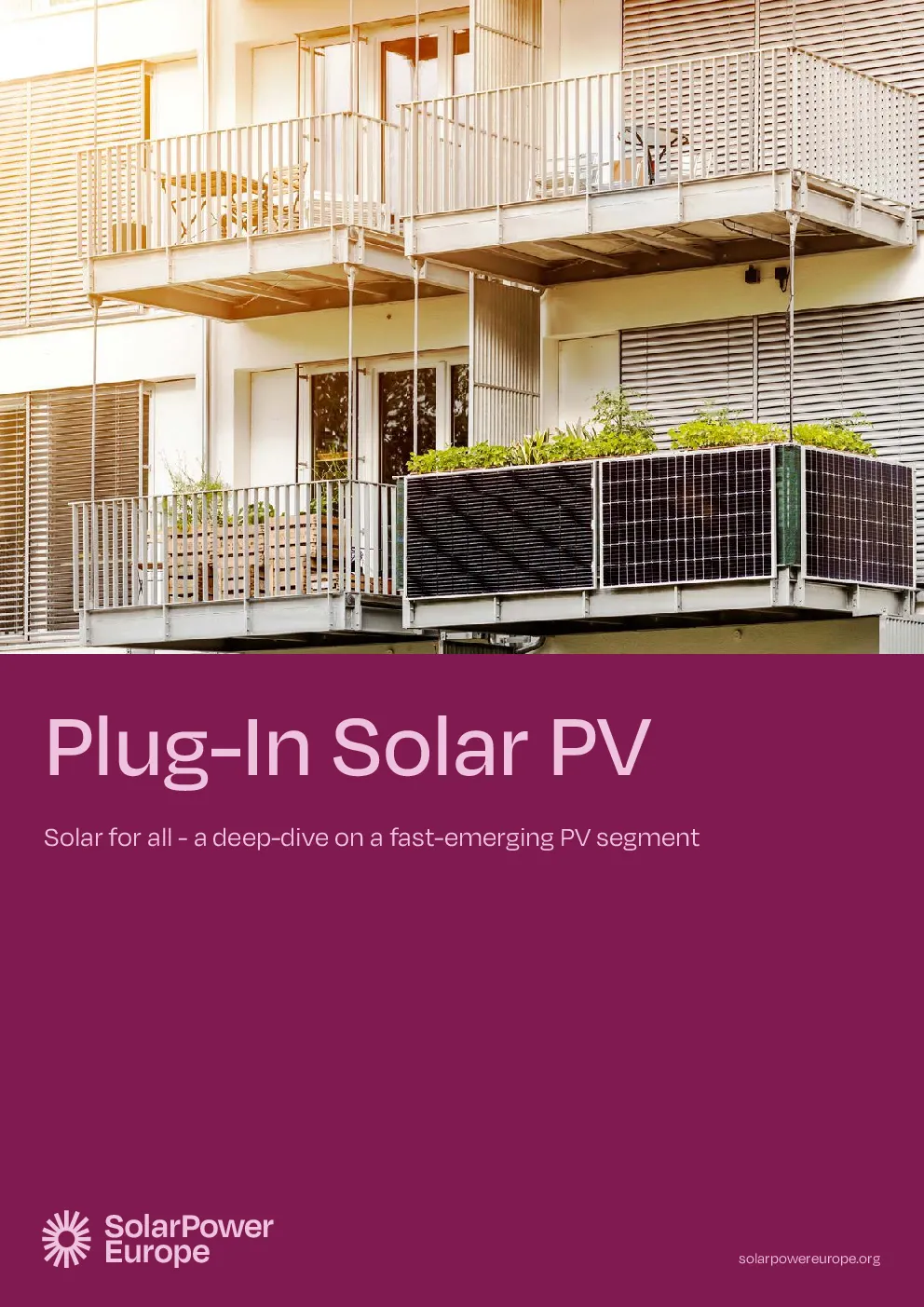
报告封面

To know more, visitwww.enphase.com.IQ Balcony Solar SystemA simple, powerful and easyto install plug-in solution. Table of ContentsExecutive Summary1.IntroductionWhat is plug-in solar PV?Modelling of a plug-in PV system2.Plug-in solar PV in EU marketsGermany – the birthplace of plug-in PVOther EU markets3.EU regulatory landscape for plug-in solarEU regulatory landscapeNational frameworks for plug-in solar1.For or against: From technology bans to financial incentives for deployment2.Administrative procedures3.Technical requirements and best practices4.Plug-in PV frameworks - ConclusionsSummary of regulations in place in EU Member StatesContents 35891520212425262727293135363Plug-In Solar PV SolarPower EuropeBriefing Paper4Project lead:Michael Schmela, SolarPower EuropeProject manager:Leah Le Pénuizic, SolarPower EuropeMarket intelligence and internal co-authors:Leah Le Pénuizic, Raffaele Rossi & Michael Schmela, SolarPower EuropePlease cite as:SolarPower Europe (2025):Plug-In Solar PVFor media use and queries:Adrien Rodrigues, SolarPower Europe.a.rodrigues@solarpowereurope.orgDate of publication:March 2025ISBN:9789464669251Contact:info@solarpowereurope.org.Design:Onehemisphere AB, Sweden. contact@onehemisphere.seCover image:© Mariana Serdynska/Shutterstock.comThanks to our Sponsor Members:Disclaimer:This report has been prepared by SolarPower Europe. It is being furnished to the recipients forgeneral information only. Nothing in it should be interpreted as an offer or recommendation of anyproducts, services or financial products. This report does not constitute technical, investment,legal, tax or any other advice. Recipients should consult with their own technical, financial, legal,tax or other advisors as needed. This report is based on sources believed to be accurate. However,SolarPower Europe does not warrant the accuracy or completeness of any information containedin this report. SolarPower Europe assumes no obligation to update any information containedherein. SolarPow¬er Europe will not be held liable for any direct or indirect damage incurred by theuse of the information provided and will not provide any indemnities. Unless otherwise stated, thecopyright and other intellectual property rights of market intelligence data and resources providedare owned by SolarPower Europe.SolarPower EuropeBriefing Paper 5Plug-In Solar PVPlug-in PV has emerged as anaffordable and easy-accesstechnology which has the potentialto democratise access to low-costsolar power across the EUPlug-in solar photovoltaic (PV) is a fast-growing and popular form of renewable energy generation.It has established itself quickly in the German market, and is increasingly present in other markets,such as the Netherlands or France. In 2025 it will be legalised in Belgium. The idea of plug-in PV isthis: by simply connecting 1-2 PV modules to the home circuit using a microinverter and a cablewith a standard plug, prosumers can install a small PV generation system by themselves, savingmoney and time. With recent significant module price decreases, plug-in PV has emerged as an affordable andeasy-access technology which has the potential to democratise access to low-cost solar poweracross the EU, expanding the market from property owners to tenants.This comes with its ownchallenges - while demand is significant and the market is growing rapidly, low-cost products areincreasingly present on this market, and product standards and regulations are only slowly beingdeveloped. In Germany alone, by the end of 2024, more than 780,000 plug-in solar systems wereofficially connected to the grid.Although the “real” number of systems on the market is difficult toestablish, some estimates see up to 4 million plug-in PV installations already connected to the gridin Germany alone, most of which are not registered, raising the issue of transparency and visibilityfor grid operators across the EU.This report is a “State of Play” market brief and policy overview of existing regulatory frameworksand best practices for plug-in solar PV across selected EU Member States. SolarPower Europe’smodelling in this report also shows that plug-in systems have limited interaction with the gridas most of the electricity generated is self-consumed, even in countries like Spain with veryfavourable irradiation-levels.The present research identifies an urgent need to develop strict standards against whichresponsible manufacturers can certify their products. Today’s technology, such as power controlsystems (PCS), can use software to limit all relevant parameters to levels deemed as safe byregulators and standardisation bodies. The industry will hopefully see such a first standarddeveloped by the German VDE in 2025.6ProsConcernsDemocratising the energy transition•Expanding the solar PV market:plug-in solar PVcan help reach more citizens, including tenantsand lower income households.•Easy access to solar:plug-in PV is designed tobe installed by the system owner, saving oncost and ti