您的浏览器禁用了JavaScript(一种计算机语言,用以实现您与网页的交互),请解除该禁用,或者联系我们。[Milliman]:CMS医疗补助和CHIP管理式医疗服务准入、财务和质量拟议规则制定的州指导支付考虑因素 - 发现报告

CMS医疗补助和CHIP管理式医疗服务准入、财务和质量拟议规则制定的州指导支付考虑因素

2023-05-12Milliman有***
AI智能总结
查看更多
CMS医疗补助和CHIP管理式医疗服务准入、财务和质量拟议规则制定的州指导支付考虑因素

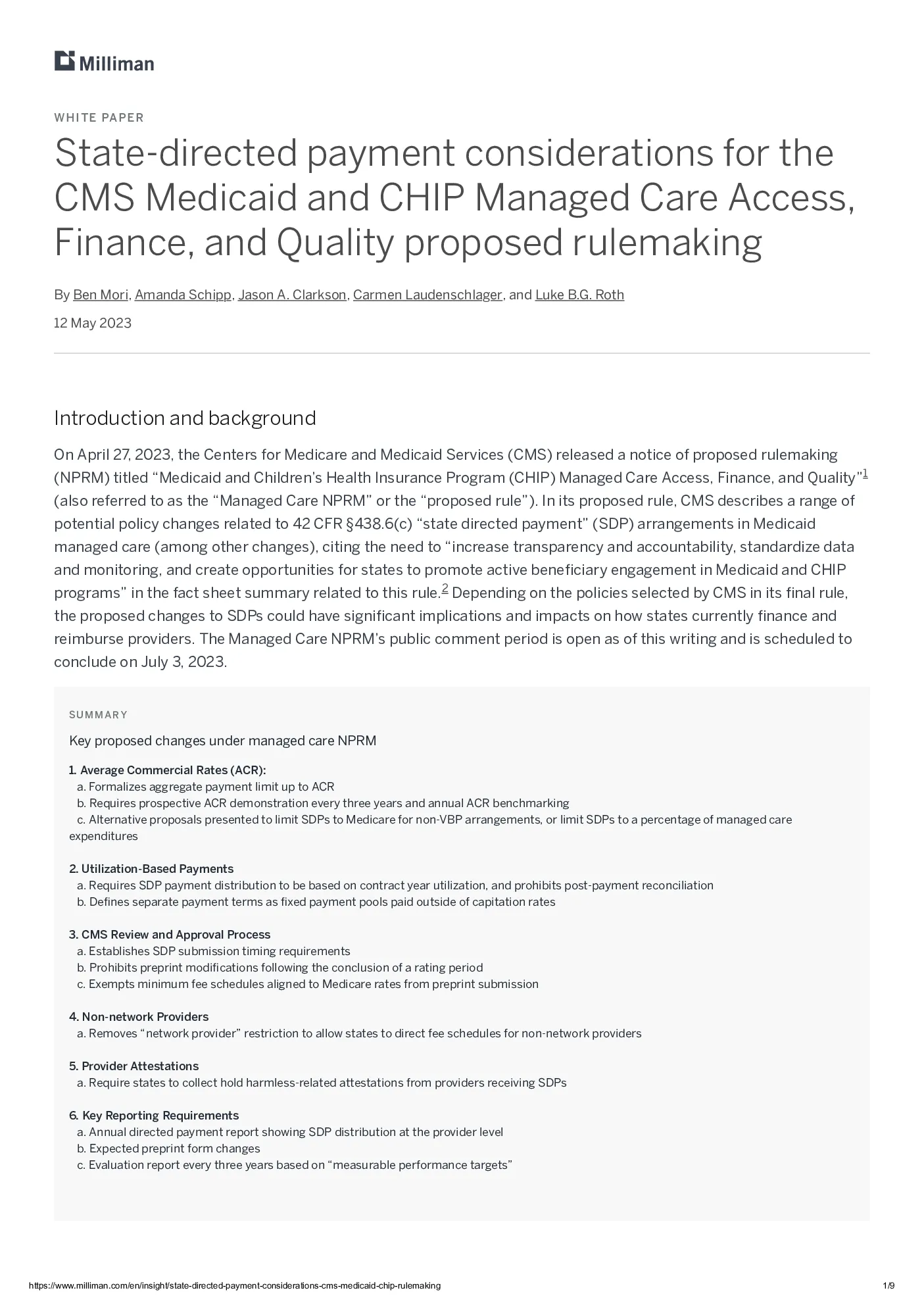
WHITE PAPER State-directed payment considerations for theCMS Medicaid and CHIP Managed Care Access,Finance, and Quality proposed rulemaking By Ben Mori,Amanda Schipp, Jason A. Clarkson,Carmen Laudenschlager, and Luke B.G. Roth 12 May 2023 Introduction and background On April 27, 2023, the Centers for Medicare and Medicaid Services (CMS) released a notice of proposed rulemaking(NPRM) titled “Medicaid and Children’s Health Insurance Program (CHIP) Managed Care Access, Finance, and Quality”(also referred to as the “Managed Care NPRM” or the “proposed rule”). In its proposed rule, CMS describes a range ofpotential policy changes related to 42 CFR §438.6(c) “state directed payment” (SDP) arrangements in Medicaidmanaged care (among other changes), citing the need to “increase transparency and accountability, standardize dataand monitoring, and create opportunities for states to promote active beneficiary engagement in Medicaid and CHIPprograms” in the fact sheet summary related to this rule.Depending on the policies selected by CMS in itsfinal rule,the proposed changes to SDPs could have significant implications and impacts on how states currentlyfinance andreimburse providers. The Managed Care NPRM’s public comment period is open as of this writing and is scheduled toconclude on July 3, 2023.12 SU M M A RY Key proposed changes under managed care NPRM 1.Average Commercial Rates (ACR): a.Formalizes aggregate payment limit up to ACRb.Requires prospective ACR demonstration every three years and annual ACR benchmarkingc.Alternative proposals presented to limit SDPs to Medicare for non-VBP arrangements, or limit SDPs to a percentage of managed careexpenditures 2.Utilization-Based Payments a.Requires SDP payment distribution to be based on contract year utilization, and prohibits post-payment reconciliationb.Defines separate payment terms asfixed payment pools paid outside of capitation rates 3.CMS Review and Approval Process a.Establishes SDP submission timing requirementsb.Prohibits preprint modifications following the conclusion of a rating periodc.Exempts minimum fee schedules aligned to Medicare rates from preprint submission 4.Non-network Providers a.Removes “network provider” restriction to allow states to direct fee schedules for non-network providers 5.Provider Attestations a.Require states to collect hold harmless-related attestations from providers receiving SDPs 6.Key Reporting Requirements a.Annual directed payment report showing SDP distribution at the provider levelb.Expected preprint form changesc.Evaluation report every three years based on “measurable performance targets” SDPs allow states to require managed care plans to make specified payments to healthcare providers when thepayments support overall Medicaid program goals and objectives.In addition, these arrangements provide apermissible mechanism for making supplemental payments to providers through managed care programs, as analternative to the legacy pass-through payments and “grey area” payments.Whereas pass-through and grey areapayments were often opaque and not clearly understood by all affected parties, SDPs enable state agencies to establishclear guidelines and direction for managed care plans and providers. These arrangements also allow states tocoordinate value-based purchasing (VBP) and other delivery system reform initiatives in managed care programs.34 This white paper contains a summary of key changes to SDPs under the proposed rule that may be impactful to stateMedicaid agencies. Given the substantial number of changes proposed by CMS, this paper is not a comprehensive list,but rather highlights key proposed changes for states’ consideration. If implemented, we anticipate many states will berequired to revise existing SDP program design and operations to achieve compliance with thefinal rule. Average commercial rate Payment ceiling: ACR vs. Medicare rate CMS is seeking comment on whether to set a payment ceiling for SDP at the average commercial rate (ACR) or whetherto align with Medicare rates, although the proposed rule expresses a preference for the former. The SDP proposal thatCMS expects to have the “most significant economic impact” is officially establishing an SDP aggregate “ceiling” basedon ACRs.This proposed ACR limit would be applicable to inpatient hospital services, outpatient hospital services,qualified practitioner services at academic medical centers, and nursing facility services. CMS does not propose toestablish an SDP ceiling for other services at this time (other than the requirement that SDPs be “reasonable,appropriate, and attainable”), citing the need for future research.5 This portion of the proposed rule, which would become effective in thefirst rating period following thefinal rule, isconsistent with CMS’s current operation procedures. CMS cited that it has approved 145 SDPs since 2017 for theseservice types(expenditures totaling $11.6 billion in 2022)where aggregate Medicaid managed