碳风险因素对股权动态的影响
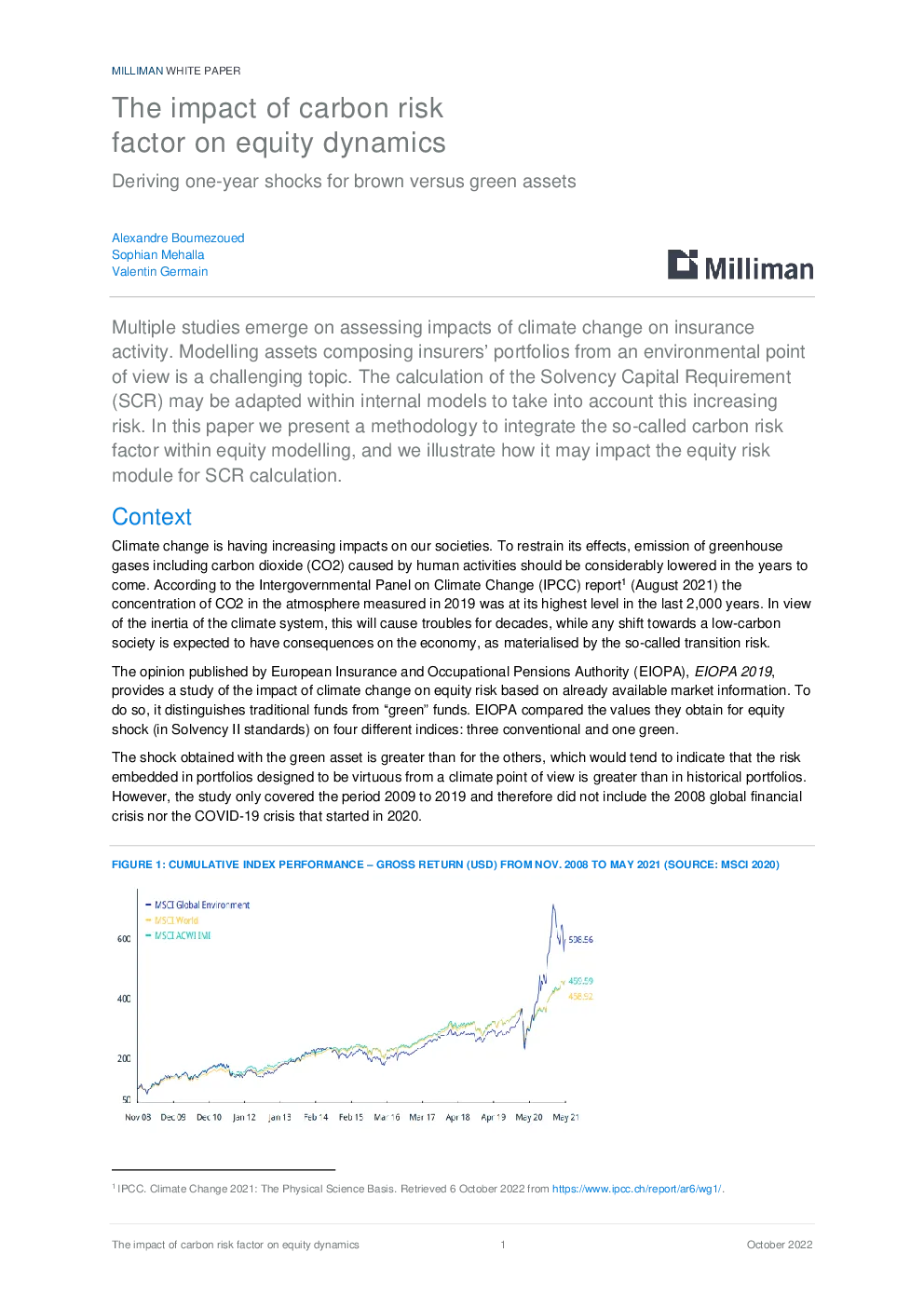
The impact of carbon riskfactor on equity dynamics Deriving one-year shocks for brown versus green assets Alexandre BoumezouedSophian MehallaValentin Germain Multiple studies emergeon assessingimpacts of climate change on insuranceactivity.Modelling assetscomposing insurers’portfolios fromanenvironmental pointof view is a challenging topic.The calculation of the Solvency Capital Requirement(SCR)may be adaptedwithininternal modelsto take into account this increasingrisk.In this paper we presenta methodologytointegratethe so-called carbon riskfactorwithin equity modelling,and we illustrate how itmay impacttheequity riskmodulefor SCR calculation. Context Climate changeis havingincreasingimpactson oursocieties.To restrain itseffects, emission of greenhousegases including carbon dioxide (CO2)caused by human activitiesshould be considerably loweredin the years tocome.According to theIntergovernmental Panel on Climate Change (IPCC)report1(August 2021)theconcentration of CO2 in the atmospheremeasuredin 2019was at its highest level in the last 2,000 years.In viewof the inertia of the climate system, this will causetroublesfor decades,while any shift towards a low-carbonsociety is expected to have consequences on the economy, asmaterialisedby the so-called transition risk. The opinion published byEuropean Insurance and Occupational Pensions Authority (EIOPA),EIOPA2019,providesa studyof the impact of climate changeon equity riskbased on already available market information.Todo so,itdistinguishestraditionalfundsfrom “green”funds. EIOPAcomparedthe valuesthey obtain forequityshock(inSolvency IIstandards)onfourdifferentindices:three conventional and one green. The shock obtainedwiththe green asset is greater than for the others,which would tend to indicatethat the riskembedded in portfoliosdesigned to be virtuous from a climate point of view isgreaterthan inhistoricalportfolios.However, the study onlycoveredtheperiod2009 to 2019 and thereforedidnot include the 2008globalfinancialcrisis northe COVID-19 crisis that started in 2020. When reproducingEIOPA’s study,based onMSCI’s indices,over a largerperiodof2008to2021,some newlessons can be learned.The cumulative performancesofthe MSCI World, theMSCIACWI IMIandtheMSCIGlobalEnvironmentare in line withEIOPA'sconclusionsover the 2008-2019period(Figure1):the three indicesappear to be highlycorrelated over thisperiodwith the green index(MSCI Global Environment)underperformingthe conventional indices. However, theseconclusionscanbequestionedin subsequent years. Indeed, fromthe COVID-19 crisis, there is acleardivergencebetweentheconventional and thegreen indices. In 2020, the annual performance of the greenindexwas+96%as opposed tothe+17%returnfor the MSCI World. Whilestandardassetshave fallenfollowing the first wave oflockdowns,with then a reasonablerecovery,greenassets have risen unprecedentedly—studies suggest thatequitiesassociatedwithcompanieshavinghighenvironmental, social andcorporategovernance (ESG)scoreshavebeen considered as more robustbyinvestorsjustafterthe structuralmarket crash of end-February 2020.The fasterrising of green indiceshascreateda market opportunityde factothat hasamplified the rise of green indices.Standard indicesrose againwith a certain delay thatcould be explained by two main causes: Aforced halt in demand has led to a halt in supply and hasthusdrastically reducedneedfortransport andtravel, thus impacting carbon-emittingsectorsThegeneral decline in consumption has impacted many companies’manufacturingproducts Tosomeextent,theCOVID-19crisiscan beseen asan occurrence of some form of transition risk, evenifephemeral. Ifitspreciseoriginisstill a subject of debate, the consequences were that a substantial part ofcarbon-issuing sectors were stopped.Therefore, this crisishas partlymaterialisedexperience ofhowthefutureinternational economycould function withregular stresseson energy supply(plannedorendured). Theseobservationsled us toconsideran approachto better differentiate equity shocks by sector, as it is expectedthatassets forthose sectors that are more exposed tothecarbon economy would be riskier thanthe othersfrom theperspective of climate transition risk,capturing a shift towardsa low-carbon economy.To do so,weapplyamethodologythat allowsusto identify a specificcarbon riskfactor in historical assetreturns.Henceforth, one is ableto calculatedifferentiated one-yearshock values by sector of activitysubject to carbonrisk factor, and toanalysethesensitivity of each sector to a stress on the volatility parameter of the carbon risk factor. Using this method,aninsurance or reinsurance companywouldbe able to: 1.Use the carbonriskexposure coefficients to understand the sensitivity oftheportfolioexposurebysectorunder climate transition risk scenarios2.Leverage the model to reflectincentives (ordisincentives) on investments within green (orbrown)sectorsin the framework ofstrategic asset allocation3.Use thesector-specificshock valuesand model a capi