团体医疗保险优势情况说明书
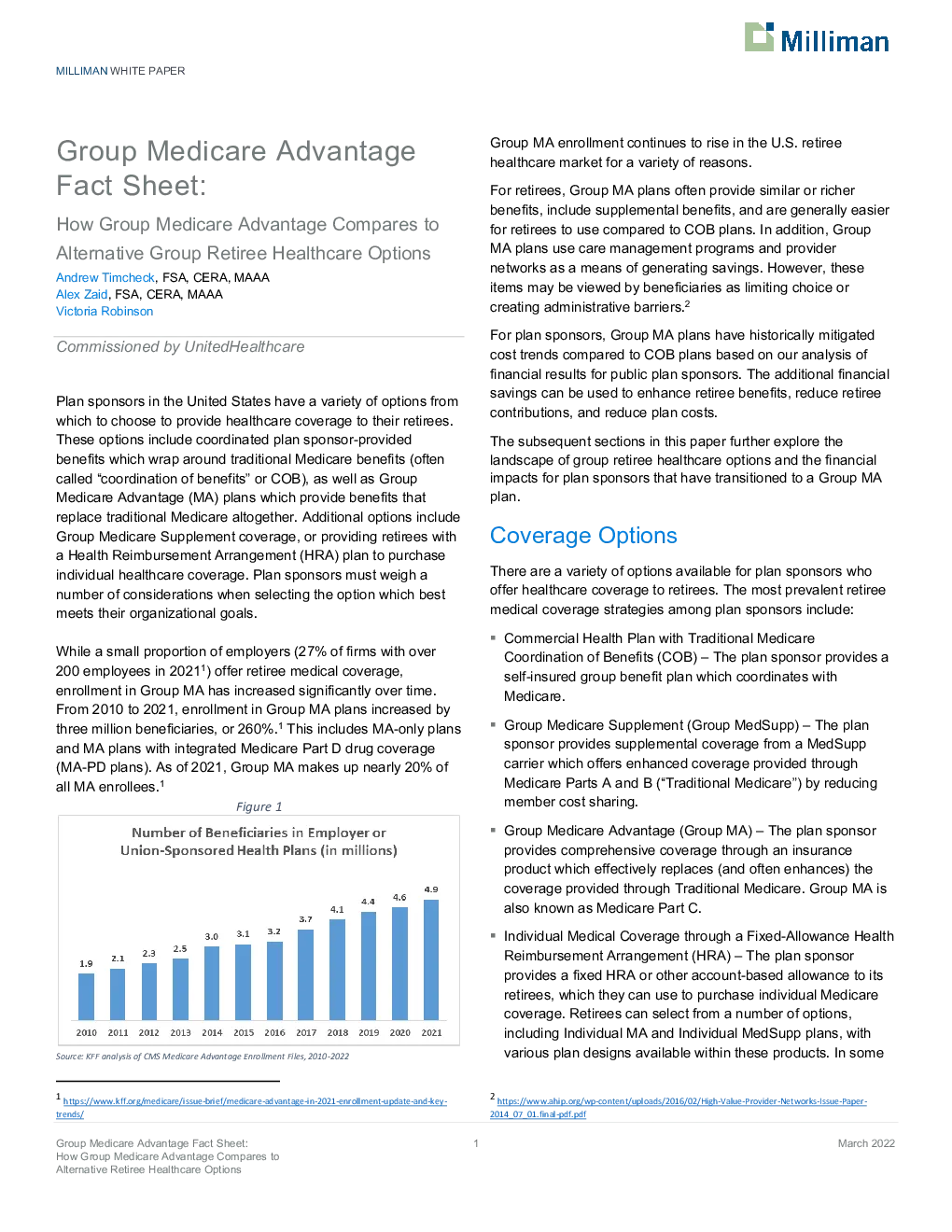
Group MA enrollment continues to rise in the U.S. retireehealthcare market for a variety of reasons. Group Medicare AdvantageFact Sheet: For retirees, Group MA plans often provide similar or richerbenefits, include supplemental benefits, and are generally easierfor retirees to use compared to COB plans. In addition, GroupMA plans use care management programs and providernetworks as a means of generating savings. However, theseitems may be viewed by beneficiaries as limiting choice orcreating administrative barriers.2 How Group Medicare Advantage Compares toAlternative Group Retiree Healthcare Options Andrew Timcheck, FSA, CERA, MAAAAlex Zaid, FSA, CERA, MAAAVictoria Robinson For plan sponsors, Group MA plans have historically mitigatedcost trends compared to COB plans based on our analysis offinancial results for public plan sponsors. The additional financialsavings can be used to enhance retiree benefits, reduce retireecontributions, and reduce plan costs. Commissioned by UnitedHealthcare Plan sponsors in the United States have a variety of options fromwhich to choose to provide healthcare coverage to their retirees.These options include coordinated plan sponsor-providedbenefits which wrap around traditional Medicare benefits (oftencalled “coordination of benefits” or COB), as well as GroupMedicare Advantage (MA) plans which provide benefits thatreplace traditional Medicare altogether. Additional options includeGroup Medicare Supplement coverage, or providing retirees witha Health Reimbursement Arrangement (HRA) plan to purchaseindividual healthcare coverage. Plan sponsors must weigh anumber of considerations when selecting the option which bestmeets their organizational goals. The subsequent sections in this paper further explore thelandscape of group retiree healthcare options and the financialimpacts for plan sponsors that have transitioned to a Group MAplan. Coverage Options There are a variety of options available for plan sponsors whooffer healthcare coverage to retirees. The most prevalent retireemedical coverage strategies among plan sponsors include: Commercial Health Plan with Traditional MedicareCoordination of Benefits (COB) – The plan sponsor provides aself-insured group benefit plan which coordinates withMedicare. While a small proportion of employers (27% of firms with over200 employees in 20211) offer retiree medical coverage,enrollment in Group MA has increased significantly over time.From 2010 to 2021, enrollment in Group MA plans increased bythree million beneficiaries, or 260%.1This includes MA-only plansand MA plans with integrated Medicare Part D drug coverage(MA-PD plans). As of 2021, Group MA makes up nearly 20% ofall MA enrollees.1 Group Medicare Supplement (Group MedSupp) – The plansponsor provides supplemental coverage from a MedSuppcarrier which offers enhanced coverage provided throughMedicare Parts A and B (“Traditional Medicare”) by reducingmember cost sharing. Group Medicare Advantage (Group MA) – The plan sponsorprovides comprehensive coverage through an insuranceproduct which effectively replaces (and often enhances) thecoverage provided through Traditional Medicare. Group MA isalso known as Medicare Part C. Individual Medical Coverage through a Fixed-Allowance HealthReimbursement Arrangement (HRA) – The plan sponsorprovides a fixed HRA or other account-based allowance to itsretirees, which they can use to purchase individual Medicarecoverage. Retirees can select from a number of options,including Individual MA and Individual MedSupp plans, withvarious plan designs available within these products. In some cases, plan sponsors will also provide retirees with access to aprivate retiree health exchange to assist retirees in navigatingbenefit offerings in the Medicare marketplace. Finally, retireescan use the account to fund expenses not covered byTraditional Medicare. member cost sharing and/or more robust supplemental benefitcoverage, whereas a lean plan design will generally have highermember cost sharing and fewer additional covered benefits. Plan sponsors have significant control over the “richness” of thebenefits they offer to their retirees. Since plan sponsors are notrequired to offer health plans to their retirees in the U.S., thoseoffering Group MedSupp, Group MA, and Traditional COB plansare typically doing so for other reasons, such as collectivebargaining requirements, historical practice, or to attract andretain employees in a competitive industry. There can besignificant differences in benefit plan design among these plansponsors, but the retiree medical coverage provided throughthese products typically includes richer benefits than thoseavailable in individual plans. These medical coverage options can then be paired with variouspharmacy coverage options, including: Self-Insured Group Plan – The plan sponsor provides a self-insured group benefit plan for prescription drug coverage.Federal subsidies are often provided to the plan sponsor