您的浏览器禁用了JavaScript(一种计算机语言,用以实现您与网页的交互),请解除该禁用,或者联系我们。[国际能源署]:2025年光伏故障情况说明书 - 发现报告

2025年光伏故障情况说明书

AI智能总结
查看更多
2025年光伏故障情况说明书

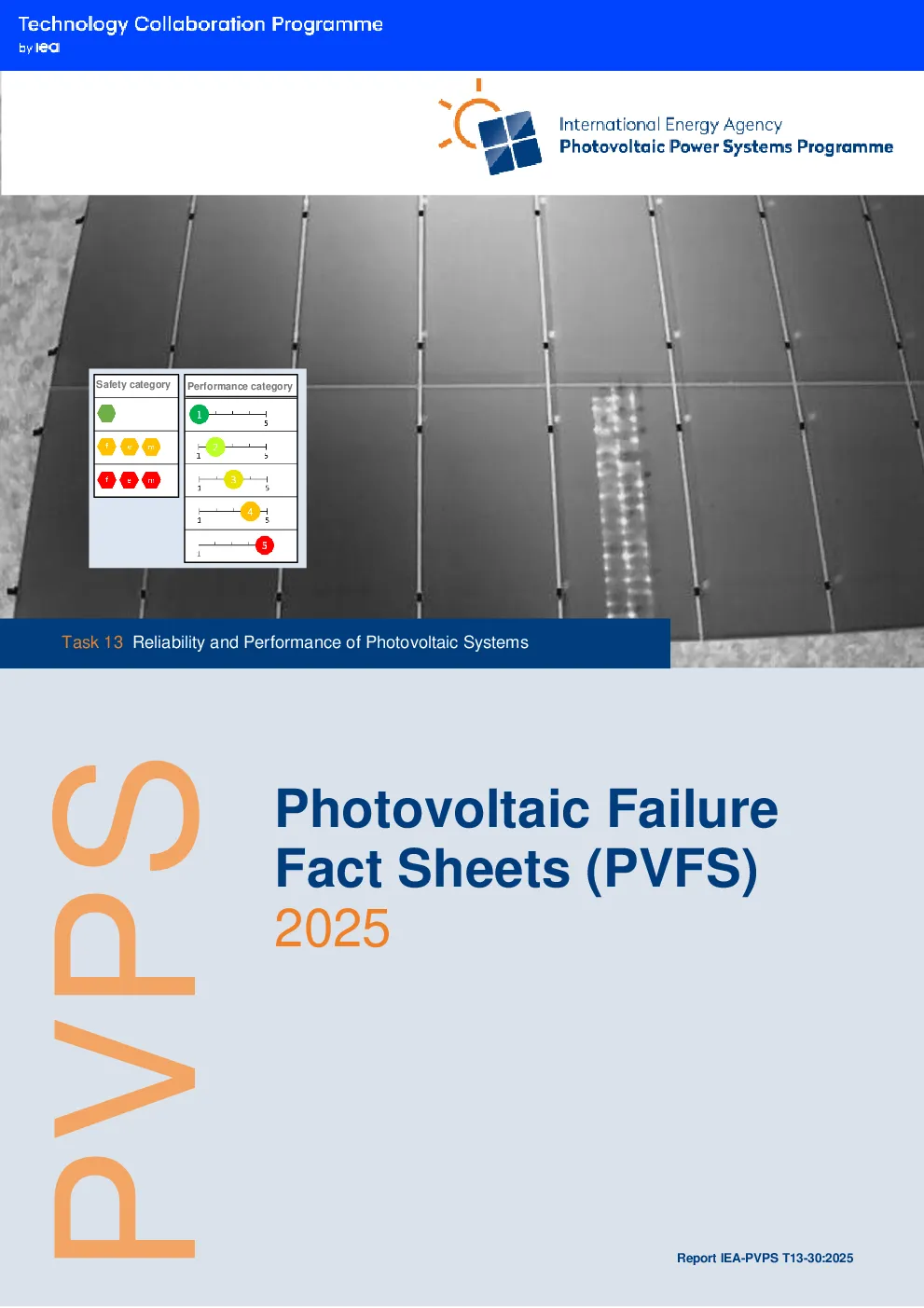
PhotovoltaicFailureFact Sheets (PVFS)2025 What is IEA PVPS TCP? The International Energy Agency (IEA), founded in 1974, is an autonomous body within the framework of the Organization for EconomicCooperation and Development (OECD). The Technology Collaboration Programme (TCP) was created with a belief that the future of energysecurity and sustainability starts with global collaboration. The programme is made up of 6.000 experts across government, ac ademia, andindustry dedicated to advancing common research and the application of specific energy technologies. The IEA Photovoltaic Power Systems Programme (IEA PVPS) is one of the TCP’s within the IEA and was established in 1993. The missionof the programme is to “enhance the international collaborative efforts which facilitate the role of photovoltaic solar energy as a cornerstonein the transition to sustainable energy systems.” In order to achieve this, the Programme’s participants have undertaken a variety of jointresearch projects in PV power systems applications. The overall programme is headed by an Executive Committee, comprised of one dele-gate from each country or organisation member, which designates distinct ‘Tasks,’ that may be research projects or activity areas. The IEA PVPS participating countries are Australia, Austria, Belgium, Canada, China, Denmark, Finland, France, Germany,India,Israel, Italy, Japan, Korea, Malaysia, Morocco, the Netherlands, Norway, Portugal, South Africa, Spain, Sweden, Switzerland, Thailand,Türkiye, and the United States of America. The European Commission, Solar Energy Research Institute of Singapore and Solar PowerEurope are also members. Visit us at: www.iea-pvps.org What is IEA PVPS Task 13? Within the framework of IEA PVPS, Task 13 aims to provide support to market actors working to improve the operation, the reliability and thequality of PV components and systems. Operational data from PV systems in different climate zones compiled within the project will helpprovide the basis for estimates of the current situation regarding PV reliability and performance. The general setting of Task 13 provides a common platform to summarize and report on technical aspects affecting the quality,performance,reliability and lifetime of PV systems in a wide variety of environments and applications. By working together acrossnational boundaries wecan all take advantage of research and experience from each member country and combine and integrate this knowledge into valuablesummaries of best practices and methods for ensuring PV systems perform at their optimum and continueto provide competitive return oninvestment. Task 13 has so far managed to create the right framework for the calculations of various parameters that can give an indication of the qualityof PV components and systems. The framework is now there and can be used by the industry who has expressed appreciation towards theresults included in the high-quality reports. The IEA PVPS countries participating in Task 13 areAustralia, Austria, Belgium, Canada, Chile, China, Denmark,Finland, France, Germany,Israel, Italy, Japan, the Netherlands, Norway, Spain, Sweden, Switzerland, Thailand, the United States of America, and the Solar EnergyResearch Institute of Singapore. DISCLAIMER TheIEAPVPSTCPisorganisedundertheauspicesoftheInternationalEnergyAgency(IEA)butisfunctionallyandlegallyautonomous. Views, findings and publica-tions of the IEA PVPS TCP do not necessarily represent the views or policies of the IEA Secretariat or its individualmembercountries. COVERPICTURE Infrared image of an energised module string at night. One module has a not connected bypass diode. Thanks to photovoltaikbuero Ternus & Diehl GbR for thepermission to use the image. ISBN978-3-907281-71-0:Task 13Report: PV Failure Fact Sheets(PVFS)–Review 2025 AUTHORS MainContributors to PVFSReview2025Gabi Friesen,SUPSI,SwitzerlandMarc Köntges, ISFH, GermanyJay Lin, PV GuiderGernot Oreski, PCCL, AustriaGabriele C. Eder, OFI, AustriaPeter Hacke, NREL, USAPaul Gebhardt, Fraunhofer ISE, GermanyEbra Özkalay, SUPSI, SwitzerlandChristof Bucher, BFH,SwitzerlandMauro Caccivio, SUPSI,SwitzerlandRomain Couderc, CEA, FranceSergiu Viorel Spataru, DTU, Denmark Editors Gabi Friesen,SUPSI,SwitzerlandJay Lin, PV GuiderUlrike Jahn,Fraunhofer CSP, Germany Acknowledgements..................................................................................................5Introduction........................................................................................................61.1PVFS structure.........................................................................................61.2Example PVFS: Front delamination..........................................................91.3List of PVFS...........................................................................................12References.............................................................................................................13ANNEX (PV FAIL