气候变化风险压力和情景测试
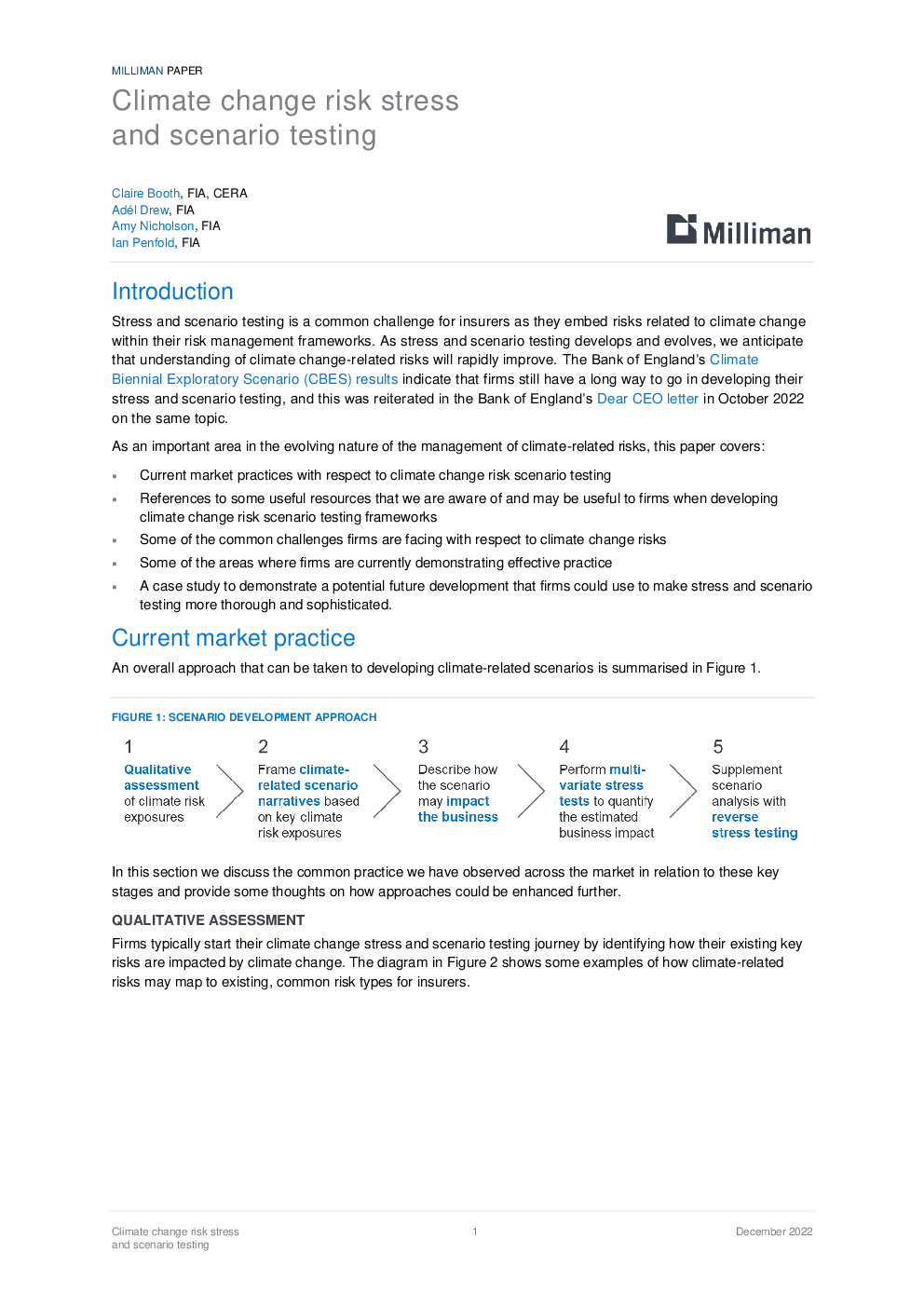
MILLIMANPAPER Climatechangeriskstressandscenario testing Claire Booth, FIA, CERAAdél Drew, FIAAmy Nicholson, FIAIan Penfold, FIA Introduction Stress and scenario testingis a common challenge for insurers as they embedrisks related toclimate changewithintheir risk managementframeworks. As stress and scenario testing develops and evolves, we anticipatethat understanding of climate change-related risks will rapidly improve.TheBank of England’sClimateBiennial Exploratory Scenario(CBES) resultsindicate that firms still have a long way to go in developing theirstress and scenario testing, and this was reiterated in the Bank of England’sDear CEO letterin October 2022on the same topic. s an important area in the evolving nature of the management of climate-related risks, this papercovers Current market practiceswith respect to climate change risk scenario testingReferences tosomeuseful resourcesthat we are aware of and may be useful to firms when developingclimate change risk scenario testing frameworksSomeof thecommon challengesfirms are facing with respect to climate change risksSome of the areas where firms are currently demonstrating effective practiceA casestudy to demonstrateapotentialfuture developmentthatfirms coulduseto makestress and scenariotestingmore thoroughand sophisticated. Currentmarketpractice Anoverall approachthat can be takento developing climate-related scenariosissummarisedin Figure 1. In this section we discuss thecommon practice we have observed across the market in relation to thesekeystages and provide some thoughts on how approaches could be enhanced further. QUALITATIVE ASSESSMENT Firms typically start their climate changestress and scenario testing journey by identifying how their existing keyrisks are impacted by climate change. The diagramin Figure 2shows some examples of how climate-relatedrisks may map to existing, common risk types for insurers. Firms canconsider each of the differentrisktypes in more depth.Forexample, forunderwriting riskit would beuseful for firms toconsider the key root causes and drivers of claims and premiums across multipletimehorizonsand across physical, transition and liability risks.This will vary depending on the type of insurance contractsoffered.Extreme weather events and changingclimateconditionsimpact the frequency and severity of claims,whilegovernment policy responses,customer operational policy responses(e.g.,changes to business travelpoliciesfor employees)andshiftsin customerdemandmayimpact premiums andclaimsfrom a transition riskpoint of view.As part ofthe 2021 UN Climate Change Conference (COP26),ClimateWiseproduced areportwhichexamined several tools that aimed to assist insurersinaligningtheir underwriting portfolios withNetZeroby 2050targets. An underwriting risk assessmenttool, which Milliman assisted to develop, was selected byClimateWise as one ofitscase studies. The tool was designed to helpnon-lifeinsurersconsider the key rootcausesand drivers mentioned above,tohelp themunderstand the impact ofclimate change on their underwritingportfolioand tosupport decision making in areas such asrisk appetite and product development. Initially firms have been focussing on their most material exposures—for example,carbon-intensive assetexposures forlifeinsurers,andlines of businessand geographical areasthat are most impacted by extremeweather eventsforgeneralinsurers—butit is also importanttoconsiderless “obvious” risk exposures such as thepotentialimpactofacute physical riskonhealth and life insurance liabilities in the future.Another keyconsiderationforinsurersis developingmultivariatescenarios,becauseclimate risk driverscanhave wide-ranging implicationsacross the business and give rise to interactions between assets and liabilities.Currentcommonly used market practice is to performstress tests onspecific risk exposures in isolation,which couldlimitaninsurer’sability to understand thewide-ranginginterdependencies ofitsclimate risk exposures. DEVELOPINGSCENARIO NARRATIVESAND DESCRIBING THE BUSINESS IMPACT Onceallmaterialclimate-related risk exposureshave beenidentified, firms shouldframe climate-related scenarionarratives based oneach material risk exposure.Acommonly used frameworkfora number of regulatorsis theNetwork for Greening the Financial System(NGFS)scenarios.For example, the CBES exercise was based onasubset of the NGFS scenarioscovering varioustimelines totransitionto Net Zeroby2050. The full set of NGFS scenarios coverssixdifferentscenarios: Netzero2050: Orderly transitionby around 2050,which limitswarming to 1.5°C. Low physical risk,moderate transition risk.Below 2°C: Orderly transition,which has a 67% chance of limiting warming to 2°C, with net zero achievedafter 2070. Moderate physical andlowtransition risk.Divergentnetzero:Disorderly transition,which limits warming to 1.5°Cby 2050. Low physical risk, hightransition risk.Delayedtransition: Disorderly transitionstarting in 2030,which has a 67% chance of limiting