您的浏览器禁用了JavaScript(一种计算机语言,用以实现您与网页的交互),请解除该禁用,或者联系我们。 [EFPIA]:小市场中创新药物不可用和延迟的根本原因 - 发现报告

小市场中创新药物不可用和延迟的根本原因

2025-05-14 EFPIA 叶剑锋
报告封面

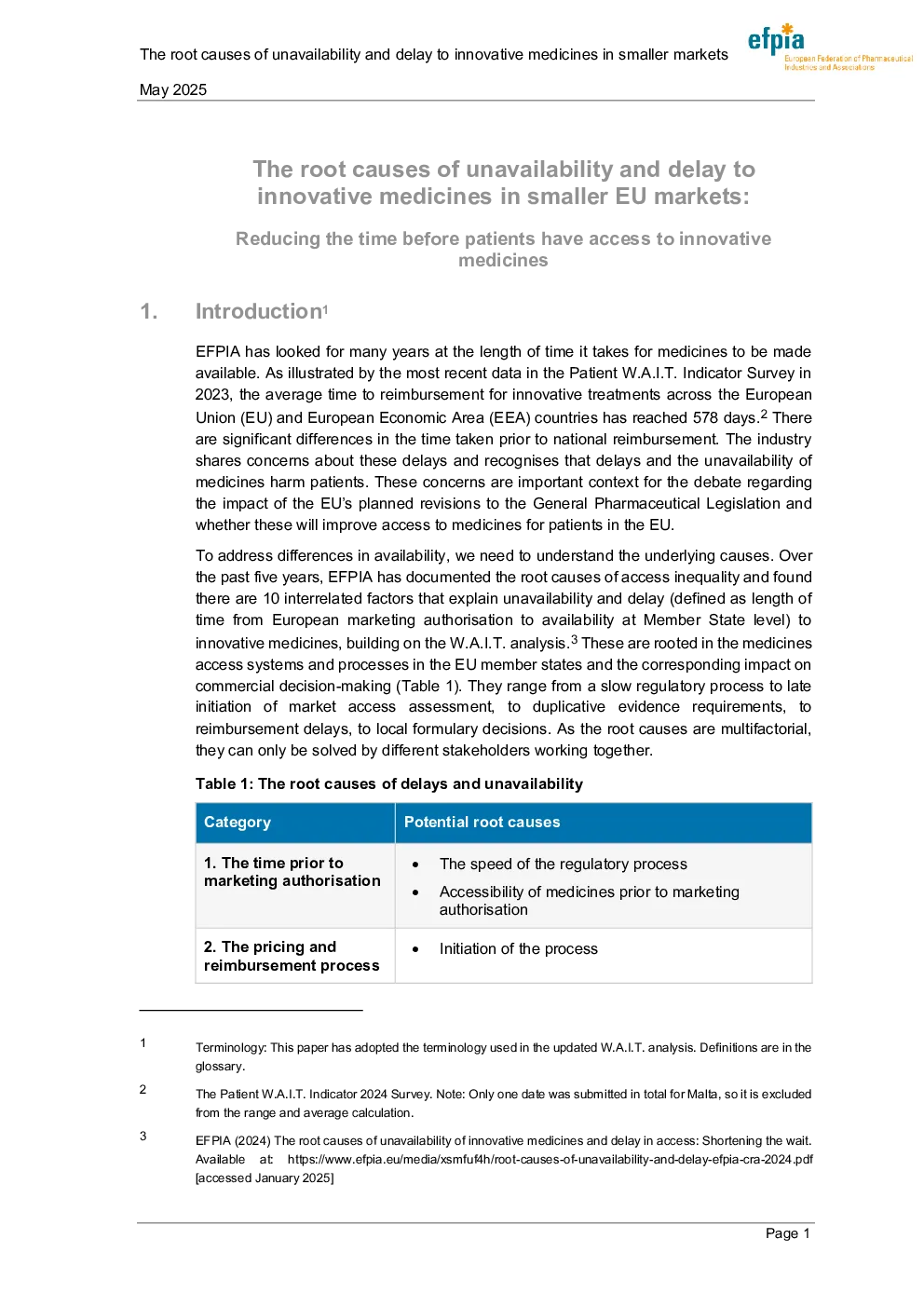
The root causesof unavailability and delay toinnovative medicinesin smallerEUmarkets: Reducing the time before patients have accessto innovativemedicines 1.Introduction1 EFPIA haslookedfor many years at the length of time it takes for medicines to be madeavailable. As illustrated by the most recent data in the Patient W.A.I.T. Indicator Survey in2023, the average time to reimbursement for innovative treatments acrossthe EuropeanUnion (EU)and European Economic Area (EEA) countries has reached578days.2Thereare significant differences in the time taken prior to national reimbursement. The industryshares concerns about these delays and recognises that delays and the unavailability ofmedicines harm patients. These concerns are important context for thedebate regardingthe impact oftheEU’splanned revisions to theGeneral Pharmaceutical Legislation andwhether thesewill improve access to medicines for patients in the EU. To address differences in availability,we need to understand the underlying causes. Overthe past five years, EFPIA has documented the root causesof access inequality and foundthere are 10 interrelated factors that explain unavailability and delay (defined as length oftime from European marketing authorisation to availability at Member State level) toinnovative medicines, building on the W.A.I.T. analysis.3These are rooted in the medicinesaccess systems and processes in the EU member states and the corresponding impact oncommercial decision-making(Table1). They range from a slow regulatory process to lateinitiationofmarketaccessassessment,toduplicativeevidencerequirements,toreimbursement delays,tolocal formulary decisions. As the root causes are multifactorial,they can only be solved by different stakeholders working together. Terminology: This paper has adopted the terminology used in the updated W.A.I.T. analysis. Definitions are in theglossary. The Patient W.A.I.T. Indicator 2024 Survey. Note: Only one date was submitted in total for Malta, so it is excludedfrom the range and average calculation. EFPIA(2024) The root causes of unavailability of innovative medicines and delay in access: Shortening the wait.Availableat:https://www.efpia.eu/media/xsmfuf4h/root-causes-of-unavailability-and-delay-efpia-cra-2024.pdf[accessedJanuary 2025] Even with thesignificantfocusgiven toreducing access inequalitiesby the industry andpolicymakers, there has been little progress in improving availability, with the samesmallercountries reporting low rates year on year.Europeancountries share many of the sameissues–or example, the regulatory process is jointly undertaken for those in the EU–butthere is a concern that smaller markets have additional or specific challenges in addition tothosepreviously describedin the existing Root Causesstudies.4This reportcomplementsthe Root Causespaper and considerswhetherthere are issues specific to the smallermarkets that have not been previously documentedandwhethertargeted solutions arerequired. 2.Evidence on unavailability and delaysin smaller markets To investigate this,we chose to focus onsevenEU countries (whichsharethe sameEUregulatory process):Croatia,Cyprus,Estonia,Latvia,Lithuania,Malta,and Slovenia; andtwo non-EU countries (includedto examine the impact oflocal regulatoryprocesses insmaller markets):MontenegroandNorth Macedonia.5Theserepresenta range of smallermarkets,all with availabilityof innovative medicinesbelow the median in Europeandwithpopulation sizes below4 million people. However, from the outset it is important torecognisethatalthough they may have commonalities,there are also significant differencesand each country is unique: for example, the populationsizevaries from3.9 millionin Croatiato 560,000in Malta,6andGDP per capitavariesfrom €37,400 in Malta to €8,000inNorth Macedonia.7 Whilehere areannual fluctuations in the data onavailability and delay in these markets,the overall picture has not changedsubstantiallysince 2019.Comparingresults ontheproportionof recent approvalsby the European Medicines Agency (EMA)8that areavailable in each countryshows us that there are significantlydifferent rates of availabilityacross smaller countries(Figure2), withSloveniademonstrating the highest rates,largelyin line with the EU average, and Malta and North Macedonia consistently showing thelowestrates.Manycountriesexhibitfluctuationsinavailabilityovertime;however,availabilityhasgenerallyimprovedover timein countries such asLatvia and Cyprus.9 Common acrossmost of thesmaller markets is that there areclear delays in availability(Figure3).Comparing trends inrates of availability versus time to availabilityshows thatthere are somecommonalities(Slovenia and Croatiagenerallyscore higher on both metricsthantheother smaller markets) but also some outliers (for example, North Macedonia hasone of the poorest rates of availability, but medicines that are available have beenreimbursed relatively quickly). 3.What are theadditionalfactors that could explainunavailability and