影响印度的行动方式
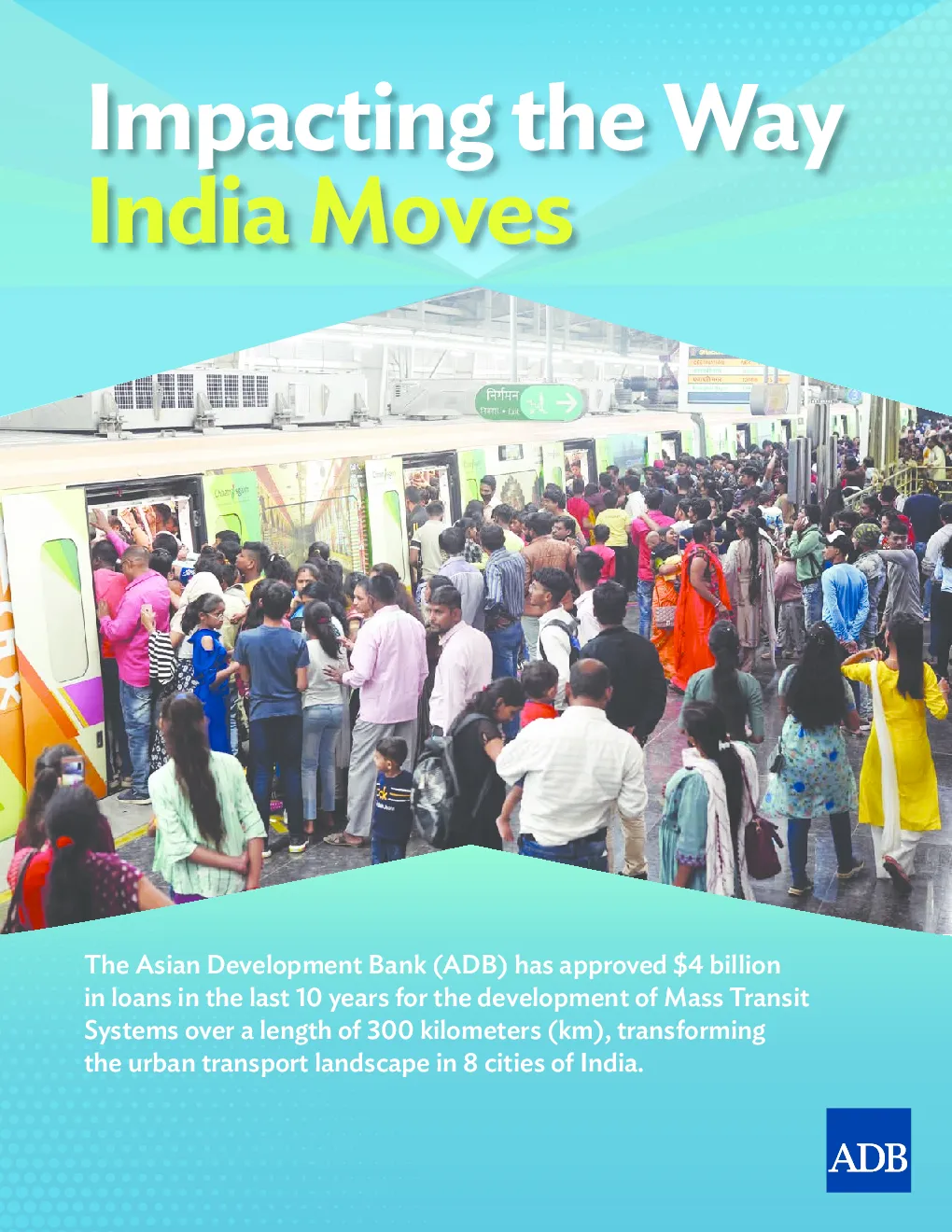
Impacting the WayIndia Moves The Asian Development Bank (ADB) has approved $4 billionin loans in the last 10 years for the development of Mass TransitSystems over a length of 300 kilometers (km), transformingthe urban transport landscape in 8 cities of India. ADB is helping India in setting new benchmarks in high-speedregional transit in its National Capital Region (NCR), connectingcities and transforming lives (photo from the National CapitalRegion Transport Corporation). (On the front cover) Supported by ADB, the Nagpur Metro UrbanMobility Project (NMUMP) is reshaping daily commutes with speed,comfort, and modern design in Nagpur, India (photo from theMaharashtra Metro Rail Corporation Limited). The Mass Rapid TransitSystems Revolution in India In the heart of India’s bustling cities, where the pulse of life beats through crowded streets and narrow lanes, a new waveof urban transformation is quietly but powerfully reshaping the way people move. Mass Rapid Transit Systems (MRTSs),once a distant dream, have become the lifeline of modern urban mobility, offering an elegant solution to the chaos of trafficcongestion and pollution. From the vibrant streets of Delhi to the coastal allure of Mumbai, India’s network of MRTS hasrevolutionized daily commutes, offering a glimpse into the future of smart, sustainable cities. In the quest for urban mobility that is efficient, inclusive, and sustainable, such systems stand as a testament tovisionary planning and progressive thinking. What began as an ambition to tackle overcrowded roads and deterioratingair quality has now transformed into a symbol of modernity and progress in Indian cities. As the cities grow taller and thepopulation swells, these projects have emerged as a game changer in the realm of urban transportation. Across India, the expansion of the MRTS network has gained unprecedented momentum—increasing from 248 km in2014 to 973 km in 2024—and transformed urban mobility on a national scale. New lines are constantly being added,expanding existing networks, and connecting previously underserved regions. The government’s push for MRTSdevelopment is fostering a new era of public transport that promises to alleviate congestion, reduce carbon footprints,and enhance connectivity. With ambitious plans for cities both big and small, India’s MRTS expansion is not only atransportation revolution but also a powerful tool for driving economic growth, improving quality of life, and supportingthe vision of smart, sustainable cities. Delhi–Meerut Regional Rapid Transit System Total Project Cost$3.95billion Design Speed180 km per hour ADB’s ApprovalJuly 2020 Corridor Length82 km with 24 stations The Delhi–Meerut Regional Rapid Transit System (DM RRTS) is India’s first RRTS corridor in its NationalCapital Region (NCR) connecting Delhi to Meerut in Uttar Pradesh via the populated sections ofSahibabad, Ghaziabad, and Duhai. In January 2025, a 55-km section of the corridor became operationalbetween Ashok Nagar and Meerut South. ADB is financing DM RRTS through a Multitranche FinancingFacility of $1.049 billion and has also arranged $500 million of joint cofinancing from the AsianInfrastructure Investment Bank, $500 million of parallel cofinancing from New Development Bank,and $3 million from the Japan Fund for Poverty Reduction. Ultramodern trainsets are lined up at the depot, reflecting India’srapid strides in next-generation regional rapid rail infrastructure andworld-class mobility solutions. (Top of the page) A Namo Bharat trainglides swiftly along the tracks, symbolizing India’s leap into a new era ofregional rapid connectivity (photos from the National Capital RegionTransport Corporation). Transport-Oriented Developmenton the Ground A woman pilot is steering the controls of the NamoBharat train (photo from the National CapitalRegion Transport Corporation). D E LH I – ME E RU TRE GI ON ALRAPI D TRAN SI TSYSTE MDelhi–Meerut Regional Rapid Transit System Nagpur Metro Urban Mobility Project TOD Zone4.0 floor area ratio within 500 meterson either side of Metro Rail (TOD zone) Total Funding$200million ADB’s ApprovalJuly 2024 Route Length43.8 km with32 elevated stations The Nagpur Metro Urban Mobility Project (NMUMP) is an extension of the metro in the north,south, east, and west totaling 43.8 km (Phase 2). It will improve the connectivity to new and urbanagglomerations around Nagpur. Loan proceeds will be drawn in Japanese yen, thereby leveraging theflexibility of wide currency options available in ADB’s Flexible Loan Product. P h ase 2Nagpur Metro Phase 2 Mumbai Metro Rail Systems Project Total Project Cost$1,675 million Made in IndiaAll trains madeindigenously ADB’s ApprovalJanuary 2019 Route Length58 km Metro Carriages504 (84 trainsets) The Mumbai Metro Rail Systems Project (MMRP) is 58 km of metro rail in Mumbai comprised of Line 2Afrom Dahisar to DN Nagar, Line 2B from DN Nagar to Mandale via Bandra, and Line 7 from Dahisar toAndheri. Loan p