《拉丁美洲和加勒比经济评论》,2025年4月:拉丁美洲和加勒比海的有组织犯罪和暴力2025
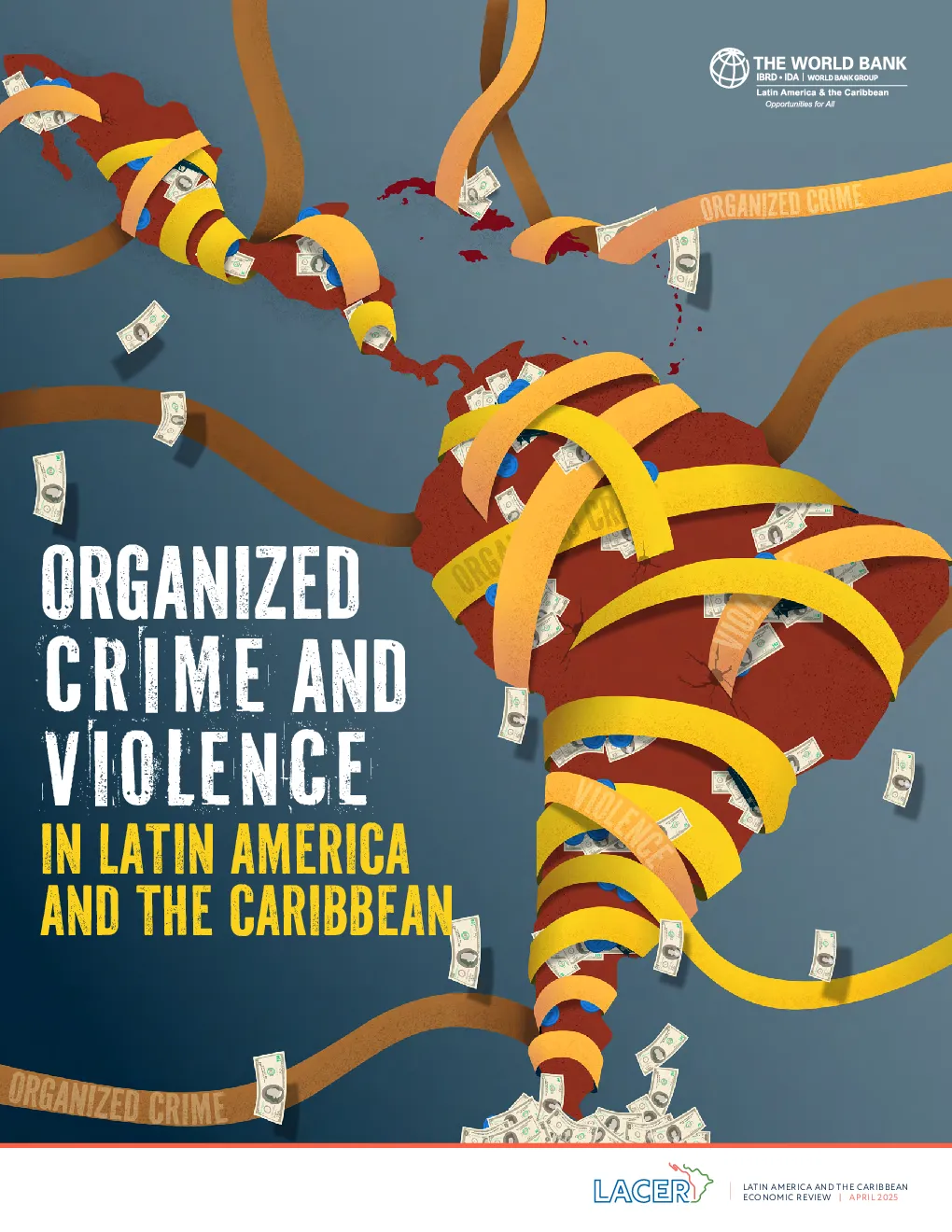
OrganizedCrimeandViolenceIn Latin Americaand the caribbean 1 2 3 4 28 27 26 25 This work is a product of the staff of The World Bank with external contributions. The findings, interpretations, and conclusions expressed in this workdo not necessarily reflect the views of The World Bank, its Board of Executive Directors, or the governments they represent. The World Bank does notguarantee the accuracy, completeness, or currency of the data included in this work and does not assume responsibility for any errors, omissions, ordiscrepancies in the information, or liability with respect to the use of or failure to use the information, methods, processes, or conclusions set forth.The boundaries, colors, denominations, links/footnotes and other information shown in this work do not imply any judgment on the part of The WorldBank concerning the legal status of any territory or the endorsement or acceptance of such boundaries. The citation of works authored by others doesnot mean the World Bank endorses the views expressed by those authors or the content of their works. Nothing herein shall constitute or be construed or considered to be a limitation upon or waiver of the privileges and immunities of The World Bank,all of which are specifically reserved. Rights and Permissions This work is available under the Creative Commons Attribution 3.0 IGO license (CC BY 3.0 IGO) http://creativecommons.org/licenses/by/3.0/igo. Underthe Creative Commons Attribution license, you are free to copy, distribute, transmit, and adapt this work, including for commercial purposes, underthe following conditions: Attribution—Please cite the work as follows: Maloney, William, Marcela Melendez, and Raul Morales. 2025.Organized Crime and Violence in LatinAmerica and the Caribbean.Latin America and the Caribbean Economic Review (April). World Bank, Washington, DC. doi:10.1596/978-1-4648-2235-3.License: Creative Commons Attribution CC BY 3.0 IGO Translations—If you create a translation of this work, please add the following disclaimer along with the attribution:This translation was not created byThe World Bank and should not be considered an official World Bank translation. The World Bank shall not be liable for any content or error in this translation. Adaptations—If you create an adaptation of this work, please add the following disclaimer along with the attribution:This is an adaptation of anoriginal work by The World Bank. Views and opinions expressed in the adaptation are the sole responsibility of the author or authors of the adaptation andare not endorsed by The World Bank. Third-party content—The World Bank does not necessarily own each component of the content contained within the work. The World Bank thereforedoes not warrant that the use of any third-party-owned individual component or part contained in the work will not infringe on the rights of those thirdparties. The risk of claims resulting from such infringement rests solely with you. If you wish to re-use a component of the work, it is your responsibilityto determine whether permission is needed for that re-use and to obtain permission from the copyright owner. Examples of components can include,but are not limited to, tables, figures, or images. All queries on rights and licenses should be addressed to World Bank Publications, The World Bank, 1818 H Street NW, Washington, DC 20433, USA;e-mail:pubrights@worldbank.org. Acknowledgements This report is a product of the Chief Economist Office for Latin America and the Caribbean at theWorld Bank. The preparation of the report was led by William Maloney (Chief Economist), RaulMorales Lema (Economist), and Marcela Meléndez Arjona (Deputy Chief Economist). Excellentresearch and editorial assistance were dispensed by Pilar Ruiz Orrico (Research Analyst), GastonMarinelli (Research Analyst), José Andrée Camarena Fonseca (Research Analyst), Laura Daniela TenjoGalvis (Research Analyst), Laura Victoria Gonzalez Solano (Research Analyst), Nicolas Peña Tenjo(Consultant) and Jacqueline Larrabure (Senior Program Assistant). Chapter 2 used a first draft of apolicy document written by Marcela Meléndez Arjona, Juan Fernando Vargas, and Ernesto Schargrodskyas an input. Substantive inputs were offered by the regional teams: Finance, Competitiveness and Innovation: Federico Alfonso Diaz Kalan (Financial Sector Specialist,ELCFN) and Guillermo Fernandez Zubia (Consultant, ELCFN). Poverty and Equity: Carlos Rodriguez Castelan (Practice Manager, ELCPV), Hernan Winkler (SeniorEconomist, ELCPV), Diana Marcela Sanchez Castro (Research Analyst, ELCPV), and Karen Yiseth BarretoHerrera (Consultant, ELCPV). Country-specific macroeconomic estimates and write-ups were produced by country economists in theEconomic Policy Global Practice, under the leadership of Shireen Mahdi (Practice Manager, ELCMU) andthe coordination of Elena Fernández Ortiz and Adriane Landwehr. Contributors included Daniel Barco,Rafael Barroso, Paola Brens, Luigi Butron, Natalia