2024年非洲收入统计:促进和信任是选定非洲税务机关自愿纳税的驱动力
 AI智能总结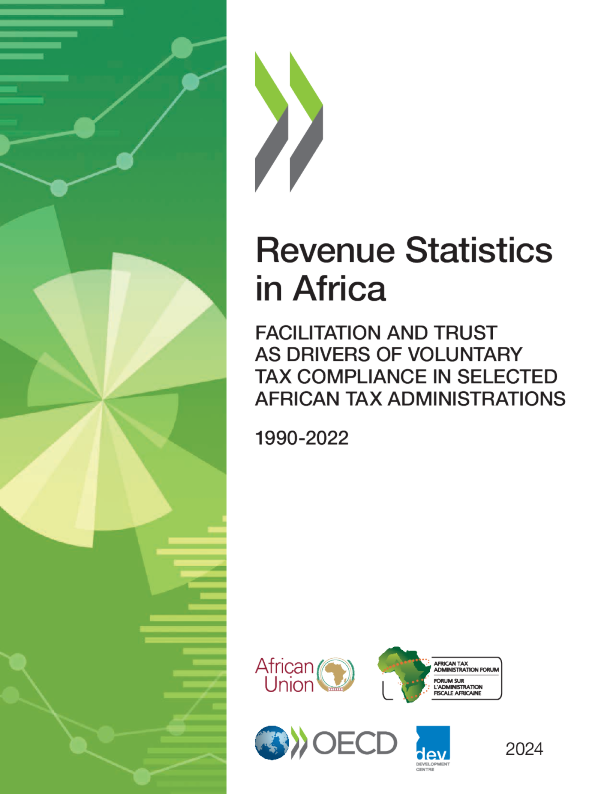
FACILITATION AND TRUSTAS DRIVERS OF VOLUNTARYTAX COMPLIANCE IN SELECTEDAFRICAN TAX ADMINISTRATIONS 1990-2022 Revenue Statistics in Africa2024 FACILITATION AND TRUST AS DRIVERSOF VOLUNTARY TAX COMPLIANCE IN SELECTEDAFRICAN TAX ADMINISTRATIONS 1990-2022 This work is published under the responsibility of the Secretary-General of the OECD, the Executive Secretary of ATAFand the Chairperson of the AUC. The opinions expressed and arguments employed herein do not necessarily reflectthe official views of the Member countries of the OECD or its Development Centre, or of the member countries of theAfrican Union or of ATAF. This document was produced with the financial assistance of the European Union. The views expressed herein can inno way be taken to reflect the official opinion of the European Union. This document, as well as any data and map included herein, are without prejudice to the status of or sovereignty overany territory, to the delimitation of international frontiers and boundaries and to the name of any territory, city or area. The names of countries, maps and territories and territorial disclaimers used in this joint publication follow the practiceof the OECD. OECD/AUC/ATAF (2024),Revenue Statistics in Africa 2024: Facilitation and Trust as Drivers of Voluntary Tax Compliance inSelected African Tax Administrations, OECD Publishing, Paris, https://doi.org/10.1787/78e9af3a-en. ISBN 978-92-64-80476-0 (print)ISBN 978-92-64-87229-5 (PDF)ISBN 978-92-64-54809-1 (HTML)ISBN 978-92-64-43429-5 (epub) Revenue Statistics in AfricaISSN 2617-653X (online) Photo credits:Cover © some of the graphic elements in the main cover illustration were adapted from Freepik.com. Corrigenda to OECD publications may be found at: https://www.oecd.org/en/publications/support/corrigenda.html.© OECD/ATAF/AUC 2024 Attribution 4.0 International (CC BY 4.0) This work is made available under the Creative Commons Attribution 4.0 International licence. By using this work, you accept to be bound by the terms of this licence(https://creativecommons.org/licenses/by/4.0/).Attribution– you must cite the work.Translations– you must cite the original work, identify changes to the original and add the following text:In the event of any discrepancy between the original work and thetranslation, only the text of original work should be considered valid.Adaptations– you must cite the original work and add the following text:This is an adaptation of an original work by the OECD, ATAF and the AUC. The opinions expressed andarguments employed in this adaptation should not be reported as representing the official views of the OECD or of its Member countries, of ATAF or the AUC or of the membercountries of the African Union or of ATAF.Third-party material– the licence does not apply to third-party material in the work. If using such material, you are responsible for obtaining permission from the third party and forany claims of infringement.You must not use the OECD’s or ATAF’s or the AUC’s respective logo, visual identity or cover image without express permission or suggest the OECD or ATAF or the AUC endorseyour use of the work.Any dispute arising under this licence shall be settled by arbitration in accordance with the Permanent Court of Arbitration (PCA) Arbitration Rules 2012. The seat of arbitration shallbe Paris (France). The number of arbitrators shall be one. Foreword RevenueStatistics in Africa 2024 is a joint publication by the OECD Centre for Tax Policy andAdministration, the OECD Development Centre, the African Union Commission and the African TaxAdministration Forum (ATAF) , with technical support from the African Development Bank and the Cerclede réflexion et d’échange des dirigeants des administrations fiscales and with financial support from thegovernments of Ireland, Japan, Luxembourg, the Netherlands, Norway, Spain, Sweden, Switzerland, theUnited Kingdomand from the European Union. The report presents detailed, internationally comparable data on tax and non-tax revenues for 36 Africancountries. Its approach is based on the well-established methodology of the OECD Interpretative Guide,which has become anessential reference for OECD members and many non-member countries, andwhich is contained in this report as Annex A. Comparisons are also made with the average for OECDeconomies and for the economies featured inRevenue Statistics in Latin America and the CaribbeanandRevenue Statistics in Asia and the Pacific. Theterm“taxes”in this publication is confined to“compulsory,unrequited payments to generalgovernment”. Taxes are “unrequited” in the sense that benefits provided by government to taxpayersarenot normally in proportion to their payments. The OECD methodology classifies a tax according to its base:income, profits and capital gains (classified under heading 1000), payroll (heading 3000), property(heading 4000), goods and services (heading 5000), and other taxes (heading 6000). Compulsory socialsecurity contributions paid