每个人都关心有时使用教育研究:知识中介的视角
 AI智能总结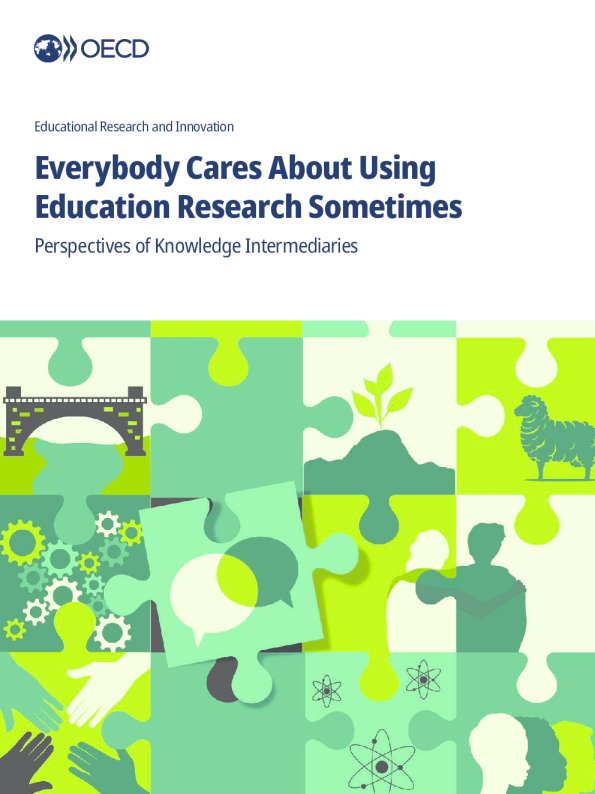
Everybody Cares About UsingEducation Research Sometimes Perspectives ofKnowledge Intermediaries Educational Research and Innovation Everybody Cares AboutUsing Education ResearchSometimes PERSPECTIVES OF KNOWLEDGE INTERMEDIARIES This work is published under the responsibility of the Secretary-General of the OECD. The opinions expressed andarguments employed herein do not necessarily reflect the official views of the Member countries of the OECD. This document, as well as any data and map included herein, are without prejudice to the status of or sovereignty overany territory, to the delimitation of international frontiers and boundaries and to the name of any territory, city or area. OECD (2025),Everybody Cares About Using Education Research Sometimes: Perspectives of Knowledge Intermediaries,Educational Research and Innovation, OECD Publishing, Paris, https://doi.org/10.1787/5ef88972-en. ISBN 978-92-64-41449-5 (print)ISBN 978-92-64-50085-3 (PDF)ISBN 978-92-64-51123-1 (HTML) Educational Research and InnovationISSN 2076-9660 (print)ISSN 2076-9679 (online) Photo credits:Cover design on the basis of images from © Kit8.net/Shutterstock.com; © Suspensemoni/Shutterstock.com;© Piter Kidanchuk/Shutterstock.com; © Nadiinko/Shutterstock.com. Corrigenda to OECD publications may be found at: https://www.oecd.org/en/publications/support/corrigenda.html.© OECD 2025 Attribution 4.0 International (CC BY 4.0) This work is made available under the Creative Commons Attribution 4.0 International licence. By using this work, you accept to be bound by the terms of this licence(https://creativecommons.org/licenses/by/4.0/).Attribution– you must cite the work.Translations– you must cite the original work, identify changes to the original and add the following text:In the event of any discrepancy between the original work and thetranslation, only the text of original work should be considered valid.Adaptations– you must cite the original work and add the following text:This is an adaptation of an original work by the OECD. The opinions expressed and arguments employed inthis adaptation should not be reported as representing the official views of the OECD or of its Member countries.Third-party material– the licence does not apply to third-party material in the work. If using such material, you are responsible for obtaining permission from the third party and forany claims of infringement.You must not use the OECD logo, visual identity or cover image without express permission or suggest the OECD endorses your use of the work.Any dispute arising under this licence shall be settled by arbitration in accordance with the Permanent Court of Arbitration (PCA) Arbitration Rules 2012. The seat of arbitration shallbe Paris (France). The number of arbitrators shall be one. Foreword Education research plays a critical role in shaping effective policies and practices that empower individualsand societies to thrive in an ever-evolving world. The Centre for EducationalResearch and Innovation(CERI) remains committed to supporting countries with timely research insights and forward-thinkingapproaches, helping them design education systems that are both robust and future-ready. Central toCERI's mission is the acknowledgment of education research as a key pillar for achieving quality education.The Strengthening the Impact of Education Research project has been a vital part of this mission, providingcountries with evidence-based insights to enhance the use of research inpolicy making and practice. This report,Everybody Cares About Using Education Research in Policy and Practice Sometimes, marksthe third and final publication of the project. The first report,Who Cares About Using Education Researchin Policy and Practice?, mapped the overarching landscape of actors and mechanisms that supportresearch use. The second report,Who Really Cares About Using Education Research in Policy andPractice?, explored how to develop a culture of research engagement, offering tools and processes to helpcountries foster this culture. Building on these foundational studies, this final publication shiftsits focus tothe field, examining how a diverse range of organisations engage in knowledge mobilisation to bridge thegap between education research, policy and practice. Drawing on data from the 2023 OECD Survey of Knowledge Mobilisation in Education, this report shedslight on the perspectives and activities of 288 knowledge intermediaries from 34 countries, organisationsthat enable policy makers’ and practitioners’ engagement with research to support their practices anddecision making. These include formal intermediaries, research institutes, inspectorates, consultanciesand teacher unions. It explores the ways in which these organisations support the engagement of policymakersand practitioners with research,characterising their knowledge mobilisation activities andexamining their perceived effectiveness and impact. Through this, the report offers a comprehen