让公众站在一边:如何让改革在设计上可接受
 AI智能总结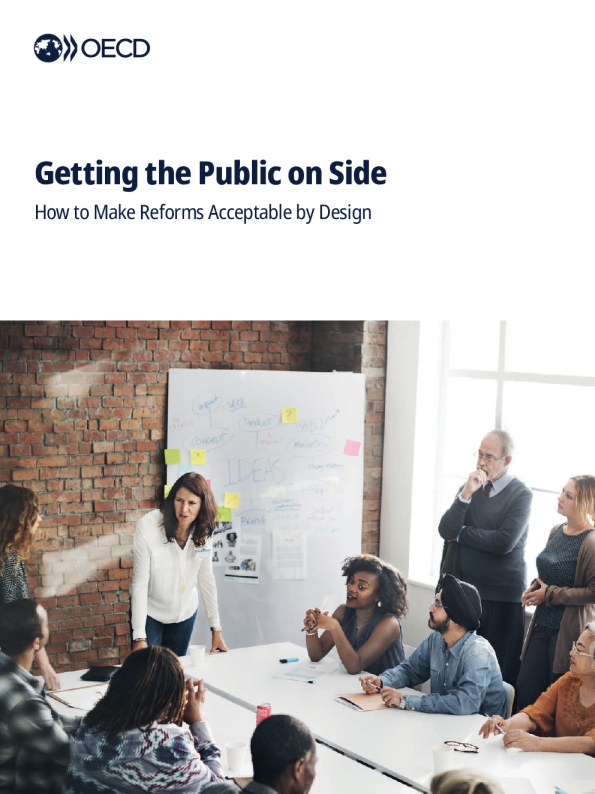
How toMake Reforms Acceptable byDesign Getting the Public on Side HOW TO MAKE REFORMS ACCEPTABLE BY DESIGN This work is published under the responsibility of the Secretary-General of the OECD. The opinions expressed andarguments employed herein do not necessarily reflect the official views of the Member countries of the OECD. This document, as well as any data and map included herein, are without prejudice to the status of or sovereignty overany territory, to the delimitation of international frontiers and boundaries and to the name of any territory, city or area. The statistical data for Israel are supplied by and under the responsibility of the relevant Israeli authorities. The use ofsuch data by the OECD is without prejudice to the status of the Golan Heights, East Jerusalem and Israeli settlements inthe West Bank under the terms of international law. Photo credits:Cover © Rawpixel.com/Shutterstuck.com. Corrigenda to OECD publications may be found at: https://www.oecd.org/en/publications/support/corrigenda.html.© OECD 2025 Attribution 4.0 International (CC BY 4.0) This work is made available under the Creative Commons Attribution 4.0 International licence. By using this work, you accept to be bound by the terms of this licence(https://creativecommons.org/licenses/by/4.0/).Attribution– you must cite the work.Translations– you must cite the original work, identify changes to the original and add the following text:In the event of any discrepancy between the original work and thetranslation, only the text of original work should be considered valid.Adaptations– you must cite the original work and add the following text:This is an adaptation of an original work by the OECD. The opinions expressed and arguments employed inthis adaptation should not be reported as representing the official views of the OECD or of its Member countries.Third-party material– the licence does not apply to third-party material in the work. If using such material, you are responsible for obtaining permission from the third party and forany claims of infringement.You must not use the OECD logo, visual identity or cover image without express permission or suggest the OECD endorses your use of the work.Any dispute arising under this licence shall be settled by arbitration in accordance with the Permanent Court of Arbitration (PCA) Arbitration Rules 2012. The seat of arbitration shallbe Paris (France). The number of arbitrators shall be one. Foreword Public acceptability is an issue of core importance for policymakers and for the international organisations,such as theOECD, that are tasked with advising them. Ambitious policies are needed to enhance well-being, overcome fiscal challenges and successfully navigate the profound changes brought about bypopulation ageing, climate change, rising inequalities, and the digital transition.These policies cannot beimplemented on the scale required or sustained over time without a better understanding of how to buildsufficient public support. At the same time, efforts to measure and analyse thesubjective factors (such asperceptions and attitudes) and social factors (such as shared norms and social preferences)that shapepeople’s views and responses to policy in different areas have greatly increased, providing a growing bodyof evidence on the “demand-side” of policy. The OECD has notably introduced new data collection toolsof this kind, including theRisks that Mattercross-national survey, theDrivers of Trust in Public Institutionssurvey and the pilot survey onInternational AttitudesTowards Climate Policies. Getting the Publicon Side: How toMakeReformsAcceptable byDesigntakes stock of this emerging fieldand seeks to draw actionable lessons for improving the design, communication and implementation ofreforms. The report contributes to twostreams of OECD work: on the causes and consequences ofinequality and on the political economy of reform.In particular, it builds on and extends the analysisconducted in two landmark OECD reports:Does Inequality Matter? How PeoplePerceiveEconomicDisparities andSocialMobilityandMaking Reform Happen: Lessons from OECDCountries. •Does Inequality Matter?provided an in-depth study of the role played by subjective factors in anarea where research is most advanced and the evidence best established,focusingon perceptionsof inequality and their impact on people’s willingness to supportredistributiveand social welfarepolicies.In doing so,it highlighted the valuable additional insights that can be drawn bycomplementingconventional statistical measures of inequality with available “subjective” measuresthat reflect the way in which individuals perceive inequalities and social mobility.The current reportaddresses some of the outstanding methodological issues identifiedinDoes Inequality Matter?and broadens the scope of analysis to other important forms of inequality, in line with theprogramme of work of theOECD Observatory on Social Mobility and Equal Opportunity. •Ma