适合所有年龄段的城市
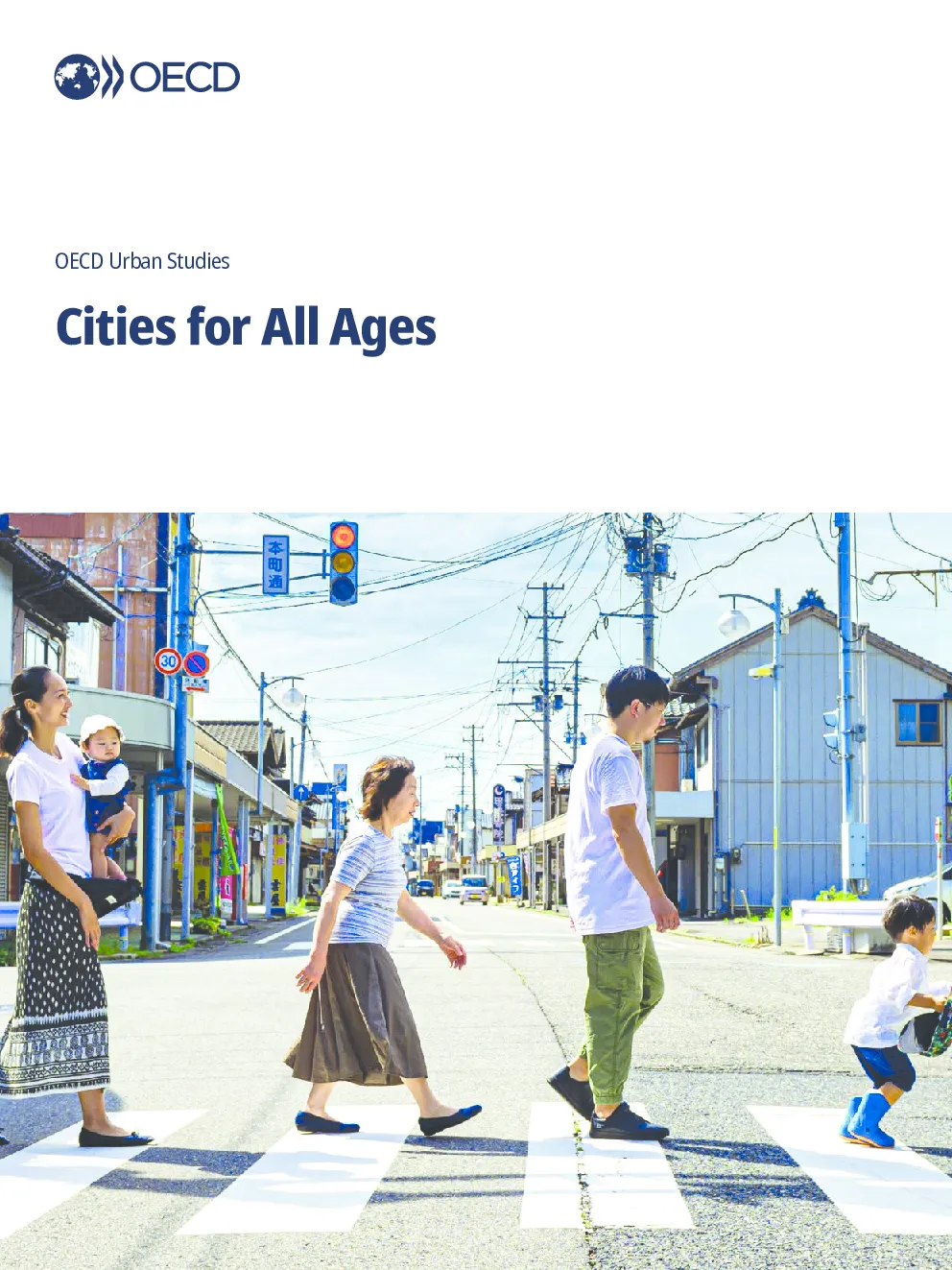
Cities forAll Ages OECD Urban Studies Cities for All Ages This work is published under the responsibility of the Secretary-General of the OECD. The opinions expressed andarguments employed herein do not necessarily reflect the official views of the Member countries of the OECD. This document, as well as any data and map included herein, are without prejudice to the status of or sovereignty overany territory, to the delimitation of international frontiers and boundaries and to the name of any territory, city or area. ISBN 978-92-64-49468-8 (print)ISBN 978-92-64-96739-7 (PDF)ISBN 978-92-64-96733-5 (HTML) OECD Urban StudiesISSN 2707-3432 (print)ISSN 2707-3440 (online) Photo credits:Cover © Kei Uesugi/Getty Images Plus. Corrigenda to OECD publications may be found at: https://www.oecd.org/en/publications/support/corrigenda.html.© OECD 2025 Attribution 4.0 International (CC BY 4.0) This work is made available under the Creative Commons Attribution 4.0 International licence. By using this work, you accept to be bound by the terms of this licence(https://creativecommons.org/licenses/by/4.0/).Attribution– you must cite the work.Translations– you must cite the original work, identify changes to the original and add the following text:In the event of any discrepancy between the original work and thetranslation, only the text of original work should be considered valid.Adaptations– you must cite the original work and add the following text:This is an adaptation of an original work by the OECD. The opinions expressed and arguments employed inthis adaptation should not be reported as representing the official views of the OECD or of its Member countries.Third-party material– the licence does not apply to third-party material in the work. If using such material, you are responsible for obtaining permission from the third party and forany claims of infringement.You must not use the OECD logo, visual identity or cover image without express permission or suggest the OECD endorses your use of the work.Any dispute arising under this licence shall be settled by arbitration in accordance with the Permanent Court of Arbitration (PCA) Arbitration Rules 2012. The seat of arbitration shallbe Paris (France). The number of arbitrators shall be one. Foreword Across the OECD, the share of older adults in the urban population is growing rapidly, including in theOECD’s largest cities that continue to grow and serve as magnets for younger people. Whether growingor not, these profound demographic changes are forcing cities to re-evaluate urban policies on investment,infrastructure, urban spaces, housing and services to ensure that they are able to cater to all age groups. As part of the OECD’s work on promoting inclusive growth in cities and managing demographic change inregions, this report provides a number of actions that governments can take to respond to rapid ageingand, in the process, transform cities into age-inclusive places that ensure opportunities, accessibilityandsafety for residents at every stage of life. In promoting an “age-inclusive” approach–such as universally accessible public transport, diversifiedhousing options, investment in the“silver economy”and telemedicine–the report highlights direct andimmediate benefits to well-being of residents and economic growth but also emphasises how such anapproach can generate broader and long-lasting benefits for quality urbanisation, climate resilienceanddigital inclusion.For example, reskilling older adults so they can continue to work if they choose to do socan help ease labour market tightness in many OECDmembercountries and improve digital literacy skills,enabling access to many public e-services, including health. The report also considers the economic andsocial costs of inaction. For example,investing in pedestrian safety to encourage active mobility can helpreduce emissions and the longer-term costs (on health and the environment) associated with them. The report provides achecklist of ninekey actions that governments at all levels can take to createage-inclusive cities. Grounded in global best practices from both national and local governments, thechecklist offers a practical tool for designing cities that meet the needs of all generations. An earlier version of the report was presented for discussion at the 36thWorking Party on Urban Policy ofthe Regional Development Policy Committee on 3December2024 under cote[CFE/RDPC/URB(2024)22]. Acknowledgements This report onCities for All Ageswas prepared by the OECD Centre for Entrepreneurship, SMEs, Regionsand Cities (CFE), led by Lamia Kamal-Chaoui, Director, as part of the Programme of Work and Budget ofthe OECD Regional Development Policy Committee (RDPC). The report was carried out with the financialsupport of theMinistry of Land, Infrastructure, Transport and Tourism (MLIT) of Japan. The policy dialogue was co-ordinated by Andrew Lombardi, Policy Analyst, under the supervision ofCamille Viros, Head of the I