经合组织劳动力市场和社会政策审查:保加利亚2025
 AI智能总结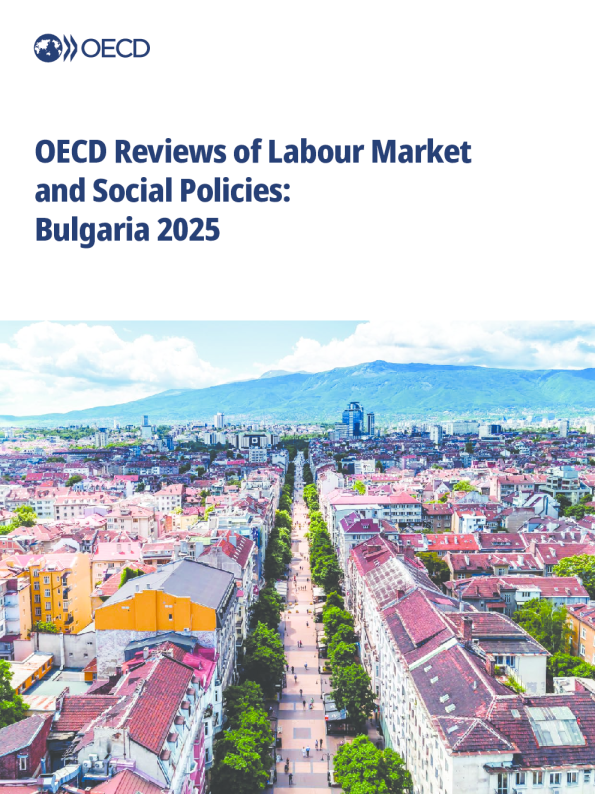
OECD Reviews of LabourMarket and Social Policies:Bulgaria2025 This document, as well as any data and map included herein, are without prejudice to the status of or sovereignty overany territory, to the delimitation of international frontiers and boundaries and to the name of any territory, city or area. The statistical data for Israel are supplied by and under the responsibility of the relevant Israeli authorities. The use ofsuch data by the OECD is without prejudice to the status of the Golan Heights, East Jerusalem and Israeli settlements inthe West Bank under the terms of international law. Note by the Republic of Türkiye The information in this document with reference to “Cyprus” relates to the southern part of the Island. There is no singleauthority representing both Turkish and Greek Cypriot people on the Island. Türkiye recognises the Turkish Republic ofNorthern Cyprus (TRNC). Until a lasting and equitable solution is found within the context of the United Nations, Türkiyeshall preserve its position concerning the “Cyprus issue”. Note by all the European Union Member States of the OECD and the European UnionThe Republic of Cyprus is recognised by all members of the United Nations with the exception of Türkiye. Theinformation in this document relates to the area under the effective control of the Government of the Republic of Cyprus. OECD (2025),OECD Reviews of Labour Market and Social Policies: Bulgaria 2025, OECD Reviews of Labour Market and SocialPolicies, OECD Publishing, Paris, https://doi.org/10.1787/81e7cac7-en. ISBN 978-92-64-39759-0 (print)ISBN 978-92-64-47603-5 (PDF)ISBN 978-92-64-31832-8 (HTML) OECD Reviews of Labour Market and Social PoliciesISSN 2074-3416 (print)ISSN 2074-3408 (online) Photo credits:Cover © Media Trading Ltd/Getty Images. Corrigenda to OECD publications may be found at: https://www.oecd.org/en/publications/support/corrigenda.html.© OECD 2025 Attribution 4.0 International (CC BY 4.0) This work is made available under the Creative Commons Attribution 4.0 International licence. By using this work, you accept to be bound by the terms of this licence(https://creativecommons.org/licenses/by/4.0/).Attribution– you must cite the work.Translations– you must cite the original work, identify changes to the original and add the following text:In the event of any discrepancy between the original work and thetranslation, only the text of original work should be considered valid.Adaptations– you must cite the original work and add the following text:This is an adaptation of an original work by the OECD. The opinions expressed and arguments employed inthis adaptation should not be reported as representing the official views of the OECD or of its Member countries.Third-party material– the licence does not apply to third-party material in the work. If using such material, you are responsible for obtaining permission from the third party and forany claims of infringement.You must not use the OECD logo, visual identity or cover image without express permission or suggest the OECD endorses your use of the work.Any dispute arising under this licence shall be settled by arbitration in accordance with the Permanent Court of Arbitration (PCA) Arbitration Rules 2012. The seat of arbitration shallbe Paris (France). The number of arbitrators shall be one. Foreword TheOECD Council decided to open accession discussions with Bulgaria on 25 January 2022. On 10 June2022, the Council adopted the Roadmap for the accession of Bulgaria tothe OECD Convention[C/M(2022)22/FINAL] (the Roadmap) setting out the terms,conditions and process for accession to theOECD. The Roadmap provides that in order to allow the Council to take an informed decision on theaccession of Bulgaria, Bulgaria will undergo in-depth reviews by the OECD technical committees listed inthe Roadmap, including the Employment, Labour and Social Affairs Committee. The background report[DELSA/ELSA/ACS(2024)1/REV1]that follows was prepared by the OECDSecretariat to support theaccession review discussion of the Employment, Labour and Social AffairsCommittee withBulgaria.Thereportwas prepared by Marius Lüske (project lead,Chapters1, 2 and 3),Ana Damas de Matos (Chapters 1 and4), and Sebastian Königs(Chapters 1 and5), with statistical supportprovided by Dana Blumin. Editorial assistance wasprovided by Natalie Corryand Hanna Varkki. Valuablecomments were provided byStefano Scarpetta,Mark Pearson,Jean-Christophe Dumont, Paul Yu andseveral other colleagues at the OECD. TheSecretariat is grateful for the insights andcontributions provided byspecialists from a wide range ofinstitutions, includingvarious national authorities, the social partners,non-governmental organisations andresearch institutions.The reportbenefitted fromcomments received from the BulgarianMinistry of Labourand Social Policy. In accordance with paragraph 28 of the Roadmap and upon request of Bulgaria, the Employment, Labourand Social Affairs Committee agreed to declassif