您的浏览器禁用了JavaScript(一种计算机语言,用以实现您与网页的交互),请解除该禁用,或者联系我们。[美股招股说明书]:花旗集团美股招股说明书(2025-05-06版) - 发现报告

花旗集团美股招股说明书(2025-05-06版)

2025-05-06美股招股说明书严***
AI智能总结
查看更多
花旗集团美股招股说明书(2025-05-06版)

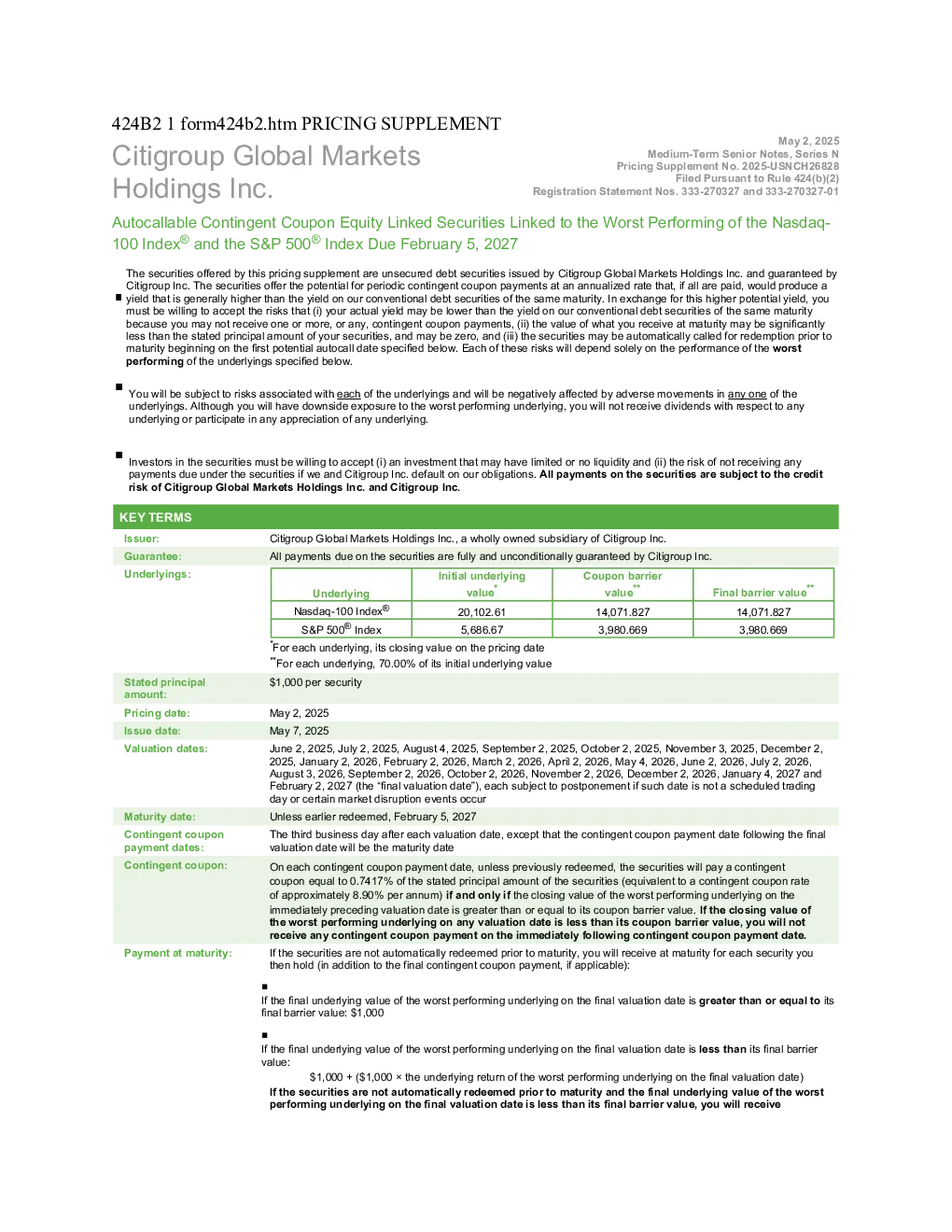
The securities offered by this pricing supplement are unsecured debt securities issued by Citigroup Global Markets Holdings Inc. and guaranteed by Citigroup Inc. Thesecurities offer the potential for periodic contingent coupon payments at an annualized rate that, if all are paid, would produce a yield that is generally higher than the yield called for redemption prior to maturity beginning on the first potential autocall date specified below. Each of these risks will depend solely on the performance of theworstperformingof the underlyings specified below. You will be subject to risks associated witheachof the underlyings and will be negatively affected by adverse movements inany oneof the underlyings. Although you will have downside exposure to the worst performing underlying, you will not receive dividends with respect to any underlying or participate in any appreciation of any underlying.Investors in the securities must be willing to accept (i) an investment that may have limited or no liquidity and (ii) the risk of not receiving any payments due under thesecurities if we and Citigroup Inc. default on our obligations.All payments on the securities are subject to the credit risk of Citigroup Global Markets Holdings Inc.and Citigroup Inc. UnderlyingInitial underlying value*Coupon barrier value**Final barrier valueNasdaq-100 Index®20,102.6114,071.82714,071.827 **For each underlying, 70.00% of its initial underlying valueStated principal amount:$1,000 per security underwriting fee. As noted above, the underwriting fee is variable.Investing in the securities involves risks not associated with an investment in conventional debt securities. See “Summary Risk Factors” CUSIP / ISIN:17333JF39 / US17333JF394 supplemented by this pricing supplement. The accompanying product supplement, prospectus supplement and prospectus containimportant disclosures that are not repeated in this pricing supplement. For example, the accompanying product supplement containsimportant information about how the closing value of each underlying will be determined and about adjustments that may be made tothe terms of the securities upon the occurrence of market disruption events and other specified events with respect to each underlying. automatically called for redemption following a valuation date that is also a potential autocall date. The examples in the second section belowillustrate how to determine the payment at maturity on the securities, assuming the securities are not automatically redeemed prior to maturity.The examples are solely for illustrative purposes, do not show all possible outcomes and are not a prediction of any payment that may be made or final barrier values of the underlyings. For the actual initial underlying value, coupon barrier value and final barrier value of each underlying,see the cover page of this pricing supplement. We have used these hypothetical values, rather than the actual values, to simplify the calculations and aid understanding of how the securities work. However, you shouldunderstand that the actual payments on the securities willbe calculated based on the actual initial underlying value, coupon barrier value and final barrier value of each underlying, and not thehypothetical values indicated below. For ease of analysis, figures below have been rounded. UnderlyingHypothetical initial underlyingvalueHypothetical coupon barrier70.00 (70.00% of its hypothetical The three hypothetical examples belowillustrate how to determine whether a contingent coupon will be paid and whether the securities will beautomatically redeemed following a hypothetical valuation date that is also a potential autocall date, assuming that the closing values of the Hypothetical closing value ofthe Nasdaq-100 Index®onhypothetical valuation dateHypothetical closing value ofthe S&P 500®Index onhypothetical valuation dateHypothetical paymentper$1,000.00 security on relatedcontingent coupon paymentdate underlying on the hypothetical valuation date. In this scenario, the closing value of the worst performing underlying on the hypothetical valuationdate is less than its coupon barrier value. As a result, investors would not receive any payment on the related contingent coupon payment dateand the securities would not be automatically redeemed.Investors in the securities will not receive a contingent coupon on the contingent coupon payment date following a valuation date if contingent coupon is paid following a valuation date depends solely on the closing value of the worst performing underlying on thatvaluation date. On the hypothetical valuation date, the Nasdaq-100 Index®has the lowest underlying return and, therefore, is the worst performingunderlying on the hypothetical valuation date. In this scenario, the closing value of the worst performing underlying on the hypothetical valuation the related contingent coupon payment date for an amount in cash equal to $1,000.00plusthe related contingent coupon payment.If