量化技术分析:SPX与DXY死亡交叉后的宏观趋势
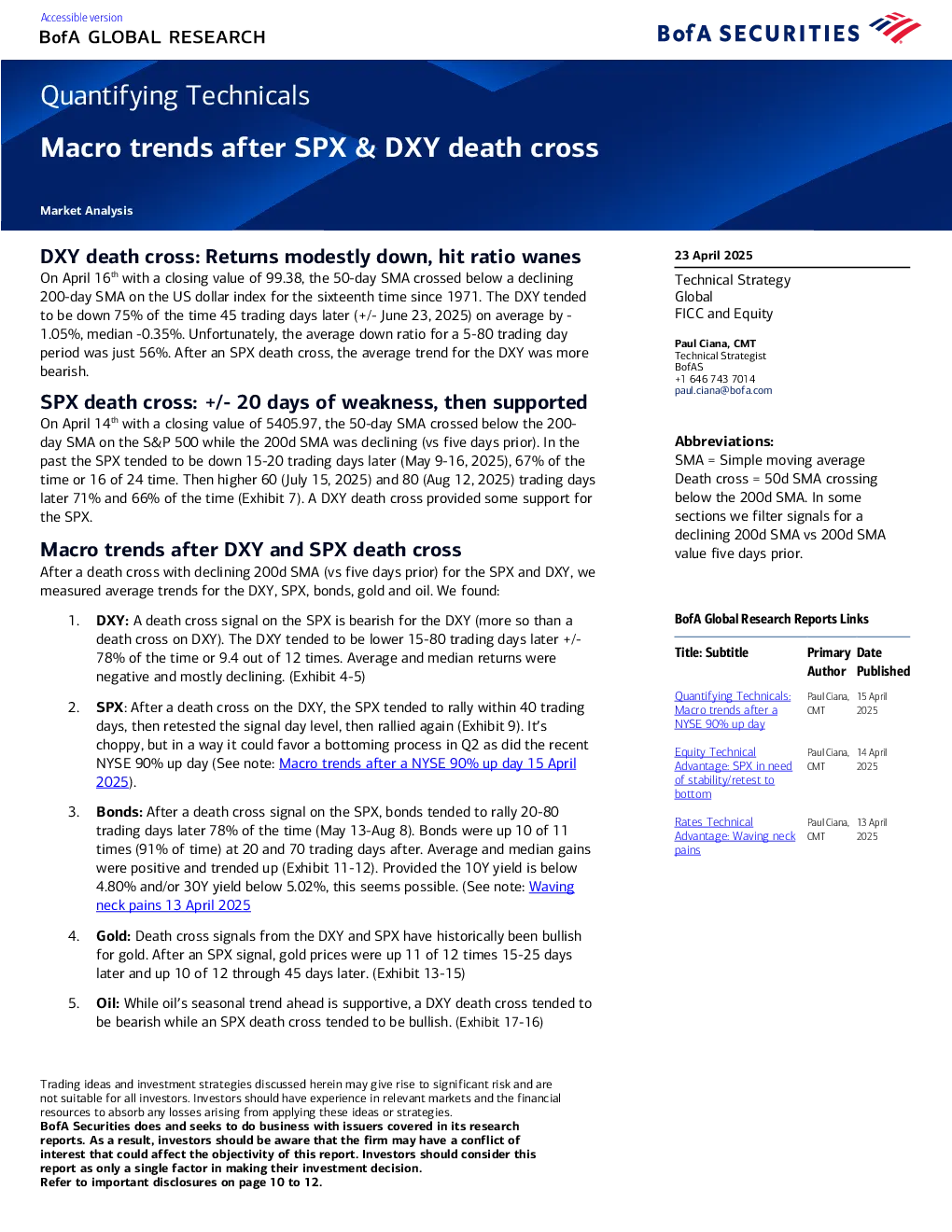
Macro trends after SPX & DXY death cross Market Analysis DXY death cross: Returns modestly down, hit ratio wanesOn April 16thwith a closing value of 99.38, the 50-day SMA crossed below a declining 23 April 2025 200-day SMA on the US dollar index for the sixteenth time since 1971. The DXY tendedto be down 75% of the time 45 trading days later (+/- June 23, 2025) on average by -1.05%, median -0.35%. Unfortunately, the average down ratio for a 5-80 trading dayperiod was just 56%. After an SPX death cross, the average trend for the DXY was morebearish. Technical StrategyGlobalFICC and Equity Paul Ciana, CMTTechnical StrategistBofAS+1 646 743 7014paul.ciana@bofa.com SPX death cross: +/- 20 days of weakness, then supportedOn April 14thwith a closing value of 5405.97, the 50-day SMA crossed below the 200- day SMA on the S&P 500 while the 200d SMA was declining (vs five days prior). In thepast the SPX tended to be down 15-20 trading days later (May 9-16, 2025), 67% of thetime or 16 of 24 time. Then higher 60 (July 15, 2025) and 80 (Aug 12, 2025) trading dayslater 71% and 66% of the time (Exhibit 7). A DXY death cross provided some support forthe SPX. Abbreviations: SMA = Simple moving averageDeath cross = 50d SMA crossingbelow the 200d SMA. In somesections we filter signals for adeclining 200d SMA vs 200d SMAvalue five days prior. Macro trends after DXY and SPX death cross After a death cross with declining 200d SMA (vs five days prior) for the SPX and DXY, wemeasured average trends for the DXY, SPX, bonds, gold and oil. We found: 1.DXY:A death cross signal on the SPX is bearish for the DXY (more so than adeath cross on DXY). The DXY tended to be lower 15-80 trading days later +/-78% of the time or 9.4 out of 12 times. Average and median returns werenegative and mostly declining. (Exhibit 4-5) 2.SPX: After a death cross on the DXY, the SPX tended to rally within 40 tradingdays, then retested the signal day level, then rallied again (Exhibit 9). It’schoppy, but in a way it could favor a bottoming process in Q2 as did the recentNYSE 90% up day (See note:Macro trends after a NYSE 90% up day 15 April2025). 3.Bonds:After a death cross signal on the SPX, bonds tended to rally 20-80trading days later 78% of the time (May 13-Aug 8). Bonds were up 10 of 11times (91% of time) at 20 and 70 trading days after. Average and median gainswere positive and trended up (Exhibit 11-12). Provided the 10Y yield is below4.80% and/or 30Y yield below 5.02%, this seems possible. (See note:Wavingneck pains 13 April 2025 4.Gold:Death cross signals from the DXY and SPX have historically been bullishfor gold. After an SPX signal, gold prices were up 11 of 12 times 15-25 dayslater and up 10 of 12 through 45 days later. (Exhibit 13-15) 5.Oil:While oil’s seasonal trend ahead is supportive, a DXY death cross tended tobe bearish while an SPX death cross tended to be bullish.(Exhibit 17-16) Trading ideas and investment strategies discussed herein may give rise to significant risk and arenot suitable for all investors. Investors should have experience in relevant markets and the financialresources to absorb any losses arising from applying these ideas or strategies.BofA Securities does and seeks to do business with issuers covered in its researchreports. As a result, investors should be aware that the firm may have a conflict ofinterest that could affect the objectivity of this report. Investors should consider thisreport as only a single factor in making their investment decision.Refer to important disclosures on page 10 to 12. DXY Death Cross History Average & median returns lower, but hit ratio wanes On April 16thwith a closing value of 99.38, the 50-day SMA crossed below the 200-daySMA on the US dollar index. This has happened 36 times since 1971. The art of thissignal suggests price is in a downtrend. Declining average and median returns mostlyagree. However history shows an average % down ratio of just 52% of time (Exhibit 1). When the 200-day SMA was declining, a bearish trend slightly improved. The DXY tendedto be down 75% of the time 45 trading days later (around June 23, 2025) 12 of 16times. Average decline of -1.05% and median -0.35%. Unfortunately, the avg down ratiofrom 5-80 trading days is just 56% (Exhibit 2). We show signals since 1971 inExhibit 3. Exhibit 1: Price trend after the 50d SMA crossed below the 200d SMAWhen the 50d SMA crossed below the 200d SMA, in the past the DXY was down 61% of the time 5 days later by -0.2% on average Exhibit 2: Price trend after the 50d SMA crossed below the 200d SMA and the 200d SMA had a negative slopeWhen the 50d SMA crossed below the 200d SMA and 200d SMA had a negative slope, in the past DXY was down 75% of the time 45 days later by -1.05% on average Exhibit 3:DXY death cross signals with declining 200d SMA (vs five days prior)All death cross signals since 1971 with declining a 200d SMA DXY bearish after an SPX death cross Seasonally flat, post DXY death cross lower, po