AI智能总结
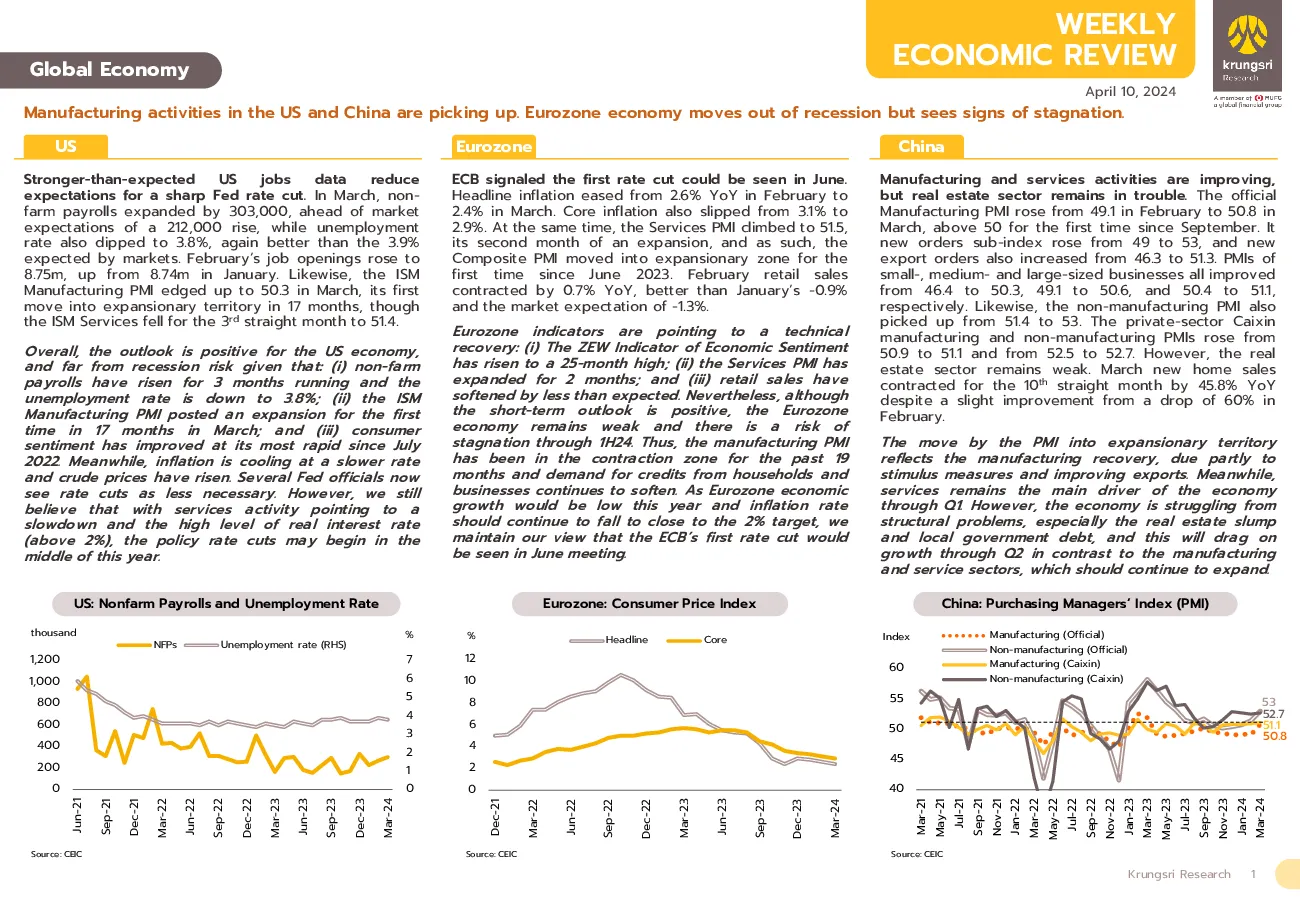
Manufacturing activities in the US and China are picking up. Eurozone economy moves out of recession but sees signs of stagnation. US Eurozone China ECB signaled thefirst rate cut could be seen in June.Headline inflation eased from2.6% YoY in February to2.4% in March. Core inflation also slipped from 3.1% to2.9%. At the same time, the Services PMI climbed to51.5,itssecond month of an expansion,and as such,theComposite PMI moved into expansionary zone for thefirsttime since June 2023.February retail salescontractedby 0.7%YoY,better than January’s-0.9%and the market expectation of-1.3%. Stronger-than-expectedUSjobsdatareduceexpectations for a sharp Fed rate cut.In March, non-farm payrolls expanded by303,000, ahead of marketexpectationsof a 212,000 rise,while unemploymentrate also dipped to3.8%, again better than the 3.9%expected by markets. February’s job openings rose to8.75m,up from 8.74m in January.Likewise,the ISMManufacturing PMI edged up to50.3 in March, its firstmove into expansionary territory in17 months, thoughthe ISM Services fell for the3rdstraight month to51.4. Manufacturingand services activities are improving,but real estate sector remains in trouble.The officialManufacturing PMI rose from 49.1 in February to 50.8 inMarch, above 50 for the first time since September. Itneworders sub-index rose from 49 to 53,and newexport orders also increased from 46.3 to 51.3. PMIs ofsmall-, medium-and large-sized businesses all improvedfrom46.4 to 50.3,49.1 to 50.6,and 50.4 to 51.1,respectively. Likewise, the non-manufacturing PMI alsopickedup from 51.4 to 53.The private-sector Caixinmanufacturingand non-manufacturing PMIs rose from50.9to 51.1 and from 52.5 to 52.7.However,the realestatesector remains weak.March new home salescontractedfor the 10th straight month by 45.8%YoYdespite a slightimprovement from a drop of 60%inFebruary. Eurozoneindicators are pointing to a technicalrecovery: (i) The ZEW Indicator of Economic Sentimenthas risen to a25-month high; (ii) the Services PMI hasexpandedfor 2 months;and(iii)retail sales havesoftened by less than expected. Nevertheless, althoughtheshort-term outlook is positive,the Eurozoneeconomyremains weak and there is a risk ofstagnation through1H24. Thus, the manufacturing PMIhasbeen in the contraction zone for the past 19months and demand for credits from households andbusinesses continues to soften. As Eurozone economicgrowthwould be low this year and inflation rateshould continue to fall to close to the2% target, wemaintain our view that the ECB’s first ratecut wouldbe seen in June meeting. Overall, the outlook is positive for the US economy,andfar from recession risk given that:(i)non-farmpayrollshave risen for 3 months running and theunemploymentrate is down to 3.8%;(ii)the ISMManufacturing PMI posted an expansion for the firsttimein 17 months in March;and(iii)consumersentiment hasimproved at its most rapid since July2022. Meanwhile, inflation is cooling at a slower rateand crude prices have risen. Several Fed officials nowseerate cuts as less necessary.However,we stillbelievethat with services activity pointing to aslowdownand the high level of real interest rate(above2%),the policy rate cuts may begin in themiddle of this year. Themove by the PMI into expansionary territoryreflectsthe manufacturing recovery,due partly tostimulus measures and improving exports. Meanwhile,servicesremains the main driver of the economythrough Q1. However, the economy is struggling fromstructural problems,especially the real estate slumpandlocal government debt,and this will drag ongrowth through Q2 in contrast to the manufacturingand service sectors, which should continue to expand. Headline inflation remained negative for the 6thmonth inMarch, while core inflation continues to cool. MPC mayloosenmonetary policy later in the year.In March,headlineinflation stood at-0.47%YoY,despite lessnegativerate than January and February’s-1.11%and-0.77%, respectively. Prices have fallen on: (i) continuinggovernment subsidies on the cost of living, specifically fordiesel and electricity, prices for which are now lower thanthe same period last year; and (ii) the increasing supplyoffresh meat and vegetables,which has then pusheddown prices. Core inflation, which excludes raw food andenergyprices,also softened to 0.37%from 0.43%inJanuary. For 1Q24, headline and core inflation rates havethus averaged-0.79% and 0.44%, respectively. The government has widened budget deficit for fiscalyear 2025 by THB 150bn, with the additional fundsbeingused to finance the Digital Wallet scheme.Funding sources for this scheme will be announcedon 10 April.At a meeting held on 2 April, the cabinetagreedto revise the medium-term fiscal framework(for FY2025-2028) and as part of this, the cabinet isextending the FY2025 budget deficit by THB 152.7bn,raising this from THB 713bn to a total of THB 865.7bn.This will be used to fund stimulus spending. The expansion in the annual budget expenditure forFY2025(during Oct