AI智能总结
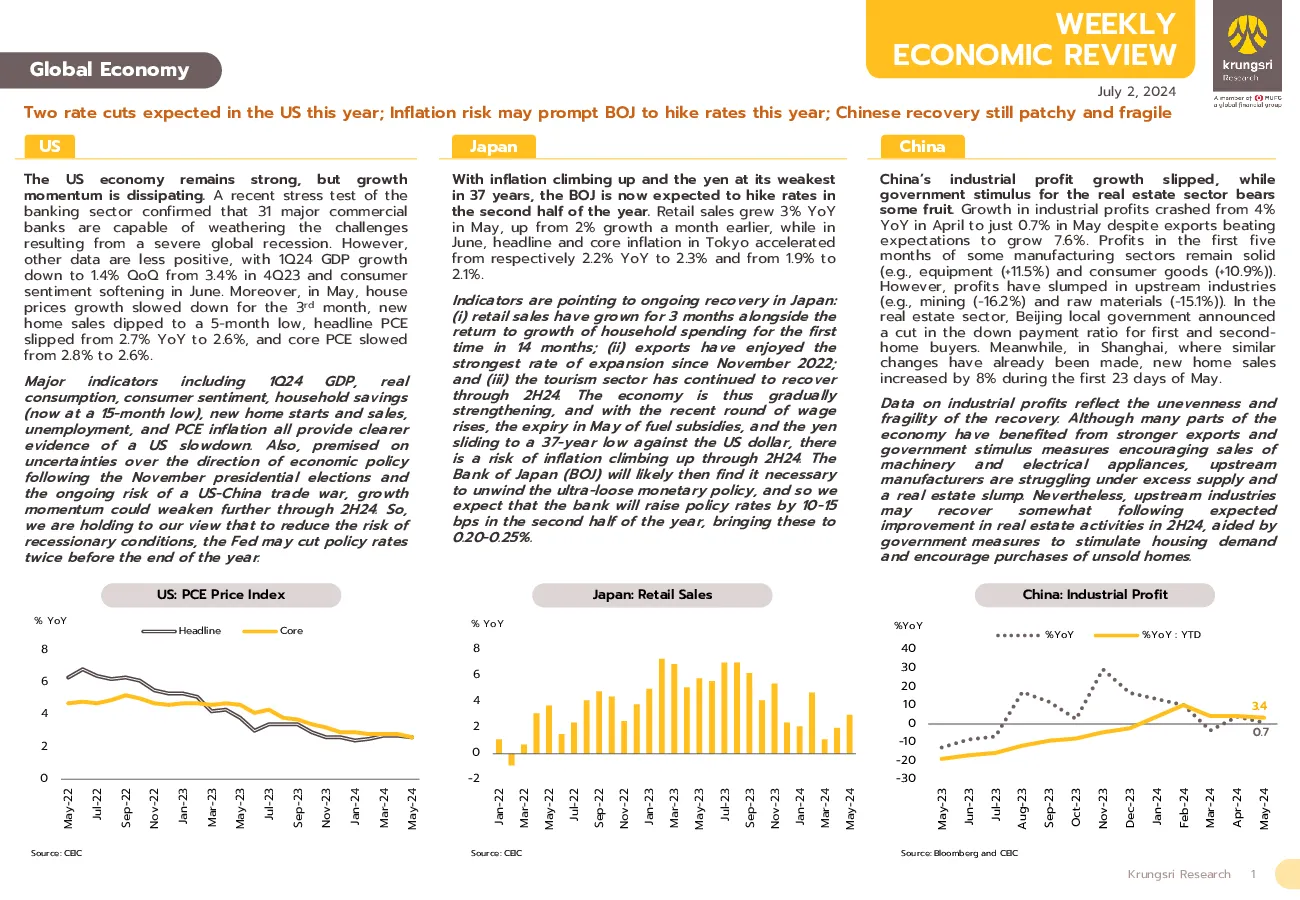
Two rate cuts expected in the US this year; Inflation risk may prompt BOJ to hike rates this year; Chinese recovery still patchyand fragile US China Japan TheUSeconomyremainsstrong,butgrowthmomentum is dissipating.A recent stress test of thebankingsector confirmed that 31 major commercialbanksare capable of weathering the challengesresultingfrom a severe global recession.However,other data are less positive, with1Q24 GDP growthdown to 1.4% QoQ from 3.4% in 4Q23 and consumersentiment softening in June. Moreover, in May, houseprices growth sloweddown for the 3rd month,newhome salesdipped to a 5-month low,headline PCEslipped from 2.7% YoY to 2.6%, and core PCE slowedfrom 2.8% to 2.6%. China’sindustrialprofitgrowthslipped,whilegovernment stimulus for the real estate sector bearssome fruit.Growth in industrial profits crashed from 4%YoY in April to just 0.7% in May despite exports beatingexpectationsto grow 7.6%.Profits in the first fivemonthsof some manufacturing sectors remain solid(e.g., equipment (+11.5%) and consumer goods (+10.9%)).However, profits have slumped in upstream industries(e.g., mining (-16.2%) and raw materials (-15.1%)). In thereal estate sector, Beijing local government announceda cut in the down payment ratio for first and second-homebuyers.Meanwhile,in Shanghai,where similarchangeshave already been made,new home salesincreased by 8% during the first 23 days of May. With inflation climbing up and the yen at its weakestin 37 years, the BOJ is now expected to hike rates inthe second half of the year.Retail sales grew 3% YoYin May, up from 2% growth a month earlier, while inJune, headline and core inflation in Tokyo acceleratedfrom respectively 2.2% YoY to 2.3% and from 1.9% to2.1%. Indicators are pointing to ongoing recovery in Japan:(i) retail sales have grown for 3 months alongside thereturn to growth of household spending for the firsttimein 14 months;(ii)exports have enjoyed thestrongest rateof expansion since November 2022;and (iii) the tourism sector has continued to recoverthrough2H24.The economy is thus graduallystrengthening, andwith the recent round of wagerises, the expiry in May of fuel subsidies, and the yensliding to a 37-year low against the US dollar, thereis arisk of inflation climbing up through 2H24. TheBank of Japan (BOJ) will likely then find it necessaryto unwind the ultra-loose monetary policy, and so weexpect that the bank will raise policy rates by 10-15bps in the second half of the year, bringing these to0.20-0.25%. Majorindicatorsincluding1Q24GDP,realconsumption, consumer sentiment, household savings(now at a 15-month low), new home starts and sales,unemployment, and PCE inflation all provide clearerevidenceof a US slowdown.Also,premised onuncertainties over the direction of economic policyfollowingthe November presidential elections andthe ongoingrisk of a US-China trade war,growthmomentum could weaken further through 2H24. So,we are holding to our view that to reduce the risk ofrecessionary conditions, the Fed may cut policy ratestwice before the end of the year. Data on industrial profits reflect the unevenness andfragility of the recovery. Although many parts of theeconomyhave benefited from stronger exports andgovernmentstimulus measures encouraging sales ofmachineryandelectricalappliances,upstreammanufacturers are struggling under excess supply anda real estate slump. Nevertheless, upstream industriesmayrecoversomewhatfollowingexpectedimprovement in real estate activities in 2H24, aided bygovernmentmeasures to stimulate housing demandand encourage purchases of unsold homes. InMay,the Thai economy benefited from ongoinggrowth in the tourism sector and an acceleration ingovernmentspending.The Bank of Thailand(BOT)reports that although economic conditions continuedto improve in May, the pace of growth has slackened.Services were a core driver of this,in particular thetourism sector, for which income rose 4.1% month-on-month (MoM)sa on the back of a 9.2%increase inforeigntourist arrivals.The economy also benefitedfrom the passing of the FY2024 budget at the end ofApriland the resulting increase in both regulardisbursements and spending on investment projects.Less positively, private consumption edged up by just0.3%,private investment contracted-3.0%,exportvalueexcludinggoldslipped-1.7%, and industrial output inched down-0.6%. Althoughmanufacturing output has likely passedthrough this cycle’s low point, deep-rooted structuralproblemsmean that recovery remains fragile.TheOfficeofIndustrialEconomicsreportsthattheManufacturing Production Index (MPI) contracted againin May, declining-1.5% YoY. This was a consequence ofslowingoutput in major industries that included:(i)automotives,where weak domestic purchasing powerand tighter lending conditions have fed into a 10-monthrun of declines; (ii) electronic components and boardsand (iii) manufacturers of concrete, cement and plaster,which have been hurt by high inventories and slowingorders.Overall,theMPIisnowdown-