印度电力部门融资流动的巴黎调整:挑战、机遇和创新解决方案
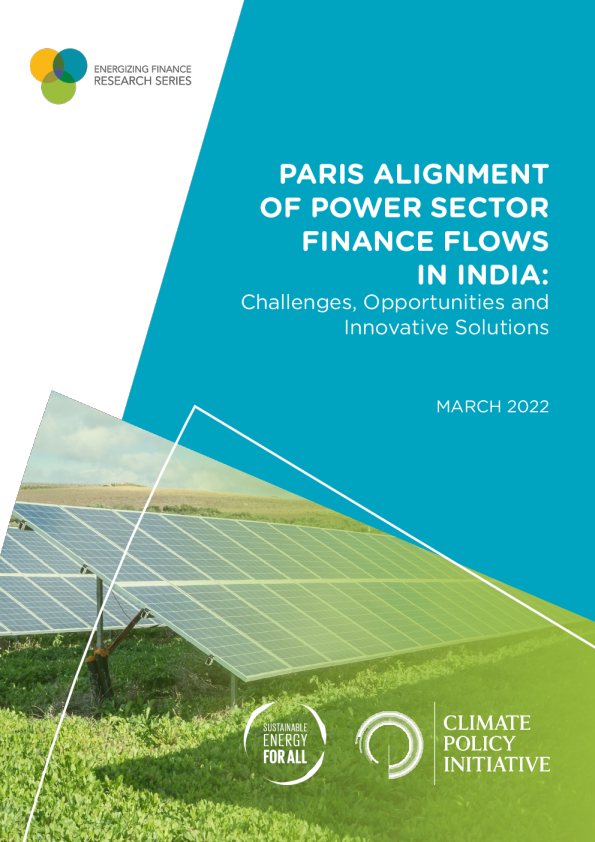
MARCH 2022 ACKNOWLEDGEMENT This brief was commissioned by Sustainable Energy for All (SEforALL). The SEforALL team was led by Olivia Coldreyand Tamojit Chatterjee, who worked in close collaboration with a team from Climate Policy Initiative (CPI), comprisingChavi Meattle and Shreyans Jain, who researched and wrote this brief. The brief benefitted from extensive review provided by colleagues from the CPI team including Angela Falconer,Cooper Wetherbee, Dhruba Purkayastha, Labanya Prakash, Paul Rosane, Tiza Mafira and Vivek Sen, and support fromCaroline Dreyer and Melina Dickson. We would like to thank the following people and organizations, without whose input the report would not havebeen possible: Daniel Wetzel, John Dulac, Organisation for Economic Co-operation and Development; GianlucaTonolo, Lucila Arboleya Sarazola and Pablo Gonzalez, International Energy Agency; Vibhuti Garg, Institute for EnergyEconomics and Financial Analysis; and Saarthak Khurana, KPMG. This knowledge brief also benefitted from research support provided by Jennifer Craft, Duke University; and MaxwellHankin Lewin, Katie Jean Huge and Anna Carrol Panknin, University of North Carolina at Chapel Hill, and Carol Hee,Clinical Associate Professor, Strategy & Entrepreneurship, University of North Carolina at Chapel Hill. We would also like to acknowledge inputs from the HSBC team. We would like to thank all SEforALL staff for their support, especially Stephen Kent, Tracey Crowe and Kanika Chawla.We also thank Jenny Nasser (editor). Valuable guidance and oversight were provided by Damilola Ogunbiyi, Chief Executive Officer and SpecialRepresentative of the UN Secretary-General for Sustainable Energy for All. We also acknowledge the Austrian Development Agency, the Charles Stewart Mott Foundation, the Ministry forForeign Affairs of Iceland, and the IKEA Foundation for their support to our work. For a full list of SEforALL supporters, please visit www.SEforALL.org. Cover Photo: Sungrow EMEA/Unsplash PREFACE In November 2021, a pivotal COP26 saw world leaders agreeing to the Glasgow Climate Pact in which 197 countriespledged to accelerate efforts on climate action, keeping the hope of capping global warming at 1.5 degrees alivewith new and updated Nationally Determined Contribution (NDC) and net-zero commitments. The non-binding pactwill set the global agenda on climate change for the next decade. COP26 also saw the announcement of several significant commitments pertaining to international financing of fossilfuel projects.A group of 25 countries together with public financial institutions signed a UK-led joint statementcommitting to ending international public financing for the unabated fossil fuel energy sector by the end of 2022,prioritizing support for clean energy transition. These actions complement announcements made earlier in the yearby China, Japan and South Korea to end overseas coal financing. Collectively, this could shift an estimated USD17.8 billion a year in public support out of fossil fuels, functionally ending almost all concessional or public financingof international coal power projects (UNFCCC 2021). Additionally, major banks and financial institutions also madesignificant commitments to end the funding of unabated coal. While efforts to build consensus on ending fossil fuelsubsidies and coal phase-out were unsuccessful, the countries agreed that advancing clean power generation andassociated energy efficiency measures should involve “the phasedown of unabated coal power and phase-out ofinefficient fossil fuel subsidies”. At COP26, India announced a target of 500 GW of non-fossil energy capacity by 2030, reducing the carbon intensityof India’s economy by less than 45 percent, and achieving net-zero emissions by 2070, demonstrating a concretecommitment on net-zero targets for the first time. India and the UK together led the launch of the Green Gridsinitiative. Backed by more than 80 countries, this initiative aims to build interconnected transnational grids to enableparts of the world with excess renewable energy capacity to transfer it to areas with deficits. India also supportedother initiatives that were announced at COP26 included scaling up of the use of green hydrogen and mandating itsuse in industries like petroleum refineries and fertilizer. This knowledge brief was developed in the lead-up to the COP26 summit in Glasgow and therefore is primarily basedon stated policies of the Government of India. At the time of writing this brief, India has not yet submitted updated2030 targets (in its NDC) to the UNFCCC as part of the five-yearly ratchet-up mechanism established in the ParisAgreement.The COP26 Glasgow Climate Pact allows for an annual review of more ambitious NDCs under whichIndia will have the opportunity to present its updated NDC by COP27. Catalysing India’sEnergy Transition Key power sector financing trends •Total tracked power sector financecommitments stood at USD 14.2 billionper annum b