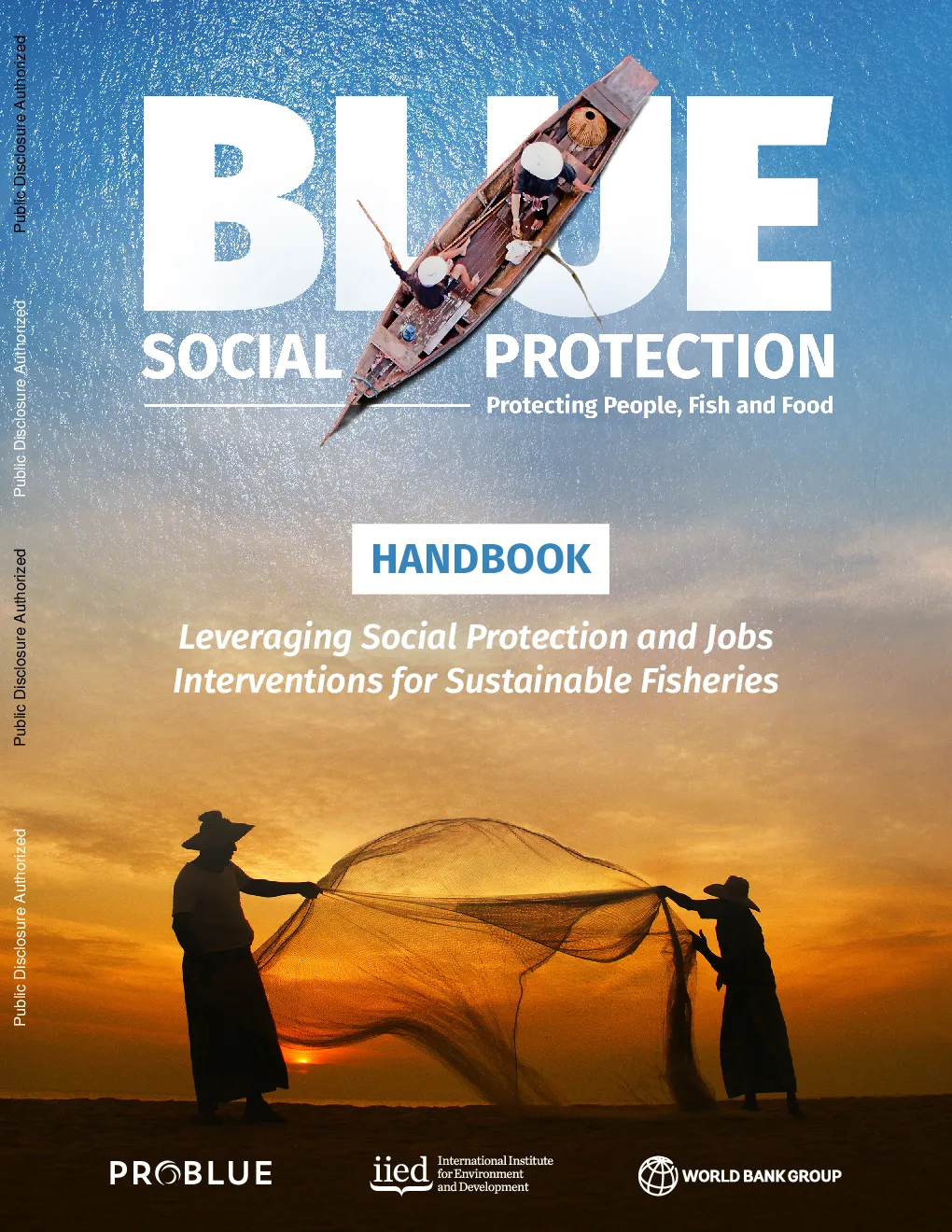
HANDBOOK Leveraging Social Protection and JobsInterventions for Sustainable Fisheries © 2025 The World Bank1818 H Street NW,Washington, DC 20433+1 202.473.1000www.worldbank.org This work is a product of the staffof The World Bank with externalcontributions. The findings,interpretations, and conclusionsexpressed in this work do notnecessarily reflect the viewsof The World Bank, its Boardof Executive Directors, or thegovernments they represent. The World Bank does notguarantee the accuracy ofthe data included in thiswork. The boundaries, colors,denominations, and otherinformation shown on any mapin this work do not imply anyjudgment on the part of TheWorld Bank concerning the legalstatus of any territory or theendorsement or acceptance ofsuch boundaries. Rights and Permissions The material in this work issubject to copyright. BecauseThe World Bank encouragesdissemination of its knowledge,this work may be reproduced, inwhole or in part, for noncommer-cial purposes as long as fullattribution to this work isgiven. Any queries on rights andlicenses, including subsidiaryrights, should be addressed to:World Bank Publications, TheWorld Bank Group, 1818 H StreetNW, Washington, DC 20433,USA; fax: 202-522-2625; e-mail:pubrights@worldbank.org COVER IMAGE: "Dance of the Fishing Nets” by RavindraRanasinghe. The photo was chosenfor the "Beauty of Sri Lanka 2024"photographic exhibition in the USA. Report and cover design:A.DELAROCHE Designs. BLUE SOCIAL PROTECTION Protecting People, Fish and Food HANDBOOK Leveraging Social Protection and JobsInterventions for Sustainable Fisheries ACKNOWLEDGEMENTS This Handbook was prepared by a joint team of the World Bank (Social Protection & Jobs andEnvironment, Natural Resources & Blue Economy Global Practices) and the International Institutefor Environment and Development (IIED; www.iied.org). The lead authors are Annabelle Bladon(IIED), Gunilla Tegelskär Greig, Yuko Okamura, and Gianluigi Nico (World Bank). This Handbookbuilds upon preceding activities carried out since 2020, and the extended team consists of thefollowing members (in alphabetical order): Tijen Arin, Samantha De Martino, Veronica YolandaJarrin, Anita Kendrick, Sachiko Kondo, Kevwe Pela, Federica Ricaldi, Luz Stella Rodriguez, MarthaSánchez Galvis, Mizushi Satoh, Shalika H. Subasinghe, Nga Thi Nguyen, Ruth Tiffer-Sotomayor,Xavier F.P. Vincent, and Vincenzo Vinci from the World Bank as well as Anna Ducros from IIED. The team is grateful to: •The management team who supported this initiative—Loli Arribas-Banos, Valerie Hickey,Christian Peter, Michal Rutkowski, and Iffath Sharif;•Reviewers who provided insightful comments—Marcelo Hector Acerbi, Hugo BroussetChaman, Diji Chandrasekharan Behr, Harrison Charo Karisa, Sandor Karacsony, andPaul Steele;•The communication and knowledge management team—Aaron Buchsbaum, DijanaFerizovic, Alexandra Humme, Nandita Roy, and Shaheera Syed;•Colleagues who initiated this activity—Ugo Gentilini, Yashodhan Ghorpade, and MiguelAngel Jorge; and•Other colleagues who have provided diverse support, including Jacqueline Alder, Andresde la Roche, Jeneen Hadj-Hammou, Samanmalee Kumari De Alwis, Helena Makarenko, AnnaMcCord, Aldo Morri, Ravindra Ranasinghe, and Ruth Pinto. We also extend our gratitude to PROBLUE—a multi-donor trust fund administered by theWorld Bank that supports the sustainable and integrated development of marine and coastalresources in a healthy ocean—which financed the activity. The Handbook also benefited fromthe Memorandum of Understanding (MOU) between the World Bank and the Ministry for ForeignAffairs of Iceland on Fisheries and the Blue Economy, within the framework of which fisheriesexpert Stefán Thorarinsson provided valuable advice. IIED’s contributions were in part financedby the Swedish International Development Cooperation Agency and Irish Aid. Furthermore, we would like to acknowledge collaboration with external partners, including theFood and Agriculture Organization of the United Nations (FAO), the General Fisheries Commissionfor the Mediterranean (GFCM), WorldFish, and the International Collective in Support of FishWorkers (ICSF). In particular, the Handbook benefitted from valuable feedback and suggestionsfrom Edward Allison, Nicola Ferri, Nicole Franz, Daniela Kalikoski, Sebastian Mathew, DaniellaSalazar, Mele Tauati, and Lena Westlund. As this Handbook aims to support many countries in leveraging social protection and jobsinterventions for more sustainable and productive fisheries, the team wishes to connect withthe communities of practitioners exploring such an approach to exchange knowledge. Forfeedback and further information, please contact at socialprotection@worldbank.org. Authorscan be reached at annabelle.bladon@iied.org, ggreig@worldbank.org, yokamura@worldbank.org, and gnico@worldbank.org. OVERVIEW1 GLOSSARY: KEY CONCEPTS AND TERMINOLOGY5 2. PROBLEM STATEMENT2.1 Social-ecological risks in the fisheries sector2.1.1 Ecological dri