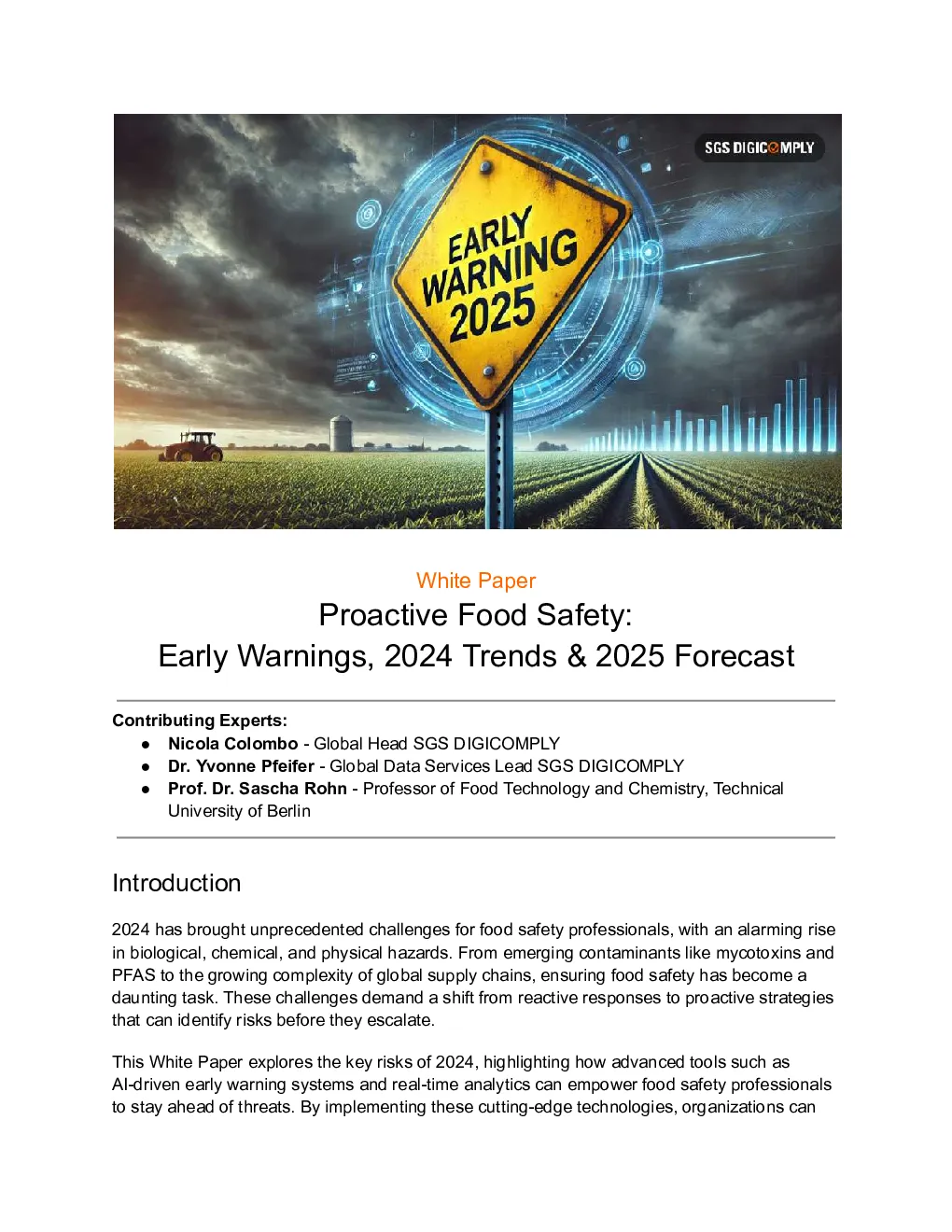
Proactive Food Safety:Early Warnings, 2024 Trends & 2025 Forecast Contributing Experts: ●Nicola Colombo- Global Head SGS DIGICOMPLY●Dr. Yvonne Pfeifer- Global Data Services Lead SGS DIGICOMPLY●Prof. Dr. Sascha Rohn- Professor of Food Technology and Chemistry, TechnicalUniversity of Berlin Introduction 2024 has brought unprecedented challenges for food safety professionals, with an alarming risein biological, chemical, and physical hazards. From emerging contaminants like mycotoxins andPFAS to the growing complexity of global supply chains, ensuring food safety has become adaunting task. These challenges demand a shift from reactive responses to proactive strategiesthat can identify risks before they escalate. This White Paper explores the key risks of 2024, highlighting how advanced tools such asAI-driven early warning systems and real-time analytics can empower food safety professionalsto stay ahead of threats. By implementing these cutting-edge technologies, organizations can enhance supply chain transparency, improve regulatory compliance, and protect consumerhealth. We also look to the future, uncovering the trends and innovations that will shape food safety in2025. With insights from industry experts, real-world case studies, and actionable strategies,this document serves as a guide for professionals committed to strengthening their food safetyframeworks and building resilience in an increasingly complex landscape. 2024 Food Safety Trends: Key Insights In 2024, food safety professionals faced an alarming rise in incidents, leaving many companiesunprepared to address the consequences. The fallout included not only financial losses but alsosignificant damage to reputations. Leveraging SGS Digicomply Food Safety Intelligence Hub, we can analyze the year's majortrends and summarize the key incidents, including hazards, commodities, and incidentcategories. This powerful tool combines thousands of data sources with AI-driven technology toprovide the most comprehensive and precise screening of food safety data. By contextualizinginsights with real-time laboratory results, it uncovers emerging risks that might otherwise remainhidden, helping organizations take proactive measures. Below, we see a snapshot ofEmerging risks in biological, chemical, and physical hazardsalongwith the most critical hazards and affected commodities. These insights serve as a foundationfor prioritizing risk mitigation strategies. Bio-contaminants remain the most prominent hazard, underscoring the need for targeted action: It is unsurprising that Listeria and Salmonella remain the primary hazards of concern. However,there is a notable rise in mycotoxin contamination, which highlights the need for enhancedmonitoring and proactive measures to mitigate potential risks to public health and food safety. Key Emerging Risks in 2024 Building on the analysis of bio-contaminants and adulteration trends, SGS DIGICOMPLY hasidentified three critical emerging risks in 2024:Mycotoxins,PFAS, andBisphenol A. Thesehazards represent significant challenges due to their widespread presence, potential healthimpacts, and evolving regulatory scrutiny. Trend #1 Mycotoxins: Mycotoxins remain a persistent and critical challenge in food safety, with Ochratoxin being oneof the most notable concerns in 2024. Produced by fungi such as Aspergillus and Penicillium,this toxin frequently contaminates grains, cereals, and processed products, posing significanthealth risks, including nephrotoxic and carcinogenic effects. As highlighted in the prediction model, Ochratoxin contamination incidents saw a sharp increase in late 2024, with a steady rise anticipated through early 2025. This trend is largely attributed toseasonal factors, such as fluctuating storage conditions and environmental changes, whichcreate ideal conditions for fungal growth. Proactive measures, including real-time monitoringand improved storage practices, are critical to mitigating risks and preventing further escalation. The global regulatory framework for Ochratoxin reflects its critical impact on food safety, withlimits varying by commodity and region. Common thresholds, such as 5 μg/kg for barley, maize,and general grains, are widely adopted across countries, including the UAE, Poland, and SouthKorea. Stricter regulations apply to sensitive commodities like infant food, where limits can be aslow as 0.0005 mg/kg, as seen in Kyrgyzstan. These varying standards highlight the importance of monitoring compliance on a regional basisto protect consumers and ensure market access. The table below provides a detailedbreakdown of commodity-specific limits across different jurisdictions. Trend #2 PFAS PFAS (Per- and Polyfluoroalkyl Substances), often referred to as "forever chemicals," haveemerged as a growing concern in food safety. Their persistence in the environment, coupledwith their widespread use in industrial and consumer products, has led to contamination ofwater, soil, and food s