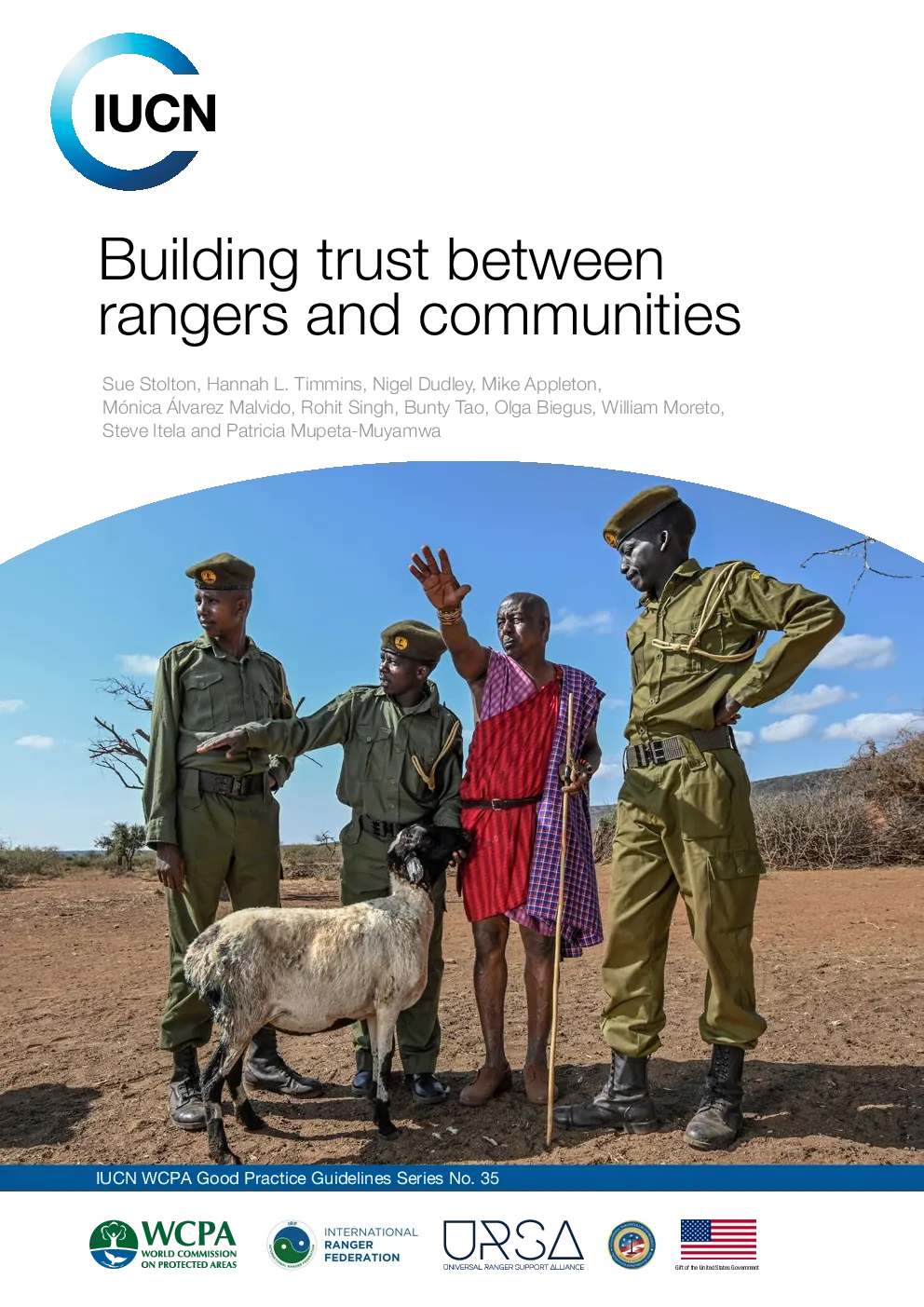
Building Trust Between Rangers and Communities
Foreword and Preface
This publication, "Building Trust Between Rangers and Communities," is part of the IUCN WCPA Good Practice Guidelines Series No. 35. It aims to foster better relationships between park rangers and local communities, enhancing conservation efforts through improved trust and cooperation.
Executive Summary
The guide emphasizes the importance of building trust between rangers and communities in protected areas. It highlights the role of the International Union for Conservation of Nature (IUCN), the World Commission on Protected Areas (WCPA), the Universal Ranger Support Alliance (URSA), and the International Ranger Federation (IRF) in supporting rangers and promoting effective conservation practices. The publication draws on the experiences and insights of various stakeholders, including government agencies, NGOs, and local communities.
Acknowledgements
The publication acknowledges the support of several organizations, including the U.S. Department of State's International Narcotics and Law Enforcement Affairs (INL), the Ministry of Foreign Affairs of Denmark, the Ministry for Foreign Affairs of Finland, the Government of France and the French Development Agency (AFD), the Ministry of Environment of the Republic of Korea, the Ministry of the Environment, Climate and Sustainable Development of the Grand Duchy of Luxembourg, the Norwegian Agency for Development Cooperation (Norad), the Swedish International Development Cooperation Agency (Sida), and the Swiss Agency for Development and Cooperation (SDC).
Acronyms and Abbreviations
- IUCN: International Union for Conservation of Nature
- WCPA: World Commission on Protected Areas
- URSA: Universal Ranger Support Alliance
- IRF: International Ranger Federation
- INL: International Narcotics and Law Enforcement Affairs
Glossary
- OECM: Other Effective Area-Based Conservation Measures
Key Points
-
Purpose and Scope:
- The guide focuses on building trust between rangers and communities to enhance conservation efforts.
- It aims to provide practical guidance for improving communication, collaboration, and mutual understanding between rangers and local communities.
-
Stakeholders:
- IUCN and WCPA: Provide scientific, technical, and policy advice, advocating for protected areas and OECMs.
- URSA and IRF: Support and promote the ranger profession, recognizing rangers as essential professionals.
- INL: Supports partner governments in building competent and legitimate criminal justice systems and international drug control cooperation.
-
Implementation:
- The guidelines emphasize the importance of recognizing, resource allocation, and representation for rangers.
- They highlight the need for inclusive and effective teams at the forefront of protecting nature, people, and the planet.
-
Challenges and Solutions:
- The publication addresses common challenges in ranger-community relations, such as conflicts over land use, resource management, and cultural differences.
- It offers practical solutions, including communication strategies, conflict resolution techniques, and community engagement initiatives.
-
Support and Resources:
- The guide provides links to complementary resources and platforms for further learning and collaboration.
- It encourages contributions to developing capacity for a Protected Planet through the websites www.30x30.solutions and www.protectedplanet.net.
Conclusion
The publication underscores the critical role of building trust between rangers and communities in achieving effective conservation outcomes. By fostering better relationships and understanding, the guide aims to enhance the overall success of conservation efforts globally.