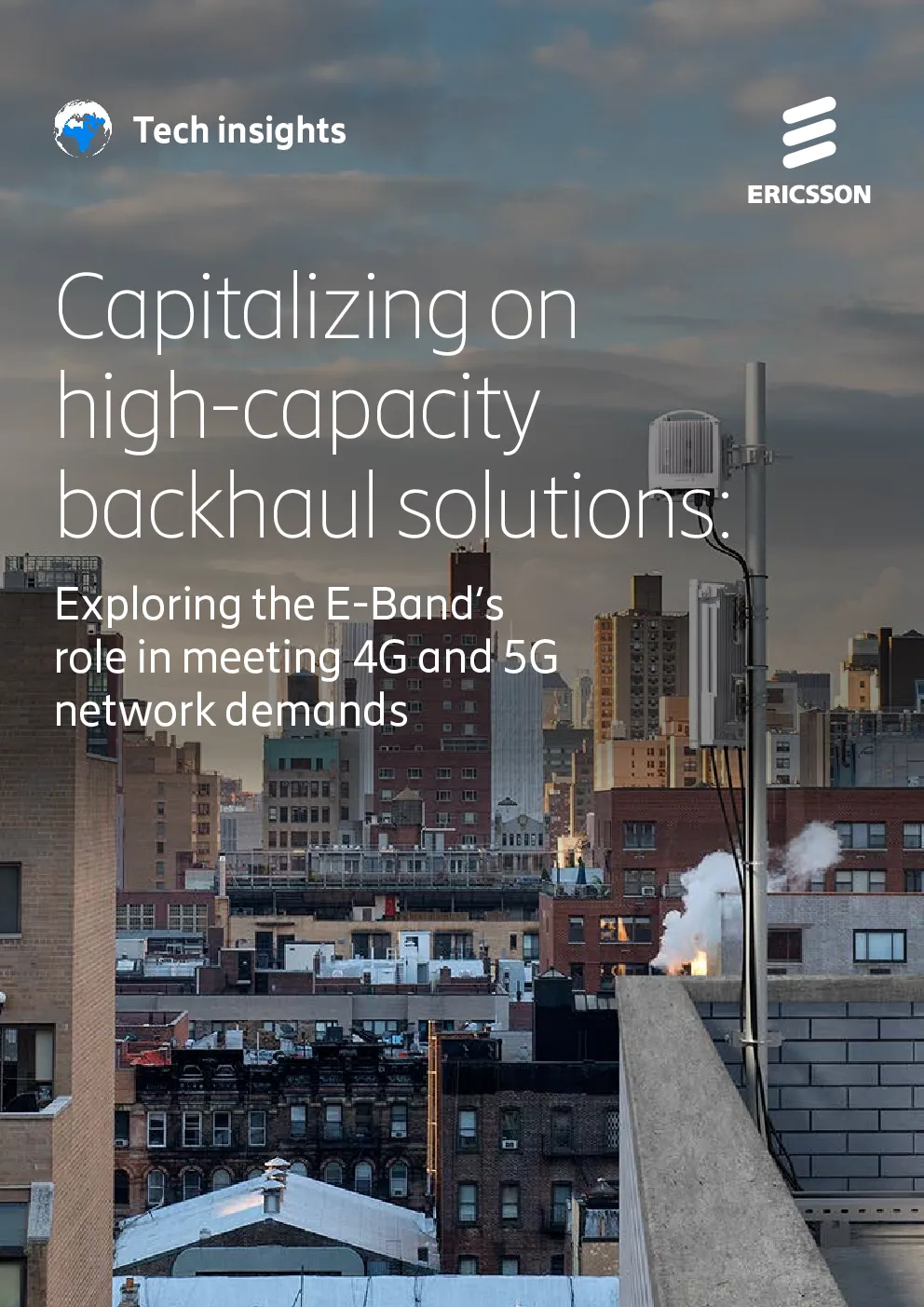
Summary of the Report: Catalyzing High-Capacity Backhaul Solutions
The report highlights the importance of robust high-capacity backhaul solutions in accommodating the growing demands of 4G and 5G networks. With the increase in packet-based capacity requirements, traditional microwave links face challenges in handling large amounts of data efficiently. The introduction of the E-band (70/80 GHz) is discussed as a significant advancement in addressing these needs.
Key Points:
-
Overview of E-band: The E-band offers wide channels that facilitate substantial capacity, making it suitable for various applications such as backhauling RAN sites, fortifying fiber optic links, and supporting FWA connections. It is advantageous for its high capacity and is increasingly being adopted over fiber in certain scenarios.
-
Comparison with Traditional Bands: While traditional microwave bands remain dominant, the E-band is gaining traction due to its unique capabilities, particularly in high-capacity use cases. It is expected to surpass traditional bands in terms of productivity once the W-band and D-band technologies mature.
-
Spectrum Accessibility: The E-band spectrum is more accessible due to its lighter licensing regime compared to traditional bands, which simplifies deployment for communication service providers (CSPs).
-
Capacity Calculation: The capacity of E-band systems is calculated based on the channel size provided by regulators. For instance, a 1000 MHz channel at 256 QAM modulation can achieve a capacity of 7689 Mbps.
-
Fiber vs. E-band Comparison: Fiber optic remains a key medium for high-capacity backhaul but faces challenges such as longer deployment times and higher costs. E-band offers a faster time to market and lower total cost of ownership for distances beyond 1.5 km, making it a more efficient solution compared to self-built fiber or dark fiber.
-
Application of E-band: E-band is particularly useful for backhauling RAN sites requiring high traffic throughput, providing high-capacity aggregation and access to 4G/5G sites and fixed wireless access (FWA). It can also serve as a fronthaul solution for connecting radio units.
-
Multi-band Solutions: For suburban areas, multi-band solutions combining E-band with traditional bands are feasible, enhancing capacity and reliability.
In conclusion, the E-band represents a significant advancement in high-capacity backhaul solutions, offering robust capacity, efficiency, and flexibility to accommodate the growing demands of 4G and 5G networks. Its adoption is driven by its ability to address the challenges posed by traditional microwave links and provide competitive advantages over fiber in specific deployment scenarios.