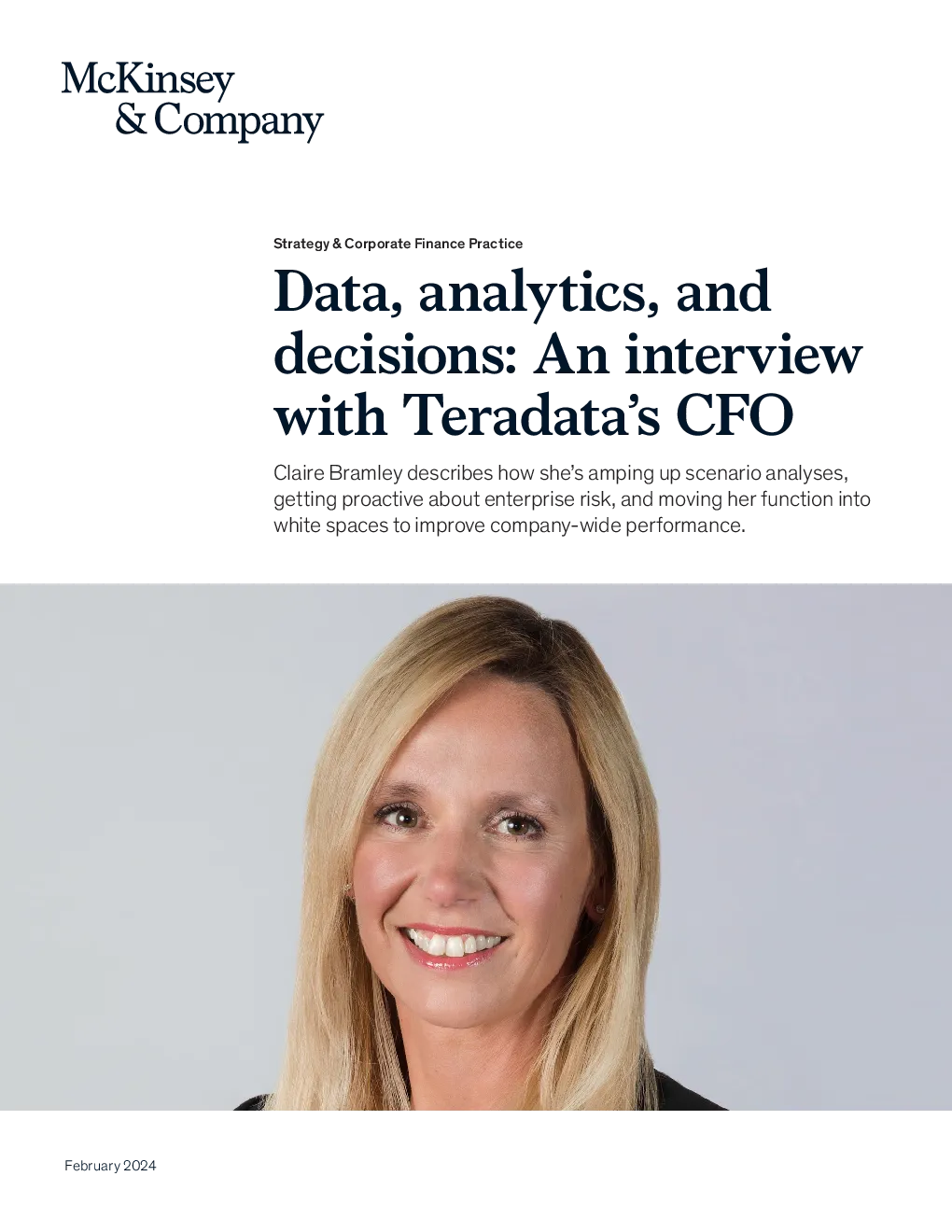
Teradata's CFO, Claire Bramley, emphasizes the critical role of data analytics and financial acumen in navigating uncertainty and making informed decisions. In her capacity as CFO, she oversees finance, IT, analytics, and security, aiming to align these functions to improve overall company performance.
Bramley underscores the importance of scenario analysis and predictive capabilities to anticipate various outcomes over short and long-term periods. This involves running numerous scenarios for long-range plans, budgets, and monthly forecasts, despite the challenge of providing clear guidance and reassurance to stakeholders amidst market volatility.
To maintain agility, she highlights the necessity of identifying "trip wires" – early indicators that signal deviations from expected trends or one-off situations. Data-driven insights guide decision-making processes, ensuring that actions taken are grounded in evidence rather than intuition alone. She also stresses the significance of having a well-rounded team that offers diverse perspectives and insights.
Bramley notes a shift in the CFO's role, emphasizing collaboration, strategy, and operational excellence beyond traditional accounting responsibilities. Her team actively engages with R&D and other departments to ensure strategic investments yield appropriate returns, while maintaining alignment with external market conditions.
In terms of organizational structure, Bramley introduces an emphasis on integrating external perspectives and prioritizing the customer experience. She sets up a new team focused on process management improvements and supports large strategic initiatives across the organization, acting as a liaison between program management and process reengineering.
Regarding enterprise risk management, Bramley advocates for a proactive approach, encouraging teams to involve her risk management team in discussions from the outset, rather than conducting audits post-decision. This proactive stance helps in managing risks effectively by considering data insights and the company's risk appetite.
Lastly, Bramley shares a significant insight into Teradata's successful long-range planning, which leverages data analytics to consider potential outcomes and tailor planning strategies accordingly. This approach enables transparency in goal setting, allowing for adjustments in multiple plans as necessary, ensuring preparedness for unexpected events without compromising strategic coherence.