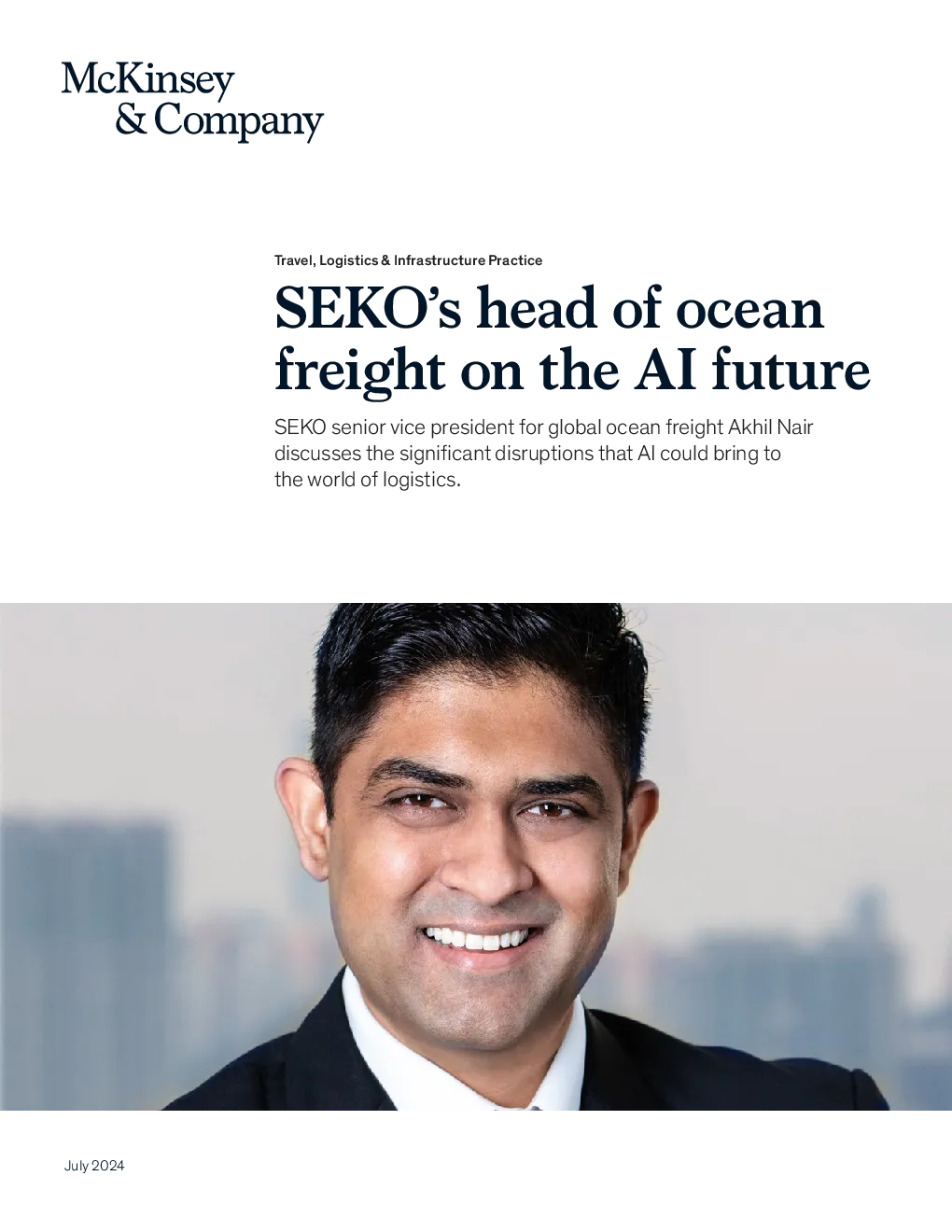
SEKO's Senior Vice President for Global Ocean Freight, Akhil Nair, discussed the significant disruptions that Artificial Intelligence (AI) could bring to the logistics industry, in an interview with McKinsey. SEKO, established in 1976, operates in over 60 countries with 150 locations, serving as a global end-to-end logistics partner for its customers.
Nair advises customers that in the current environment, they can only expect volatility, uncertainty, complexity, and ambiguity in their supply chains. To combat this, SEKO assists in building resilience within customers' organizations, recommending the implementation of routing hedges and exploring new options to ensure supply chain resilience and inventory levels. This includes utilizing futures contracts as a hedging tool, which can provide some guarantees and price protection.
Digital solutions have been instrumental in helping customers outperform during disruptions. By integrating technology with enterprise planning software, SEKO offers customers visibility into their supply chains, purchasing behavior, and market conditions, enabling them to prioritize shipments and build resilience into their supply chains. This leads to improved coordination among departments, reduced noise and escalations internally and externally, and proactive adjustments in case of impending problems.
Logistics and supply chain roles have gained prominence in boardroom discussions, reflecting the critical nature of logistics in ensuring sales. However, while there is a playbook for handling disruptions, it often requires adapting to specific circumstances and prioritizing needs rather than panicking. Creativity plays a key role in finding immediate solutions when faced with urgent demands.
To better equip the industry to respond to disruptions, Nair suggests several improvements: electronically connecting financial markets with the industry, implementing a seamless, integrated digital flow for cargo movement, promoting global free trade, and transitioning to sustainable fuels. These changes aim to enhance efficiency, resilience, and environmental sustainability.
Over the next decade, Nair foresees the 'death of the intermediary' in the industry, driven by advancements in digital growth, electronic trade documentation, and the adoption of AI solutions. AI is poised to streamline processes, from procurement to regulatory compliance, potentially eliminating human involvement in certain tasks. However, AI's limitations necessitate a collaborative approach where human expertise complements AI's capabilities. Human creativity and wisdom are crucial in interpreting AI-generated data and optimizing logistics processes, ensuring real-world applicability and avoiding logical inconsistencies.
In summary, the future of logistics involves leveraging AI to enhance efficiency and resilience, while maintaining a strategic partnership between human expertise and technological advancements.