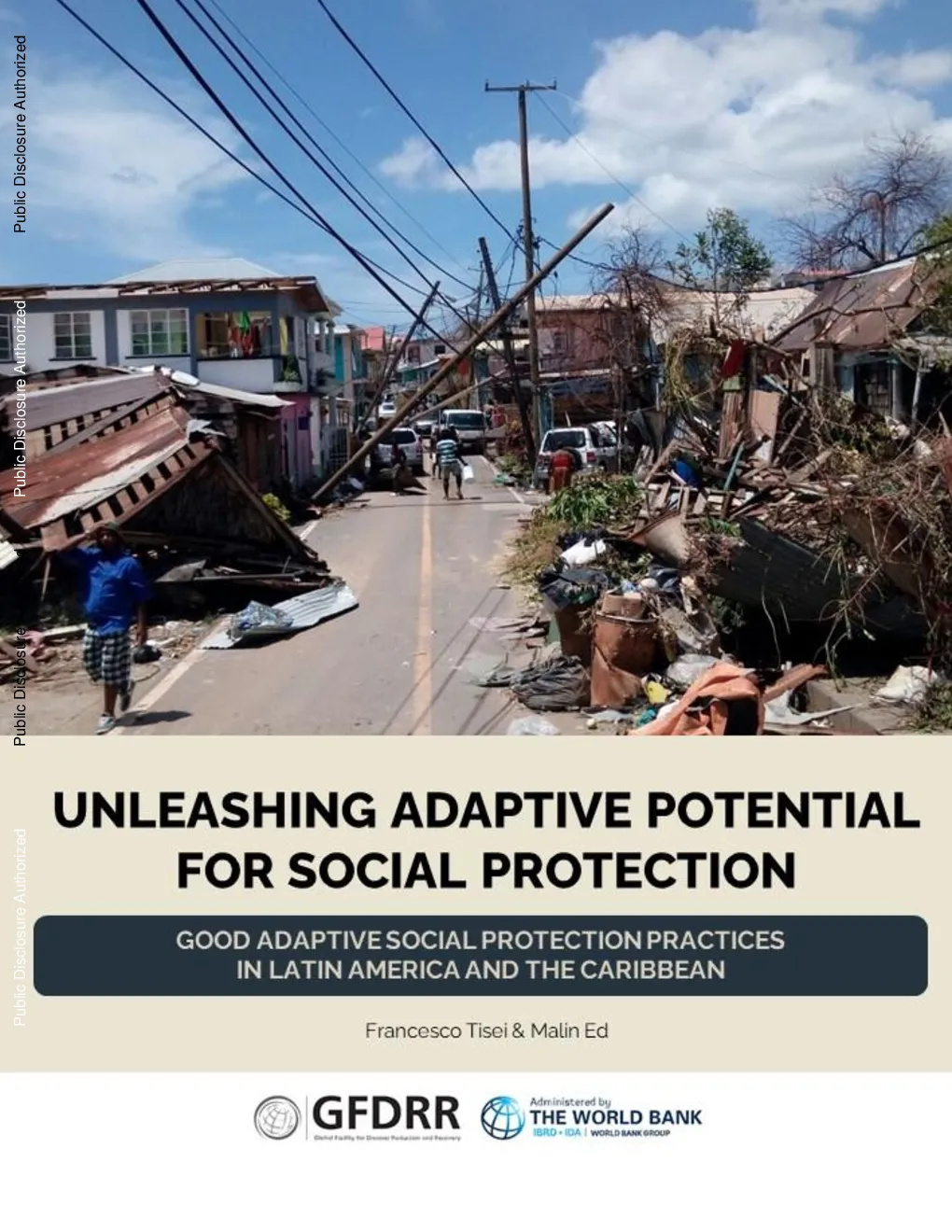
释放社会保护的适应性潜力:拉丁美洲和加勒比良好的适应性社会保护做法2024
2023 International Bank for Reconstruction and Development /The World Bank1818 H Street NW, Washington DC 20433Telephone: 202-473-1000; Internet:www.worldbank.org Some rights reserved This work is a product of the staff of The World Bankand the Global Facility for Disaster Reduction andRecovery(GFDRR).The findings, interpretations, and conclusions expressed in this work do notnecessarily reflect the viewsof The World Bank, its Board of Executive Directors, or the governmentsthey represent. The World Bank doesnot guarantee the accuracy, completeness, or currency of the dataincluded in this work and does not assumeresponsibility for any errors, omissions, or discrepancies inthe information, or liability with respect to the use of orfailure to use the information, methods,processes, or conclusions set forth.The boundaries, colors, denominations, and other informationshown on any map in this work do not imply any judgment on the part of The World Bank concerningthe legal status of any territory or the endorsement or acceptance of such boundaries. Nothing herein shall constitute or be construed or considered to be a limitation upon or waiver of theprivileges andimmunities of The World Bank, all of which are specifically reserved. Rights and Permissions.This work is subject to copyright. Because The World Bank encouragesdissemination of its knowledge, this work may be reproduced, in whole or in part, for noncommercialpurposes as long as full attribution to this work is given. Attribution.Please cite the work as follows:“Francesco Tisei and Malin Ed. 2024. Unleashing AdaptivePotential for Social Protection–Good Adaptive Social Protection Practices in The Latin America AndCaribbean Region.Washington, DC:World Bank.” Translations.If you create a translation of this work, please add the following disclaimer along with theattribution:This translation was not created by The World Bank and should not be considered an officialWorld Bank translation. TheWorld Bank shall not be liable for any content or error in this translation. Adaptations.If you create an adaptation of this work, please add the following disclaimer along with theattribution:This is an adaptation of an original work by The World Bank.Views and opinions expressed inthe adaptation are the soleresponsibility of the author or authors of the adaptation and are not endorsedby The World Bank. Third-party content.The World Bank does not necessarily own each component of the content containedwithinthe work. The World Bank therefore does not warrant that the use of any third-party-ownedindividual componentor part contained in the work will not infringe on the rights of those third parties.The risk of claims resulting fromsuch infringements restssolely with you. If you wish to reuse a componentof the work, it is your responsibility todetermine whether permission is needed for that reuse and toobtain permission from the copyright owner. Examplesof components can include, but are not limited to,tables, figures, or images. All queries on rights and licenses, including subsidiary rights, should be addressed to World BankPublications, The World Bank Group, 1818 H Street NW, Washington, DC 20433, USA; fax: 202-522-2625;e-mail:pubrights@worldbank.org. Contents Acknowledgements................................................................................................................................5Abbreviations and Acronyms...............................................................................................................7Executive summary..............................................................................................................................11Background.............................................................................................................................................19Conceptual Framework: ASP and the Stress Test Tool..............................................................21Report objectives................................................................................................................................24Chapter 1: Disaster and Climate Risk in Latin America and the Caribbean..........................27Sub-regional exposure to climate shocks.....................................................................................28COVID-19, inflation and food insecurity..........................................................................................31Socio-economic implications of shocks.........................................................................................32Impact on poverty...........................................................................................................................32Impact on human development..................................................................................................36Impact on displacement and migration.....................................................................................37Chapter 2: A sna