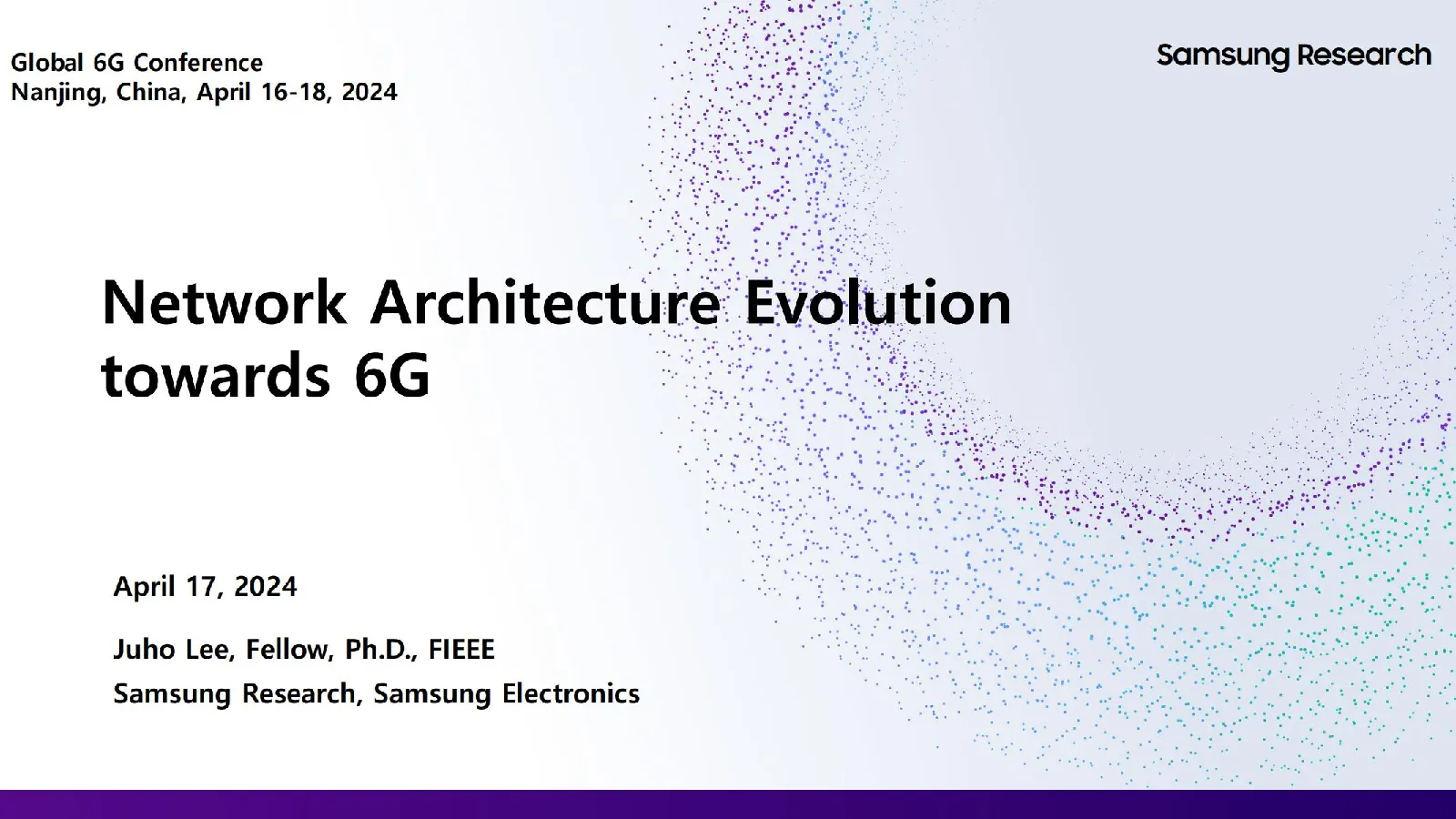
Samsung Research Conference Overview:
At the Global 6G Conference held in Nanjing, China, from April 16-18, 2024, Juho Lee, Fellow, PhD, IEEE Fellow at Samsung Research, Samsung Electronics, presented insights into the evolution of network architectures towards 6G networks.
Samsung's 5G Experiences:
Samsung has been actively contributing to the creation of value for both end-users and operators through its ongoing efforts in 5G technology. The U.S. end-users have experienced a significant increase in data throughput, up to 10 times compared to saturated ARPU levels. This has prompted operators to seek new revenue drivers while striving to maintain customer satisfaction. Comparing the ARPU growth rates:
- KT in Korea experienced a 0.8% growth,
- SK Telecom reported a 1.7% growth,
indicating a notable increase in 5G throughput compared to LTE standards, thanks to wider bandwidth.
Key Attributes of 6G Networks:
Samsung emphasizes that 6G requires innovative thinking to enable unique user experiences and services. Unlike past generations focusing primarily on peak rates and latency improvements, Samsung anticipates moderate changes in user experience attributes for future-proofing and sustainability.
Use Cases and Requirements for 6G:
Samsung identifies the need to continue generating use cases for future advancements in 6G technology. The usage scenarios evolve from 5G to include integrated sensing applications across land and air communication, beyond the scope of Integrated Sensing Applications in 5G.
Potential Services for 6G:
The use cases for 6G are expected to expand the vision of 5G technology, fulfilling long-awaited needs such as ubiquitous coverage and sustainability. These include immersive AR, VR, MR experiences integrating virtual and real worlds, sensor integration, split computation services capturing and modeling complex moving 3D objects and scenes on demand, and integrated sensing and communication capabilities.
Standardization Timeline for 6G:
Samsung outlines a timeline supporting the deployment of 6G networks around 2030. This involves an evaluation methodology and submission template for proposals, followed by ITU-RE evaluation and decision-making regarding the final view.
Key Technologies for 6G Networks:
Samsung highlights the importance of AI-native approaches in enhancing network planning, end-to-end optimization, global awareness, and network management, aiming for comprehensive AI integration.
Sustainable Network:
Samsung advocates for scalable computing resources management, utilizing network architecture with microservices and dynamic resource pooling to optimize resource utilization based on traffic changes.
Ubiquitous Coverage and Secure and Resilient Network:
Samsung addresses the challenges of secure and resilient coverage networks, proposing personal emergency services, direct communication between smartphones and satellites, and mobile services for ships and aircraft. An all-active architecture of pods with load balancing makes terrestrial networks more reliable even when one pod fails.
6G RAN-CN Architecture:
Samsung discusses the standard support of standalone architecture specifically for 6G networks, considering technical innovations based on SA deployments. They also propose enhancements to service-based architecture in both the central network and radio access network, adopting service-based interfaces within the central network extension.
Migration from 5G to 6G:
Samsung suggests strategies for migrating from 5G to 6G, including spectrum sharing and dual stack support, which act as complementary solutions. They advocate for careful consideration of market use and dependency between demand and need, enabling a smooth transition while maintaining network performance.
Thank You!