您的浏览器禁用了JavaScript(一种计算机语言,用以实现您与网页的交互),请解除该禁用,或者联系我们。 [布鲁盖尔&墨卡托中国研究中心]:中国、欧盟、美国关键技术前沿创新领先企业对比:人工智能、量子计算与半导体 - 发现报告

中国、欧盟、美国关键技术前沿创新领先企业对比:人工智能、量子计算与半导体

报告封面

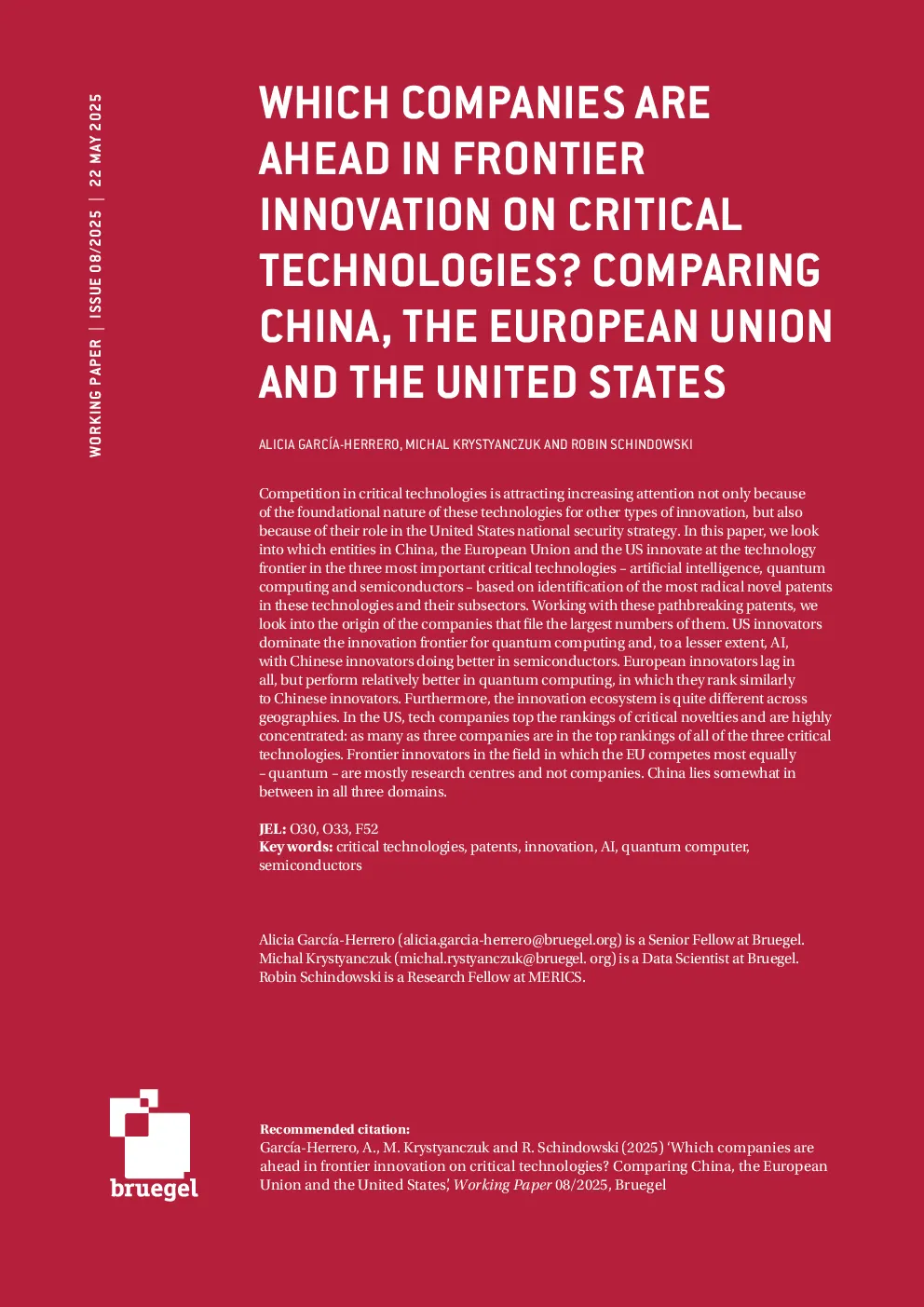
ALICIA GARCÍA-HERRERO, MICHAL KRYSTYANCZUK AND ROBIN SCHINDOWSKI Competition in critical technologies is attracting increasing attention not only becauseof the foundational nature of these technologies for other types of innovation, but alsobecause of their role in the United States national security strategy. In this paper, we lookinto which entities in China, the European Union and the US innovate at the technologyfrontier in the three most important critical technologies – artificial intelligence, quantumcomputing and semiconductors – based on identification of the most radical novel patentsin these technologies and their subsectors. Working with these pathbreaking patents, welook into the origin of the companies that file the largest numbers of them. US innovatorsdominate the innovation frontier for quantum computing and, to a lesser extent, AI,with Chinese innovators doing better in semiconductors. European innovators lag inall, but perform relatively better in quantum computing, in which they rank similarlyto Chinese innovators. Furthermore, the innovation ecosystem is quite different acrossgeographies. In the US, tech companies top the rankings of critical novelties and are highlyconcentrated: as many as three companies are in the top rankings of all of the three criticaltechnologies. Frontier innovators in the field in which the EU competes most equally– quantum – are mostly research centres and not companies. China lies somewhat inbetween in all three domains. JEL:O30, O33, F52Key words:critical technologies, patents, innovation, AI, quantum computer,semiconductors Alicia García-Herrero (alicia.garcia-herrero@bruegel.org) is a Senior Fellow at Bruegel.Michal Krystyanczuk (michal.rystyanczuk@bruegel. org) is aData Scientistat Bruegel.Robin Schindowski is a Research Fellow at MERICS. Recommended citation:García-Herrero, A., M. Krystyanczuk and R. Schindowski (2025) ‘Which companies areahead in frontier innovation on critical technologies? Comparing China, the EuropeanUnion and the United States’,Working Paper08/2025, Bruegel 1 Introduction Quantum computing, semiconductors and artificial intelligence are at the centre of the United States-Chinatechnology rivalry. They are foundational technologies with large spillover effects and potential gains inproductivity, and are therefore essential to the technological autonomy of any major economy. Some have evenargued that economic singularity – the point at which machine intelligence is capable of innovatingautonomously and beyond human capabilities – will result from progress in these technologies (Nordhaus,2021). AI is at the core of this. It promises to improve human judgement by providing predictive insights fromhistorical data through simulating human intelligence (Agrawalet al, 2018). Furthermore, through techniques ofcomputer vision and game simulation, AI has the potential to grant a significant advantage on the battlefield tothose powers that can harness it (Scharre, 2024). The advancement of AI, however, depends crucially on computing power, for which the deployment and furtherdevelopment of cutting-edge semiconductors are necessary. The semiconductor industry is characterised by ahighly globalised supply chain and by high concentration with respect to the production of advanced logic chipsneeded for AI development. It is therefore particularly subject to geopolitical risk. Finally, quantum computing is the most embryonic of the three technologies, but the economic implications arepotentially huge. Once matured, quantum computing could render traditional semiconductor chips redundant,ending the age of silicon. Hence, it may enable breakthroughs in AI, biotechnology, agricultural technology,material sciences and cybersecurity that would be impossible for traditional supercomputers (Kaku, 2023). Because of the importance of these three technologies for future competitiveness, China, the European Unionand the US – the world’s largest economic blocs – are promoting their advancement with growing resources forresearch and development (R&D) and industrial-policy strategies. The US adopted the CHIPS and Science Act in20221to further develop a US-based semiconductor ecosystem while attracting foreign investment. In addition,the US federal government has attempted to curtail the transfer to China of high-end semiconductors – and thecomponents to produce them. China has prioritised for much longer the development of these technologies inits national industrial plans. In particular, it set up the National Integrated Circuit Industry Investment Fund in2014, with a total of $98.38 billion in raised funds as of today. China has also implemented dedicated industrialpolicy initiatives such as the National Guideline for the Development and Promotion of the Integrated CircuitIndustry (2014)2and the New Generation Artificial Intelligence Plan (2017)3. Finally, less is known about howChina supports quantum computing, although it appears as a priority in cent