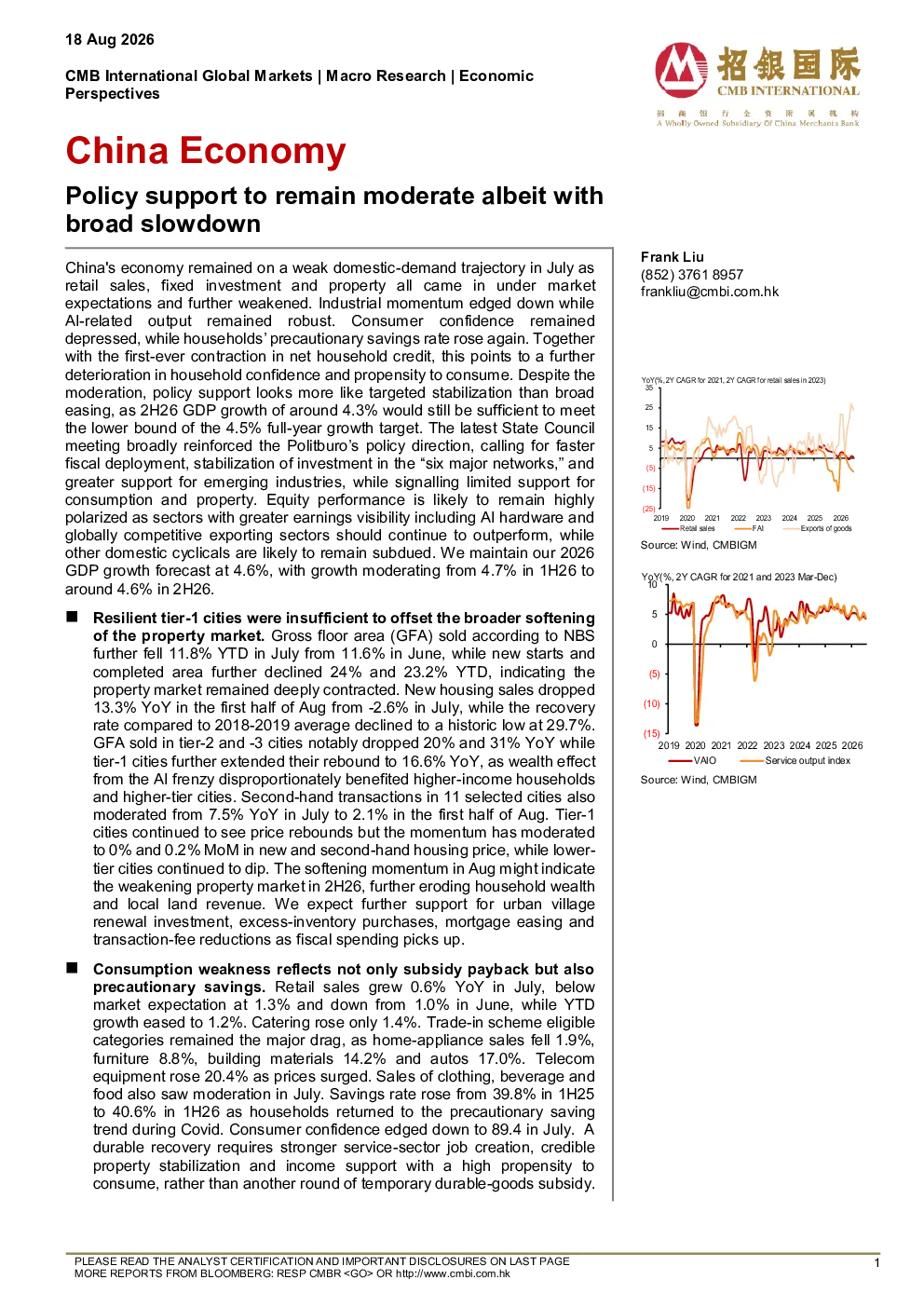
Policy support to remain moderate albeitwithbroad slowdown Frank Liu(852) 3761 8957frankliu@cmbi.com.hk China's economy remained on a weak domestic-demand trajectory in July asretailsales,fixed investment and property all came in under marketexpectations and further weakened. Industrial momentum edged down whileAI-related output remained robust.Consumer confidence remaineddepressed, while households’ precautionary savingsrate rose again. Togetherwith the first-ever contraction in net household credit, this points to a furtherdeterioration in household confidence and propensity to consume.Despitethemoderation, policy support looks more like targeted stabilization than broadeasing,as 2H26 GDP growth of around 4.3% would still be sufficient to meetthe lower bound of the 4.5% full-year growth target. The latest State Councilmeeting broadly reinforced the Politburo’s policy direction, calling for fasterfiscal deployment, stabilization of investment in the “six major networks,” andgreater support for emerging industries, while signalling limited support forconsumption and property. Equity performance is likely to remain highlypolarized as sectors with greater earnings visibility including AI hardware andglobally competitive exportingsectors should continue to outperform, whileother domestic cyclicalsare likely to remain subdued. We maintain our 2026GDP growth forecast at 4.6%, with growth moderating from 4.7% in 1H26 toaround 4.6% in 2H26. Source:Wind, CMBIGM Resilienttier-1 citieswereinsufficient to offset the broader softeningof theproperty market.Gross floorarea(GFA)sold according to NBSfurther fell 11.8% YTD in Julyfrom 11.6% inJune, while new startsandcompleted areafurther declined 24%and 23.2% YTD, indicating theproperty market remained deeply contracted.New housingsalesdropped13.3% YoY inthefirst half of Aug from-2.6% in July,while therecoveryrate compared to 2018-2019 averagedeclined toahistoric low at 29.7%.GFA sold intier-2 and-3 cities notably dropped 20% and 31% YoYwhiletier-1 citiesfurtherextendedtheirrebound to16.6%YoY, as wealth effectfromtheAI frenzy disproportionately benefited higher-income householdsand higher-tier cities.Second-hand transactionsin11 selected citiesalsomoderated from 7.5% YoY in July to 2.1% inthefirst half of Aug.Tier-1cities continued to see pricereboundsbut the momentum has moderatedto 0% and 0.2% MoM in new and second-hand housing price,while lower-tier cities continued to dip. The softening momentum in Aug might indicatethe weakening property market in 2H26, furthereroding household wealthand local land revenue. We expect further support forurban villagerenewal investment, excess-inventory purchases, mortgage easing andtransaction-fee reductionsas fiscal spending picks up. Source:Wind, CMBIGM Consumptionweakness reflects not only subsidy payback but alsoprecautionary savings.Retail sales grew 0.6% YoY in July,belowmarket expectation at 1.3% anddown from 1.0% in June, while YTDgrowth eased to 1.2%. Catering rose only 1.4%.Trade-in scheme eligiblecategoriesremained the major drag, as home-appliance sales fell 1.9%,furniture8.8%,building materials 14.2%and autos 17.0%. Telecomequipment rose 20.4% as pricessurged. Sales of clothing, beverage andfood also saw moderation in July. Savings rate rose from 39.8% in 1H25to 40.6% in 1H26 as householdsreturned totheprecautionary savingtrendduringCovid. Consumer confidence edged down to 89.4 in July. Adurable recovery requires stronger service-sector job creation,credibleproperty stabilizationand income support with a high propensity toconsume, rather than anotherround oftemporary durable-goods subsidy. Investment contraction became an even larger downside drag.Urbanfixed-asset investment fell 6.7%YTD in July,weaker than marketexpectations at-6.1%while monthly investment declined 12.8% YoY.Property,manufacturing and infrastructure investment contractedapproximately 27.5%, 4.4% and 14.7% YoY in Julywhile their YTDdeclines reached 19.2%, 1.7%and 4.1%. Manufacturing capex remaineduneven,asinvestmentinothertransportequipmentandcomputers/electronics rose 18.7% and 7.8% YTD, while autos, specialequipment andchemical products manufacturing fell 5.3%, 9.2% and7.4%.Strong technology-related output alongside weak aggregatemanufacturing investment suggests that firms remain cautious aboutdemanddurability,profitability and excess capacity.Infrastructureweakness despite available policy financing also points to impaired fiscaltransmission and project execution,instead ofsimply insufficient headlinefunding. Faster bond-funded spendingmayestablish a floor in 2H26, butisunlikely to generate a conventional investment upcycle withoutimprovement in local-government andproperty-sector balance sheets, inour view. Industrial output slowed but retained a pronounced technology andexport tilt.Value-added industrial output rose 4.5% YoY in July, weakerthanmarket expectations at 4.9%and down from 5.3%in June.Manufacturing growth eased to 5.5%, while e