MSW填埋场渗滤液管理决策支持工具及从业者技术指导
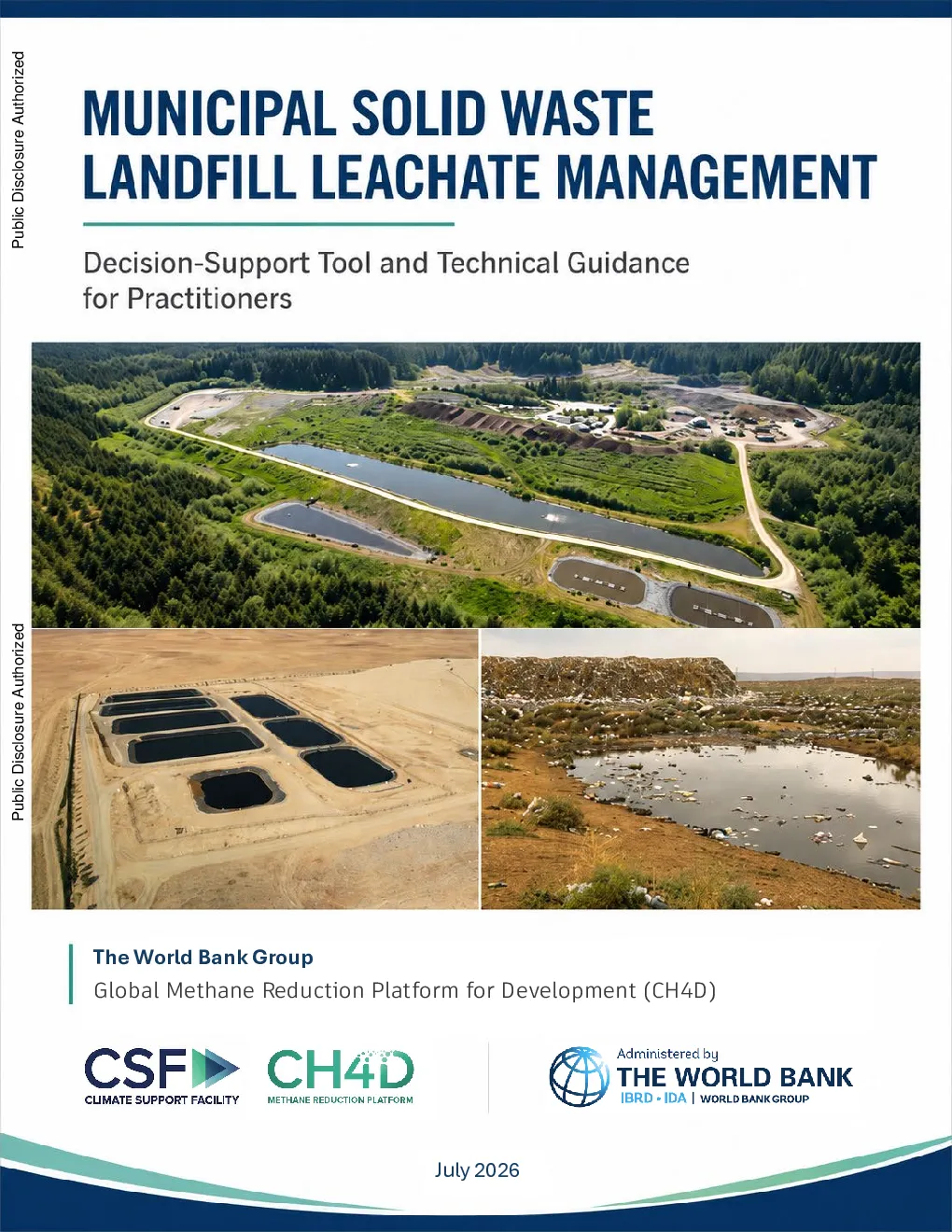
Decision-Support Tool and Technical Guidancefor PractitionersPublic Disclosure Authorized Global Methane Reduction Platform for Development (CH4The World Bank Group Global Methane Reduction Platform for Development (CH4D) Decision-Support Tool and Technical Guidancefor Practitioners PURPOSE AND AUDIENCE Landfill leachate management remains a major challenge in developing countries, where limitations ininfrastructure,technical capacity,financing,and long-term operational resources often result inunderperforming or unsustainable systems. Traditional approaches have frequently focused on end-of-pipe treatment, without sufficient attention to landfill processes, water balance, waste composition,operational practices, and the interaction between leachate and landfill gas (LFG) generation. This guidance adopts a practical, decision-oriented approach to landfill leachate management. Itemphasizesleachate minimization through water balance control,waste management practices,progressive landfill operation, and integration with LFG managementand greenhouse gas (GHG) mitigationobjectives. The document is intended to support World Bank task teams, project managers, government agencies,landfill operators, engineers, and consultants in developing scopes of work, setting expectations forfeasibility studies and detailed designs, reviewing consultant outputs, and selecting context-appropriateleachate management strategies. It is not intended to replace detailed engineering design, but rather toprovide a structured framework for asking the right questions, comparing practical options, and aligningleachate management decisions with local climate, waste composition, site conditions, institutionalcapacity, and financial constraints. The guidance combines high-level principles, practical decision-support tools, simplified assessmentapproaches, and case studies to help practitioners identify technically feasible, financially sustainable, andclimate-smart leachate management solutions for new sanitary landfills, existing dumpsites,andtransitional disposal facilities. ACKNOWLEDGEMENTS This guidance was developed by Dr. Edwin Safari, P.Eng. and Dr. Ali R. Abedini, P.Eng., under the supervisionof Kremena Ionkova. The team gratefully acknowledges the technical support, review, and valuable inputs provided by Frankvan Woerden, Esma Kreso Beslagic, Sean Christopher Nelson, Stefania AbakerliandCharis Lypiridis. This guidance was developed with support from the Global Methane Reduction Platform for Development(CH4D), a World Bank-managed multi-donor trust fund supporting accelerated methane mitigation. © 2026International Bank for Reconstruction and Development / The World Bank1818 H Street NWWashington DC 20433Telephone: 202-473-1000Internet: www.worldbank.org This work is a product of the staff of The World Bank with external contributions. The findings,interpretations, and conclusions expressed in this work do not necessarily reflect the views of The WorldBank, its Board of Executive Directors, or the governments they represent. The World Bank does not guarantee the accuracy, completeness, or currency of the data included in thiswork and does not assume responsibility for any errors, omissions, or discrepancies in the information,or liability with respect to the use of or failure to use the information, methods, processes, orconclusions set forth. The boundaries, colors, denominations, and other information shown on any mapin this work do not imply any judgment on the part of The World Bank concerning the legal status of anyterritory or the endorsement or acceptance of such boundaries. Nothing herein shall constitute or beconstrued or considered to be a limitation upon or waiver of the privileges and immunities of The WorldBank, all of which are specifically reserved. Rights and Permissions The material in this work is subject to copyright. Because The World Bank encourages dissemination ofits knowledge, this work may be reproduced, in whole or in part, for non-commercial purposes as long asfull attribution to this work is given. Any queries on rights and licenses, including subsidiary rights,should be addressed to World Bank Publications, The World Bank Group, 1818 H Street NW, Washington,DC 20433, USA; fax: 202-522-2625; e-mail:pubrights@worldbank.org Photos: © Ali Reza Abedini with permission. TABLE OF CONTENTS 1.1Background & Context.................................................................................................................11.2Problem Statement and Rationale...............................................................................................11.3Objectives of the Guideline.........................................................................................................21.4Scope and Target Audience.........................................................................................................2 2LANDFILL LEACHATE ........................................................