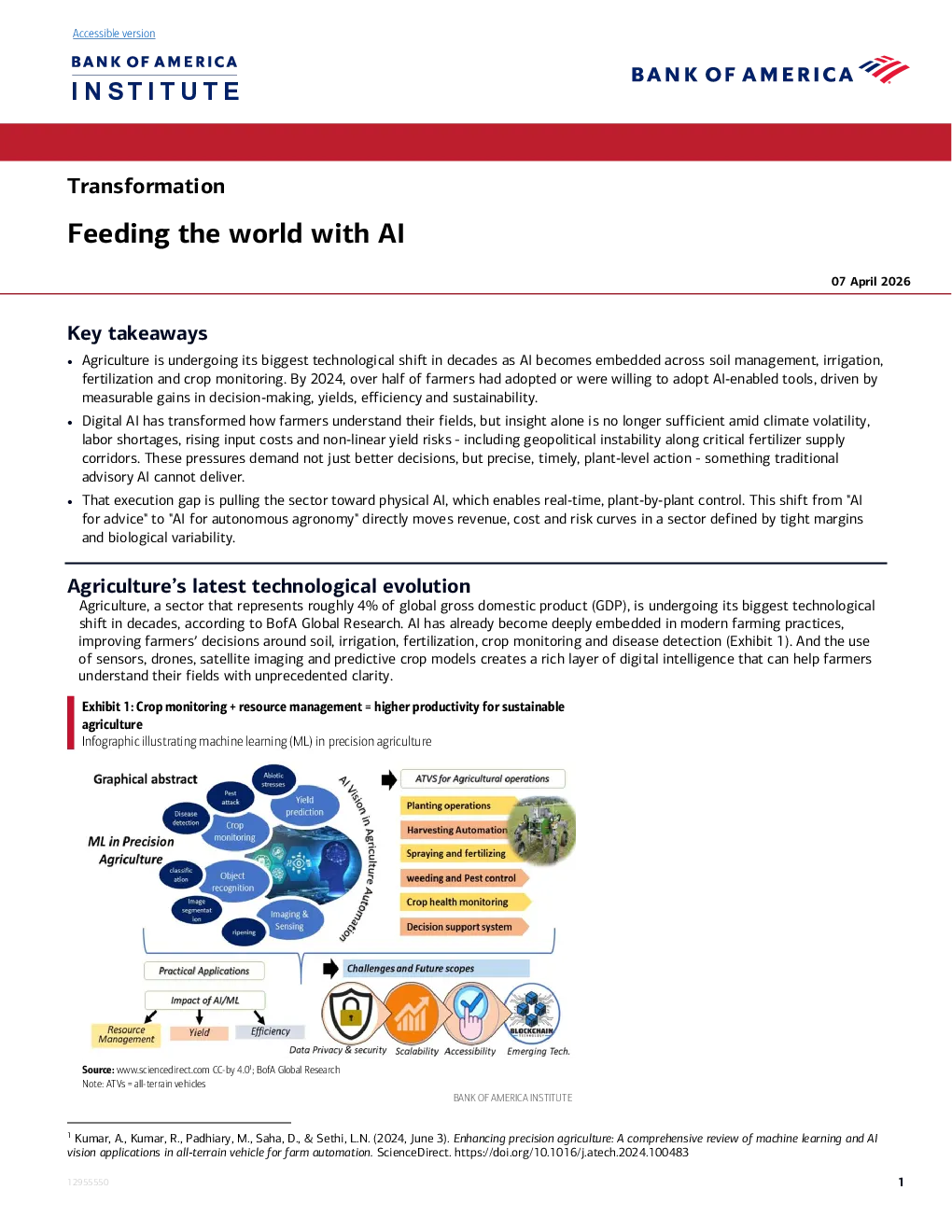
Feeding the world with AI Key takeaways •Agriculture is undergoing its biggest technological shift in decades as AI becomes embedded across soil management, irrigation,fertilization and crop monitoring. By 2024, over half of farmers had adopted or were willing to adopt AI‑enabled tools, driven bymeasurable gains in decision‑making, yields, efficiency and sustainability. •Digital AI has transformed how farmers understand their fields, but insight alone is no longer sufficient amid climate volatility,labor shortages, rising input costs and non‑linear yield risks- including geopolitical instability along critical fertilizer supplycorridors. These pressures demand not just better decisions, but precise, timely, plant‑level action - something traditionaladvisory AI cannot deliver. •That execution gap is pulling the sector toward physical AI, which enables real‑time, plant‑by‑plant control. This shift from "AIfor advice" to "AI for autonomous agronomy" directly moves revenue, cost and risk curves in a sector defined by tight marginsand biological variability. Agriculture’s latest technological evolutionAgriculture, a sector that represents roughly 4% of global gross domestic product (GDP), is undergoing its biggest technological shift in decades, according to BofA Global Research. AI has already become deeply embedded in modern farming practices,improving farmers’decisions around soil, irrigation, fertilization, crop monitoring and disease detection (Exhibit 1). And the useof sensors, drones, satellite imaging and predictive crop models creates a rich layer of digital intelligence that can help farmersunderstand their fields with unprecedented clarity. Infographic illustrating machine learning (ML) in precision agriculture AI moves from early adoption to sector-wide penetrationAs of 2024, over half of farmers worldwide had adopted or were willing to adopt at least one precision‑agriculture or AI‑enabled technology.2This uptake is driven by tangible agronomic benefits (related to crop growing and soil management): 80% offarmers using data analytics report better decision‑making. AI-enabled precision irrigation and fertilization can raise crop yieldsby 25%.3Additionally, AI improves water usage efficiency and fertilizer application accuracy,4while also reducing emissions5–anincreasingly important advantage when fertilizer supplies are constrained–thereby promoting sustainable farming practices. AI‑in‑agriculture market: ~$47 billion by 2034EApplications of AI in agriculture now span an increasingly diverse set of technologies, from AI‑guided vertical farming and biological enhancement tools, to AI-based crop modeling and precision agriculture using drones, sensors and satellites forreal‑time field intelligence. Money flows reflect this shift: agricultural technology (agtech) companies raised $7 billion in 2025,up nearly 4% year-over-year (YoY), with precision‑agriculture companies outpacing deals for crop inputs and enhancements.6 Exhibit2:Deploying precision agriculture for farm automation is attracting growing interest from researchers and industry stakeholdersKeyword network diagramfor precision agriculture Broader market outlooks underscore this transition. The AI‑in‑agriculture market is forecasted to increase at a 26.3% compoundannual growth rate (CAGR) to $46.6 billion by 2034, per Global Market Insights.8This is driven by increased use of precisioninputs, labor substitution and real‑time agronomic decision support. Machine learning–now representing roughly half of themarket–underpins emerging technologies such as generative AI, autonomous tractors and robotic sprayers (readAI dictionary,part 1: The basicsfor an intro to machine learning). It also enables real‑time object recognition across key agriculturalapplications including weed detection, livestock monitoring and yield estimation from aerial imagery. According to BofA Global Research, North America currently leads agricultural AI adoption with a 36% market share, supportedby strong capex appetite and a mature precision‑agriculture ecosystem that speeds up deployment of autonomous equipment.All these trends show that farming is shifting fromdigitalagronomy (decision support) toautonomousagronomy (execution)(Exhibit 2). Furthermore, this expansion of AI-driven and robotics-based farming technology is supported by favorable regulation,which simplifies deployment. Falling hardware costs for sensors, compute and machine vision also make adoption moreaffordable. At the same time, policy incentives are increasingly aligned with technologies that verifiably reduce chemical inputs,accelerating uptake. Physical AI: Brains behind the wheelPhysical AI integrates artificial intelligence into physical systems, such as humanoid robots, autonomous vehicles and drones (we further define this topic inPhysical AI, part 1: The basics). As a result, AI can perceive, reason and act in the real world–not justgenerate digital outputs. This matters because the