沃尔沃汽车2026年第二季度财报与评级报告(跑输大盘)
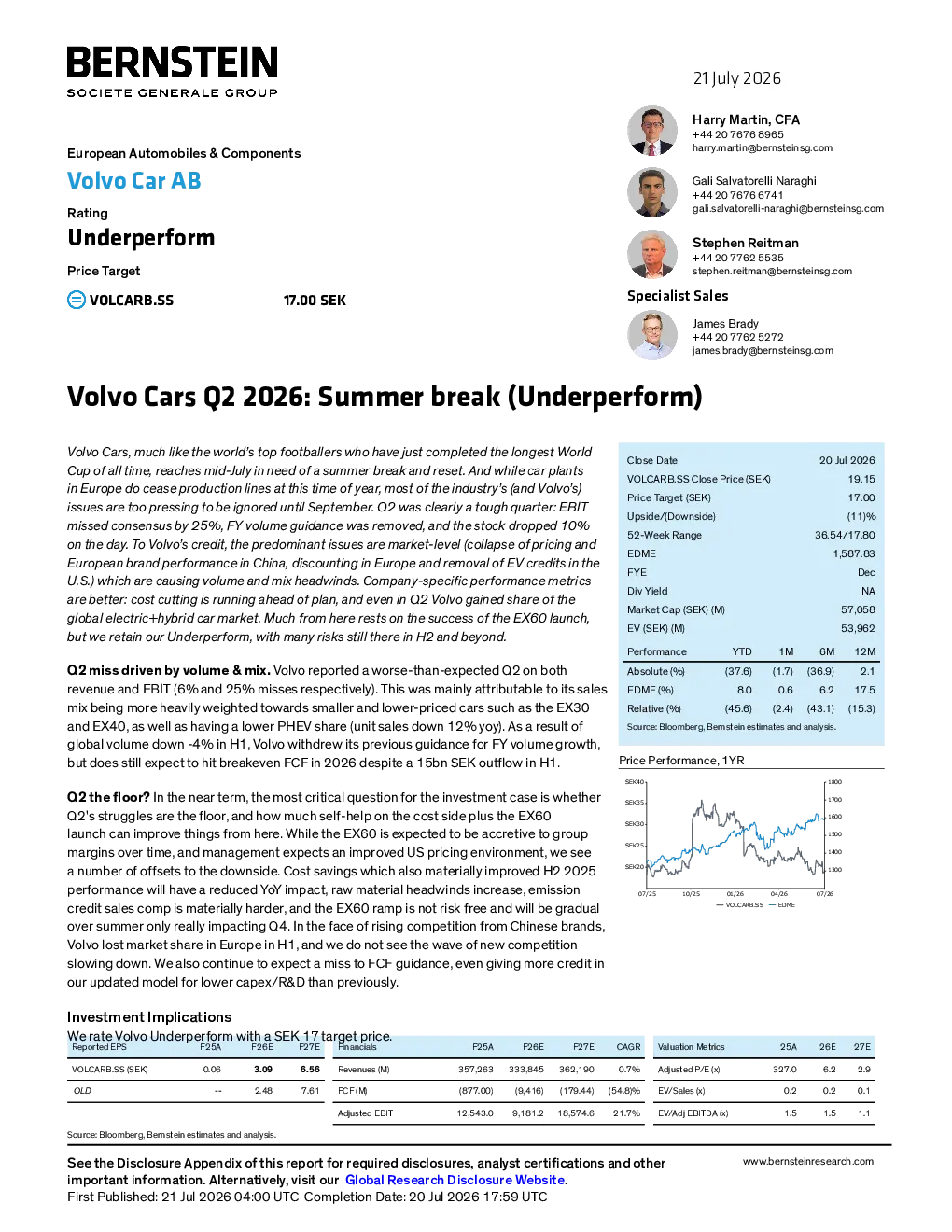
Harry Martin, CFA+44 20 7676 8965harry.martin@bernsteinsg.com Gali Salvatorelli Naraghi+44 20 7676 6741gali.salvatorelli-naraghi@bernsteinsg.com RatingUnderperform Stephen Reitman+44 20 7762 5535stephen.reitman@bernsteinsg.com Price Target Specialist Sales 17.00 SEK VOLCARB.SS James Brady+44 20 7762 5272james.brady@bernsteinsg.com Volvo Cars Q2 2026: Summer break (Underperform) Volvo Cars, much like the world’s top footballers who have just completed the longest WorldCup of all time, reaches mid-July in need of a summer break and reset. And while car plantsin Europe do cease production lines at this time of year, most of the industry’s (and Volvo’s)issues are too pressing to be ignored until September. Q2 was clearly a tough quarter: EBITmissed consensus by 25%, FY volume guidance was removed, and the stock dropped 10%on the day. To Volvo’s credit, the predominant issues are market-level (collapse of pricing andEuropean brand performance in China, discounting in Europe and removal of EV credits in theU.S.) which are causing volume and mix headwinds. Company-specific performance metricsare better: cost cutting is running ahead of plan, and even in Q2 Volvo gained share of theglobal electric+hybrid car market. Much from here rests on the success of the EX60 launch,but we retain our Underperform, with many risks still there in H2 and beyond. Close Date20 Jul 2026VOLCARB.SS Close Price (SEK)19.15Price Target (SEK)17.00Upside/(Downside)(11)%52-Week Range36.54/17.80EDME1,587.83FYEDecDiv YieldNAMarket Cap (SEK) (M)57,058EV (SEK) (M)53,962 Q2 miss driven by volume & mix.Volvo reported a worse-than-expected Q2 on bothrevenue and EBIT (6% and 25% misses respectively). This was mainly attributable to its salesmix being more heavily weighted towards smaller and lower-priced cars such as the EX30and EX40, as well as having a lower PHEV share (unit sales down 12% yoy). As a result ofglobal volume down -4% in H1, Volvo withdrew its previous guidance for FY volume growth,but does still expect to hit breakeven FCF in 2026 despite a 15bn SEK outflow in H1. Q2 the floor?In the near term, the most critical question for the investment case is whetherQ2's struggles are the floor, and how much self-help on the cost side plus the EX60launch can improve things from here. While the EX60 is expected to be accretive to groupmargins over time, and management expects an improved US pricing environment, we seea number of offsets to the downside. Cost savings which also materially improved H2 2025performance will have a reduced YoY impact, raw material headwinds increase, emissioncredit sales comp is materially harder, and the EX60 ramp is not risk free and will be gradualover summer only really impacting Q4. In the face of rising competition from Chinese brands,Volvo lost market share in Europe in H1, and we do not see the wave of new competitionslowing down. We also continue to expect a miss to FCF guidance, even giving more credit inour updated model for lower capex/R&D than previously. Investment Implications DETAILS RESULTS RECAP Overall take.After the briefing call (Link) outlined a Q2 which would be hit by cost inflation and discounting as well as the toughChina market, an 11% gross profit miss and 25% EBIT miss should perhaps come as little surprise. We went into the quartermeaningfully below consensus and the results are slightly better than our expectations for a 16% gross margin (actual 16.8%).Much lower R&D expenses also meant EBIT beat our forecast of slightly below breakeven. FCF burn was -€5bn SEK (consensushad positive FCF) but the company still expects approximately breakeven for the FY, where it will launch new models and unwindsome of the inventory build. CMD also planned for September in Stockholm. •The quarter.Volvo reported revenue of SEK 77.7bn, missing consensus by 6%, gross margin of 16.8%, 90 bps belowconsensus, and EBIT excl. items affecting comparability of SEK 826mn, a significant (25%) miss to consensus. The decreasewas driven by a combination of lower underlying wholesale volumes, weaker sales mix and pricing, FX effects, and a one-offsale of SEK 3.3 bn in 2Q25 that boosted last year’s figures. •Retail sales were overall down 6% YoY, largely driven by a 37% decline in China, but were flat and up 9% in Europe andthe US respectively. The US is said to be showing signs of a recovery in H2 after growth in May and June. In Europe, pricingpressure remains. •EBIT decline was mainly down to less favorable sales mix and pricing, weaker wholesale volumes, negative D&A effects, aswell as lower revenue benefits from emission credits (SEK 0.8bn vs 1.7bn in 2Q25). Volvo’s free cash outflow of SEK 5.2bn was considerably below consensus (1.9bn inflow). Compared to our model which hada large working capital outflow, Volvo saw a minor working capital inflow. • •Outlook.Volvo indicated that they expect “significantly stronger” sales in H2 vs H1, as well as “strong positive” FCF in thelatter parts of H2,